
Short Answer
The War of 1812 (1812–1815) was a military conflict between the United States and the United Kingdom that ended in a stalemate with the Treaty of Ghent. Despite its inconclusive outcome, the war fundamentally changed Britain’s relationship with America, shifting British policy from active containment to deliberate accommodation of the United States as a rising power. This transformation laid the groundwork for a century of peace and, eventually, a strong Anglo-American alliance.
Historical Context
Before the war, Britain and the United States had a fraught relationship marked by unresolved issues from the American Revolution, including boundary disputes, trade restrictions, and British support for Indigenous resistance to American expansion. During the Napoleonic Wars, Britain’s Orders in Council restricted neutral trade, and the Royal Navy’s impressment of sailors from American ships outraged the United States. These grievances, along with American ambitions to annex Canada, led to the U.S. declaration of war on June 18, 1812. Britain, focused on defeating Napoleonic France, saw the war as a dangerous distraction and a betrayal by its former colony.
What Happened
The war saw a series of failed American invasions of Canada, U.S. naval victories in single-ship actions, and British counteroffensives after Napoleon’s defeat in 1814. The burning of Washington, D.C., in August 1814 was a low point for the Americans, but they successfully defended Baltimore, Plattsburgh, and New Orleans. The Treaty of Ghent, signed on December 24, 1814, restored the pre-war status quo without addressing the maritime disputes that had caused the war. Both sides claimed victory, but the war was essentially a draw. For Britain, the conflict proved expensive and frustrating, and its leadership was relieved to end it, as foreign secretary Lord Castlereagh described being “released from the millstone of an American war.”
Why It Matters
The war’s legacy was profound. It convinced British policymakers that confrontation with the United States was costly and unproductive, and that accommodating American interests was the better strategy. This change led to the Rush-Bagot Agreement of 1817, demilitarizing the Great Lakes, and a series of boundary conventions that settled long-standing territorial disputes. Over the following decades, Britain accommodated U.S. expansion in the Western Hemisphere, even supporting the Monroe Doctrine in 1823. The improved relationship eventually evolved into a close alliance in the twentieth century. The war also shaped American national identity, but for Britain it marked a turning point from viewing the United States as a rebellious colony to accepting it as a legitimate, if sometimes troublesome, great power.
Definition
The change in Britain’s relationship with America refers to the shift from a policy of containment—using military force, diplomatic pressure, and Indigenous alliances to limit U.S. power—to one of accommodation, where Britain accepted and even encouraged the United States’ rise as a regional hegemon. This shift was not immediate but evolved in the years after 1815.
Background
Before the War of 1812, Britain viewed the United States as a weak and unreliable nation, but also as a potential threat to its North American colonies and Atlantic trade. Britain had maintained forts in the Northwest, allied with Indigenous peoples (such as Tecumseh’s confederation), and enforced maritime regulations that harmed American commerce. The British government believed that a strong challenge was necessary to keep the United States in check. In contrast, the United States had its own grievances and saw war as a way to assert its sovereignty and perhaps gain territory.
How It Worked
After the war, both countries moved toward diplomatic reconciliation. The British government, particularly under Lord Castlereagh and later George Canning, recognized that ongoing conflict with the United States would drain resources needed for European affairs. The demilitarization of the Great Lakes, the settlement of the U.S.-Canadian boundary along the 49th parallel, and the joint occupation of Oregon were all signs of this new approach. Britain also refrained from interfering when the United States acquired Florida from Spain in 1819 and supported the Monroe Doctrine, which warned European powers not to colonize the Americas. These steps demonstrated that Britain now saw a strong United States as a stabilizing force rather than a challenge.
Competing Viewpoints
Historians disagree on why Britain chose accommodation. Some argue it was inevitable, given the vast Atlantic distance and Britain’s limited ability to project power in North America, especially after the Napoleonic Wars. Others contend that Britain’s policy shift was a calculated response to the American military and diplomatic performance during the war. The war had shown that the United States could inflict costly defeats at sea and on the Canadian border, and that its expansion was likely to continue. Stacie Goddard and other political scientists suggest that Britain came to see U.S. aims as limited and orderly, not revolutionary, making accommodation plausible. A third perspective emphasizes that the British public and Parliament were weary of war and prioritized trade, which required peace with the United States.
Role in the War of 1812
The war itself directly influenced British calculations. The American naval victories early in the war, such as the USS Constitution’s capture of HMS Guerrière and Java, embarrassed the Royal Navy and boosted American morale. However, Britain’s successful blockade of the U.S. coast and the burning of Washington showed British military superiority. Yet the failed invasion of New York in 1814 and the defeat at Baltimore demonstrated that the United States could hold its own. The cost in money and lives, coupled with the pressing issues in Europe, convinced British leaders that any further conflict would be futile. The war also weakened the British alliance with Indigenous nations, as the United States emerged stronger and more confident, diminishing Britain’s ability to use Indigenous allies as a buffer against American expansion.
Consequences and Historical Interpretation
The long-term consequences were significant. The Rush-Bagot Agreement and the Treaty of 1818 paved the way for a largely unfortified border between the United States and Canada, a precursor to the modern peace. Britain’s accommodation allowed the United States to dominate the continent, leading to the Mexican-American War and the doctrine of Manifest Destiny. By the late 19th century, the United States had become a significant economic power, and Britain, facing challenges from Germany, saw it as a natural ally. The War of 1812 is thus seen by many historians as the point at which Anglo-American relations turned from hostility to peace, and eventually to the “special relationship” of the 20th century. However, the war’s legacy is contested: in Canada, it is a founding myth of nationhood; in Britain, it is largely forgotten; in the United States, it is often seen as a second war of independence. The shift in British policy was a precursor to the global alignment that shaped the 20th century.
Primary Sources
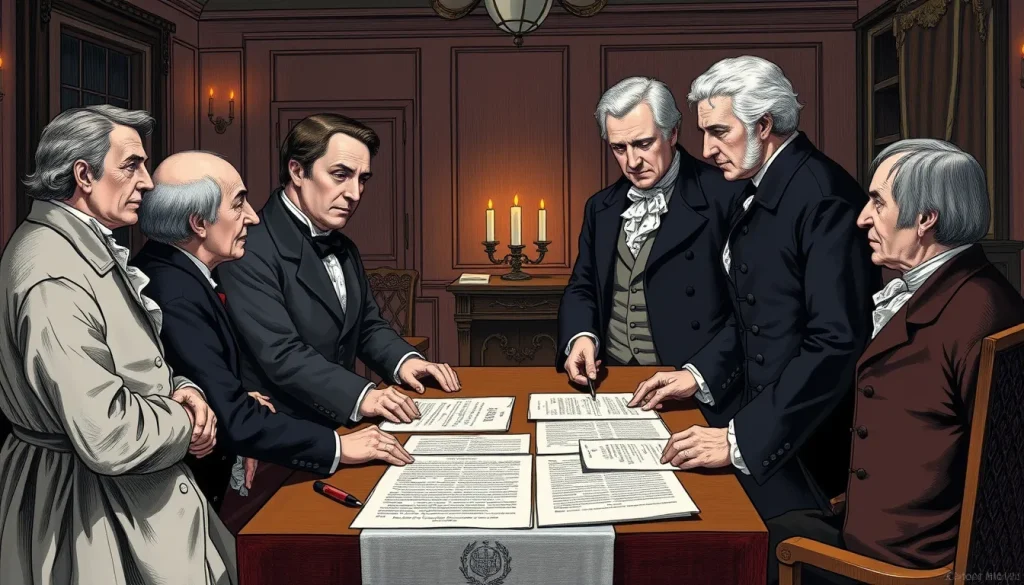
- The Treaty of Ghent (December 24, 1814) — the peace treaty that ended the war, restoring pre-war boundaries and ignoring maritime issues, revealing British desire to end the conflict.
- The Rush-Bagot Agreement (April 27, 1817) — an exchange of notes between the United States and Britain limiting naval armaments on the Great Lakes, signaling mutual trust.
- Lord Castlereagh’s diplomatic correspondence, including his statement about being “released from the millstone,” illustrating British relief in ending the war.
- British parliamentary debates from 1815–1816, which discuss the costs of the war and the need for improved relations with the United States.
Further Reading
- Donald R. Hickey, The War of 1812: A Forgotten Conflict (University of Illinois Press, 1989).
- J.C.A. Stagg, The War of 1812: Conflict for a Continent (Cambridge University Press, 2012).
- Troy Bickham, The Weight of Vengeance: The United States, the British Empire, and the War of 1812 (Oxford University Press, 2012).
- Walter R. Borneman, 1812: The War That Forged a Nation (HarperCollins, 2004).
References
- Stacie E. Goddard, “America’s Ambiguous Ambition: Britain and the Accommodation of the United States, 1817–23,” Cornell University Press eBooks, 2021, doi:10.1515/9781501730313-005.
- Donald R. Hickey, “Small War, Big Consequences,” Foreign Affairs, November/December 2012, https://www.foreignaffairs.com/reviews/small-war-big-consequences.
- Donald R. Hickey, “Released from the Millstone of an American War: The News of Peace,” National Park Service, February 26, 2015, https://www.nps.gov/articles/released-from-the-millstone.htm.
- Amanda Foreman, “The British View the War of 1812 Quite Differently Than Americans Do,” Smithsonian Magazine, July 2014, https://www.smithsonianmag.com/history/british-view-war-1812-quite-differently-americans-do-180951852/.
- Jeremy Black, “A British View of the Naval War of 1812,” Naval History Magazine, August 2008, https://www.usni.org/magazines/naval-history-magazine/2008/august/british-view-naval-war-1812.
FAQ
Did the War of 1812 change Britain's view of the United States?
Yes. The war convinced British leaders that conflict with the United States was costly and that a peaceful, accommodating relationship was in Britain's interest. This led to the Rush-Bagot Agreement and other diplomatic concessions.
What was the Treaty of Ghent and what role did it play in the shift?
The Treaty of Ghent ended the war in a stalemate but signaled Britain's willingness to accept the status quo. It did not resolve the original grievances, but both sides agreed to negotiate boundaries, laying the groundwork for improved relations.
How did the War of 1812 affect British relations with Indigenous peoples?
The war weakened British-Indigenous alliances, as Britain no longer saw Indigenous nations as a useful buffer against American expansion. The British negotiated peace without addressing Indigenous interests, leaving them at the mercy of American territorial ambitions.



Leave a Reply