Short Answer
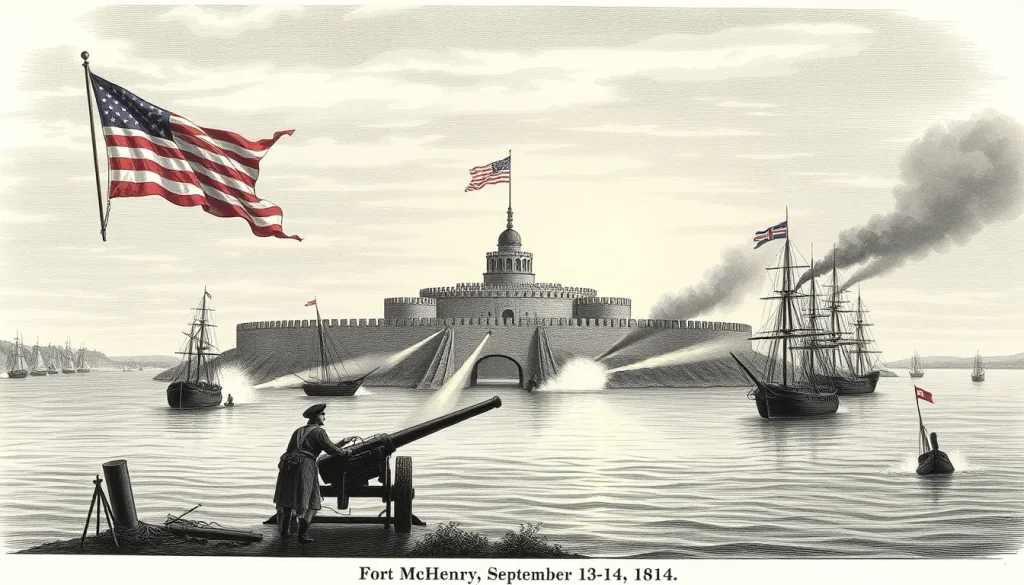
Fort McHenry, a star-shaped masonry fort at the entrance to Baltimore’s inner harbor, was the principal American strongpoint during the British attack on Baltimore on September 13–14, 1814. In the final major military operation of the War of 1812 in the Chesapeake, British naval forces subjected the fort to a heavy bombardment that failed to compel its surrender. The successful American defense and the sight of the garrison flag flying at dawn inspired Francis Scott Key to write the poem that became ‘The Star-Spangled Banner.’
Historical Context
By 1814, the United States and Great Britain had been at war for two years. Britain’s main effort was still against Napoleon, but after Napoleon’s abdication in April 1814 British veterans became available for operations in North America. In August 1814, a British force under Major General Robert Ross and Vice Admiral Alexander Cochrane entered the Chesapeake Bay, defeated an American force at Bladensburg, burned Washington, D.C., and then turned toward Baltimore, a major port and privateering base. Baltimore’s defense relied on Fort McHenry, built between 1798 and 1800 on the site of earlier fortifications, and on a series of earthworks, batteries, sunken ships, and a boom chain across the harbor.
What Happened
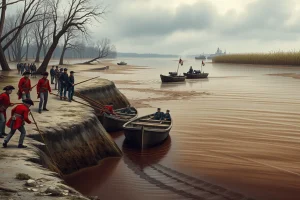
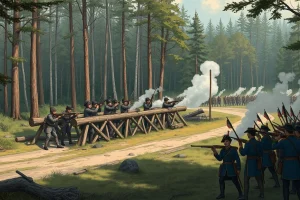
British troops landed at North Point on September 12, 1814, and advanced toward Baltimore while the navy moved up the Patapsco River. Maryland militia under Major General Samuel Smith and Brigadier General John Stricker fought a delaying action at the Battle of North Point; General Ross was killed, and command passed to Colonel Arthur Brooke. On the morning of September 13, a British squadron including bomb vessels and a rocket ship anchored about two miles from Fort McHenry and began throwing explosive mortar shells and Congreve rockets at the fort. Major George Armistead commanded more than 1,000 troops inside the fort and nearby batteries, but his guns could not reach the British ships. The bombardment continued through that day and night, with a brief interruption, and a small British landing force attempted to slip past the fort but was driven off by fire from Fort Covington and other American batteries. At dawn on September 14, the American garrison lowered its storm flag and raised a large garrison flag; Francis Scott Key, detained aboard a British ship, saw it waving and later wrote the poem that became the national anthem. Unable to reduce the fort or dislodge the American troops blocking the road to Baltimore, the British abandoned the assault and withdrew to their fleet.
Why It Matters
The defense of Fort McHenry secured Baltimore, preserved a vital American port, and boosted American morale at a time when Washington had been burned. The British failure helped persuade both sides to conclude peace negotiations, leading to the Treaty of Ghent in December 1814. Perhaps most lastingly, the battle produced Francis Scott Key’s ‘The Star-Spangled Banner,’ which became a patriotic song and, in 1931, the official national anthem of the United States. Historians have long debated the extent to which the result was a decisive military victory or a British strategic repulse, but all recognize the bombardment as a turning point in the Chesapeake campaign.
Prelude
Baltimore braced for attack for over a year. The city’s residents and militia constructed a line of earthworks on Hampstead Hill east of the city, blocked the harbor channel with sunken ships and a boom chain, and strengthened Fort McHenry. After the burning of Washington on August 24, 1814, British forces under Ross and Cochrane moved north. On September 11, the British fleet entered the Patapsco; on September 12, troops landed at North Point.
Forces and Commanders
American: Major George Armistead, U.S. Corps of Artillery, commanded the fort; he had about 1,000 effective men, including regular artillery, sea fencibles, volunteer artillery, and a detachment from Commodore Joshua Barney’s flotilla. British: Vice Admiral Alexander Cochrane commanded the naval force; bomb vessels included HMS Terror, Volcano, Meteor, Devastation, and Aetna, and the rocket ship HMS Erebus. The land force was led by Major General Robert Ross until his death and then by Colonel Arthur Brooke.
Battlefield and Map Context
Fort McHenry stood on a peninsula in the Patapsco River, about two miles south of Baltimore. The star fort had bastions and outer water batteries armed with 18-, 24-, and 36-pounder guns. The British bomb vessels anchored about two miles away, beyond the reach of most American guns. American defenses also included Fort Covington, Battery Babcock, and Fort Lookout on the Ferry Branch to the west, and a line of gun barges and sunken ships in the Northeast Channel.
Battle Chronology
September 12: British landing and Battle of North Point; American forces under John Stricker delay the British advance and General Ross is killed. September 13, early morning: British naval force of about 16 ships, including five bomb vessels and the rocket ship Erebus, takes position off Fort McHenry. At about 6:30 a.m., HMS Terror fires the first shell; the bombardment continues for about 25 hours, with more than 1,500 shell, shot, and rockets fired. During the afternoon, a British shell dismounts an American 24-pounder and kills Lieutenant Claggett and Sergeant Clemm. On the night of September 13–14, British landing parties attempting to slip past the fort are repulsed by fire from Fort Covington and other batteries. On September 14, at about 7 a.m., the bombardment ends and the fort raises its large garrison flag; the British ships withdraw down the river.
Casualties and Losses
American losses at Fort McHenry were 4 killed and 24 wounded, according to Armistead’s official report. British losses during the naval bombardment were small; the American Battlefield Trust lists one wounded, though the British landing parties also suffered some killed and wounded, including two men found dead in a sunken barge.
Result
American victory. The British bombardment failed to destroy the fort or force a passage into Baltimore. After the land attack was also blocked by strong American defenses, the British withdrew to the fleet and ended their Chesapeake campaign.
Strategic Consequences
The failed attack ended British operations in the upper Chesapeake. It helped preserve American control of Baltimore and the important privateer fleet. It also strengthened the American bargaining position at peace negotiations. Combined with other failures and the cost of the war, the British government agreed to sign the Treaty of Ghent on December 24, 1814.
Primary Accounts
Major George Armistead’s letter to the Secretary of War, dated September 24, 1814, is the principal American official account. It details his forces, the range problem, the night action, and casualties. Francis Scott Key, who had been aboard a British ship during the attack, commemorated the sunrise in verse in ‘The Star-Spangled Banner.’ British records are less detailed, but Admiral Cochrane’s dispatches and the logs of the bomb vessels would provide the British perspective; few have been published.
Battlefield Today
Fort McHenry is a National Monument and Historic Shrine, administered by the National Park Service. The original fort has been restored and the grounds include a visitor center, museum, and flag display. The surviving garrison flag is preserved at the Smithsonian Institution’s National Museum of American History.
Primary Sources
- Armistead’s official letter to the Secretary of War, dated September 24, 1814, which gives the American command’s detailed report of the attack.
- Francis Scott Key’s manuscript of ‘The Star-Spangled Banner,’ written in September 1814, now held by the Maryland Historical Society or the Library of Congress.
Further Reading
- Donald R. Hickey, The War of 1812: A Forgotten Conflict (University of Illinois Press, 1989).
- Walter Lord, The Dawn’s Early Light (W.W. Norton, 1972).
- Joseph A. Whitehorne, The Battle for Baltimore, 1814 (White Mane Publishing, 1993).
References
- National Park Service, ‘The Bombardment of Fort McHenry,’ https://www.nps.gov/fomc/learn/historyculture/the-bombardment-of-fort-mchenry.htm
- American Battlefield Trust, ‘Fort McHenry Battle Facts and Summary,’ https://www.battlefields.org/learn/war-1812/battles/fort-mchenry
- National Park Service, ‘Bombardment of Fort McHenry Part 1,’ https://www.nps.gov/fomc/learn/historyculture/bombardment-of-fort-mchenry-pt-1.htm
- ‘Official Account of the Bombardment of Fort McHenry,’ transcript, Smithsonian National Museum of American History, https://amhistory.si.edu/starspangledbanner/pdf/TRANSCRIPT%20Official%20Account%20of%20the%20Bombardment%20of%20Fort%20McHenry.pdf
- US Army Corps of Engineers, ‘Historical Vignette 127: The British Bomb Ft. McHenry in Baltimore,’ https://www.usace.army.mil/About/History/Historical-Vignettes/Military-Construction-Combat/127-Fort-McHenry/
FAQ
Why did the British attack Fort McHenry?
The British needed to clear the fort to allow their fleet to support a land assault on Baltimore. Baltimore was an important American port and privateer base, and its capture might have forced the United States to the peace table.
How long did the bombardment last?
Armistead reported about 25 hours, with two short intermissions; some modern sources say 27 hours. The bombardment began around 6:30 a.m. on September 13 and ended the following morning.
What happened to Francis Scott Key during the battle?
Key was aboard a British ship, detained after negotiating the release of a prisoner. At dawn on September 14, he saw the American flag still flying over Fort McHenry and wrote the poem that became 'The Star-Spangled Banner.'
Leave a Reply