
Short Answer
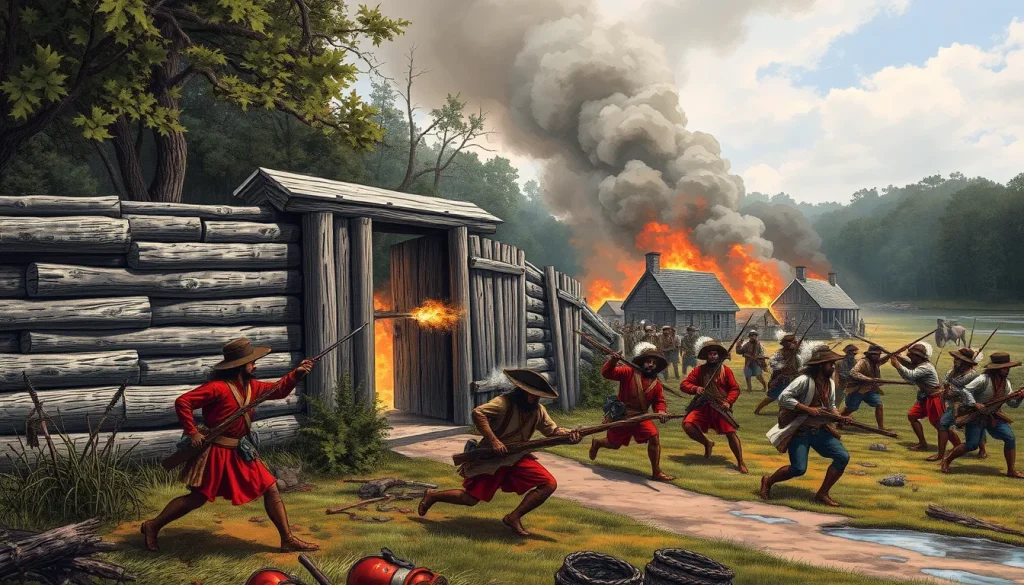
The Fort Mims Massacre was a surprise attack by Red Stick Creek warriors on a fortified plantation in the Mississippi Territory on August 30, 1813. Approximately 700 Red Sticks stormed the stockade, killing an estimated 250 soldiers, settlers, and allied Creeks and taking many captives. This event ignited the Creek War of 1813–14 and intensified American military action in the Southern theater of the War of 1812.
Historical Context
By the early 1800s, the Creek Nation faced increasing pressure from American expansion and the federal government’s “civilization” policy, which encouraged Creek men to adopt European-style agriculture and cede hunting lands. This created deep divisions between traditionalist Creeks, who sought to preserve ancestral customs, and accommodationist Creeks, who adapted to American influence. The Shawnee leader Tecumseh and his brother Tenskwatawa visited Creek towns in 1811–12, urging resistance and alliance with the British. A faction known as the Red Sticks, named for their red war clubs, embraced these nativist teachings and began receiving arms from Spanish-controlled Pensacola. In July 1813, a U.S. militia party intercepted a Red Stick supply train at Burnt Corn Creek, provoking the Red Sticks to retaliate against American-allied settlements. The town of Tensaw, a mixed-race Creek community with strong American ties, became a target. As tensions escalated, hundreds of settlers and allied Creeks sought refuge in a rough stockade around the plantation of Samuel Mims, which became known as Fort Mims.
What Happened
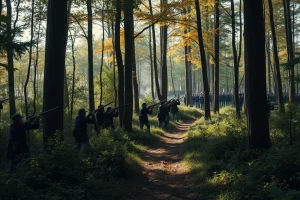
On August 30, 1813, a force of Red Stick warriors, led by William Weatherford, Far-off Warrior, and the prophet Paddy Walsh, launched a coordinated attack on Fort Mims. The post was defended by Major Daniel Beasley and a company of Mississippi Territorial Volunteers, along with Captain Dixon Bailey and a mixed force of American and Creek militiamen. The Red Sticks exploited an open gate and broke into the fort at noon, catching many defenders unprepared. Beasley and about half of the garrison were killed in the first assault, but Bailey’s men and others rallied and held the perimeter for several hours. The attackers eventually set the buildings on fire with burning arrows, and the fort’s defenses collapsed. In the ensuing massacre, most of the defenders and civilians—including men, women, and children—were killed, with some accounts reporting about 250 dead and over 100 captives. A small number escaped into the nearby swamps.
Why It Matters
The Fort Mims Massacre shocked the American public and provided a powerful rallying cry, “Remember Fort Mims.” It transformed the Creek internal conflict into a full-scale war between the United States and a powerful segment of the Creek Nation. With regular U.S. troops occupied in the northern theaters of the War of 1812, state militias from Tennessee, Georgia, and the Mississippi Territory mobilized under leaders such as Andrew Jackson. The resulting campaigns culminated in the Battle of Horseshoe Bend in March 1814 and the subsequent Treaty of Fort Jackson, which forced the Creeks to cede over 21 million acres of land. Historians interpret the massacre as a critical turning point in the Creek War, but they also debate the deeper causes, including economic divisions within Creek society and the specific grievances of the Red Sticks against the Tensaw community. Long-term consequences included the forced removal of Southeastern Indians in the 1830s.
Prelude
In the months before the attack, Red Stick activity increased along the Alabama River corridor. In July 1813, the Battle of Burnt Corn Creek, in which American militia attacked Red Sticks returning from Pensacola with supplies, escalated the conflict. Fearing retaliation, settlers and American-allied Creeks gathered at Fort Mims, a hastily built stockade around Samuel Mims’s plantation. Despite warnings of an imminent attack, the fort lacked a completed defensive wall and had an open gate. Major Beasley reportedly ignored intelligence of Red Stick movements and failed to maintain proper security.
Forces and Commanders
The Red Stick force numbered roughly 700 warriors, commanded by prominent leaders including William Weatherford, Far-off Warrior, and the prophet Paddy Walsh. The defenders consisted of approximately 100 Mississippi Territorial Volunteers under Major Daniel Beasley, plus about 45 militiamen under Captain Dixon Bailey, a Creek of mixed ancestry. Additionally, several hundred civilians—American settlers, allied Creeks, and enslaved African Americans—took refuge inside the fort. The defenders had a small cannon, but it played a limited role due to the speed of the assault.
Battlefield and Map Context
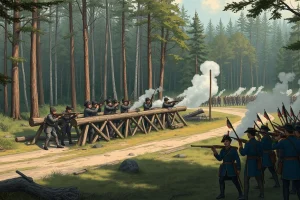
Fort Mims was located on the eastern side of the Alabama River, near the Tensaw settlement, in present-day Baldwin County, Alabama. The stockade enclosed about one acre and was constructed of vertical logs with two blockhouses at opposite corners. A gate on the east side proved vulnerable. The site today is a state historic site, roughly 40 miles north of Mobile, near the town of Stockton.
Battle Chronology
At approximately noon on August 30, the Red Sticks attacked, rushing through the fort’s open east gate. Major Beasley was killed in the initial volley, and many defenders fell. Captain Bailey organized a defensive line, and for about four hours the defenders repelled repeated assaults. The Red Sticks then shot fire arrows onto the structures within the stockade, igniting panic and collapse. The attackers entered fully, killing most of the remaining defenders and civilians. A handful of survivors escaped by cutting through the fort’s wall and fleeing into the swamps.
Casualties and Losses
Exact casualty figures are disputed, but most sources report around 250 killed, including the majority of the garrison and many civilians. At least 100 captives were taken, many of whom were later ransomed or escaped. Red Stick losses are estimated as lower, perhaps 40–60 killed, though exact numbers remain uncertain. The destruction of the fort and loss of life shocked contemporaries.
Result
The Red Sticks achieved a decisive tactical victory, capturing and destroying the fort. However, the massacre galvanized American public opinion and led to massive mobilization against the Red Sticks. The attack effectively ignited the Creek War, which would end in a U.S. victory at Horseshoe Bend.
Strategic Consequences
Within weeks, American forces from the Mississippi Territory, Georgia, and Tennessee began punitive expeditions. The Tennessee militia under Andrew Jackson, initially delayed by logistics, eventually drove deep into Creek territory. The war culminated at Horseshoe Bend, where Jackson’s army, with Cherokee and Lower Creek allies, defeated the Red Sticks. The Treaty of Fort Jackson (1814) forced the Creek Nation to cede 23 million acres, even those who had fought with the United States. British interest in the Southern frontier, including the use of Indian allies, was stymied, and the Gulf Coast remained contested until the Battle of New Orleans.
Primary Accounts
Survivor accounts were collected in the early 20th century by Henry S. Halbert and Timothy H. Ball in The Creek War of 1813 and 1814, which remains a key primary source compilation. Official reports from Major Beasley and later communications from territorial officials describe the attack. The account of a white woman who escaped and was later ransomed, as well as the testimonies of African American captives, provide varied perspectives. These accounts, while valuable, are filtered through memory and bias.
Battlefield Today
The site of Fort Mims is now the Fort Mims State Historic Site, managed by the Alabama Historical Commission. It features a reconstructed stockade, a restored blockhouse and well, and interpretive panels. The site was added to the National Register of Historic Places in 1972. Archaeological investigations have clarified the fort’s dimensions and layout. The site is not currently open to the public on a regular basis, but it remains a memorial to the events and a site for research.
Primary Sources
Key contemporary sources include the letters and reports of Major Daniel Beasley and his subordinates, as well as testimony from survivors collected by Halbert and Ball. These documents reveal the chaos of the attack and the decisions that led to the disaster, but they also reflect the biases of white and Creek participants. The National Park Service and the Encyclopedia of Alabama provide curated summaries of these sources. For those seeking primary material, the Alabama Department of Archives and History holds relevant manuscript collections.
Further Reading
- Waselkov, Gregory A. Conquering Spirit: Fort Mims and the Redstick War of 1813–14. Tuscaloosa: University of Alabama Press, 2006.
- Owsley, Frank L., Jr. Struggle for the Gulf Borderlands: The Creek War and the Battle of New Orleans, 1812–1815. Tuscaloosa: University of Alabama Press, 1981.
- Halbert, Henry S., and Timothy H. Ball. The Creek War of 1813 and 1814. Edited by Frank L. Owsley Jr. Tuscaloosa: University of Alabama Press, 1995.
- Davis, Karl. “Remember Fort Mims: Reinterpreting the Origins of the Creek War.” Journal of the Early Republic 22, no. 4 (2002): 611–36.
References
- National Park Service. “Fort Mims State Historic Site.” Accessed March 2025. https://nps.gov/places/fort-mims.htm.
- Waselkov, Gregory A. “Fort Mims Battle and Massacre.” Encyclopedia of Alabama. Last updated March 18, 2025. https://encyclopediaofalabama.org/article/fort-mims-battle-and-massacre/.
- O’Brien, Greg. “August 1813: The attack on Fort Mims prompts Choctaw involvement.” National Park Service. Accessed March 2025. https://www.nps.gov/articles/august-1813-fort-mims.htm.
- American Battlefield Trust. “Fort Mims Battle Facts and Summary.” Accessed March 2025. https://www.battlefields.org/learn/war-1812/battles/fort-mims.
- Davis, Karl. “Remember Fort Mims: Reinterpreting the Origins of the Creek War.” Journal of the Early Republic 22, no. 4 (2002): 611–36. doi:10.2307/3124760.
FAQ
What was the Fort Mims Massacre?
It was a Red Stick Creek attack on August 30, 1813, on a fortified plantation in present-day Alabama, resulting in the deaths of about 250 soldiers and civilians and sparking the Creek War.
Why did the Red Sticks attack Fort Mims?
The Red Sticks sought to strike against Creek communities that had adopted American culture and allied with the United States, and to retaliate for the July 1813 Battle of Burnt Corn.
What were the consequences of the Fort Mims Massacre?
It galvanized American public opinion and military action, leading to a U.S. campaign that culminated at the Battle of Horseshoe Bend and the cession of millions of acres of Creek land.

Leave a Reply