
Short Answer
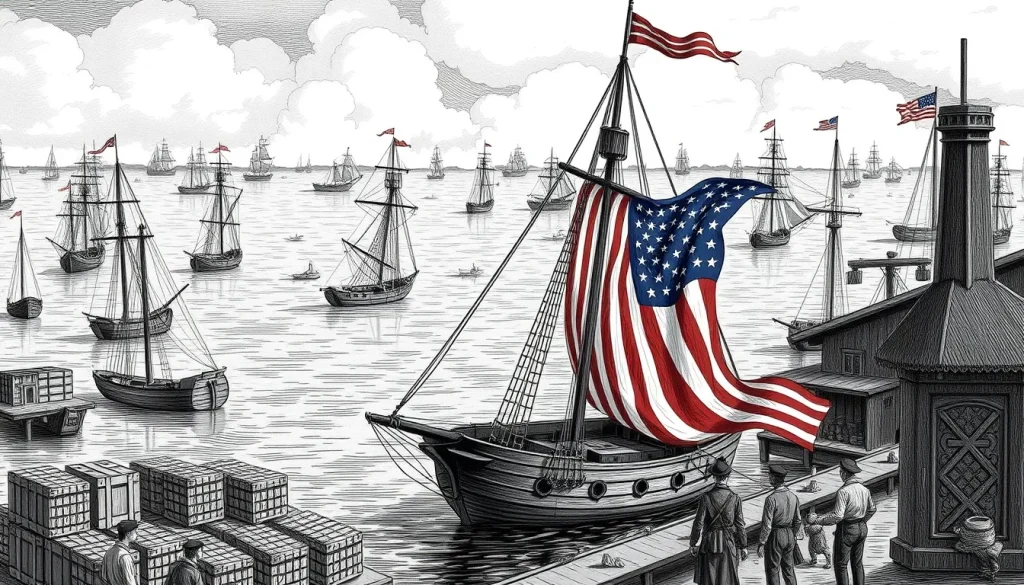
Trade during the War of 1812 (1812–1815) was a central cause and a principal battleground of the conflict. The United States, seeking to protect its maritime rights as a neutral power, faced British trade restrictions and impressment, while Britain sought to economically strangle its former colonies. The resulting commercial warfare—marked by a British blockade, American privateers, and government embargoes—devastated American exports, disrupted Atlantic commerce, and had lasting effects on both economies.
Historical Context
During the Napoleonic Wars, Britain and France both attempted to cut off each other’s trade with the United States. Britain’s Orders-in-Council (1807) restricted American trade with Europe, while France’s Milan Decree threatened to seize any neutral ship complying with British rules. American merchants, who had profited greatly from neutral re-export trade, saw their commerce increasingly harassed. In response, President Thomas Jefferson pushed the Embargo Act of 1807, which prohibited American ships from sailing to foreign ports, followed by a Non-Intercourse Act in 1809 and Macon’s Bill No. 2 in 1810. These measures failed to force British concessions and instead crippled American trade, with exports falling from $108 million in 1807 to $22 million in 1808. In 1811, a non-importation act targeted British goods specifically, setting the stage for war.
What Happened
When the United States declared war on June 18, 1812, the British Admiralty responded by declaring a naval blockade of the Chesapeake and Delaware Bays in December 1812, extended to southern ports in early 1813 and, by May of that year, to all ports south of New England. The blockade eventually included New England in 1814, completing the stranglehold on American coastwise and foreign trade. American exports collapsed from roughly $61 million in 1811 to about $7 million in 1814—an 89% decline. Federal customs revenue, the government’s main income source, fell by approximately 80%.
In response, the U.S. government issued over 1,100 privateer commissions to privately armed vessels, which captured an estimated 1,554 British merchant ships and caused heavy losses to British trade. Privateers, particularly those from Baltimore and other Chesapeake ports, operated in the West Indies, the Gulf of St. Lawrence, and even near the British Isles. Meanwhile, some New England merchants continued trading with British North America, supplying provisions to British garrisons—a practice that both sides tolerated. In the Chesapeake and along the coast, British raids destroyed tobacco stores, barns, and warehouses, while offering freedom to enslaved African Americans who escaped to British lines, further disrupting the plantation economy.
Why It Matters
The economic cost of the war helped drive both sides to negotiate the Treaty of Ghent in 1814. Britain’s blockade proved strategically decisive in limiting American resources, but American privateers and naval victories also pressured British merchants. The temporary protection from British imports gave a boost to American manufacturing, particularly in textiles, though many of these infant industries collapsed when peace resumed in 1815. The war also accelerated a shift in American economic focus from overseas trade toward westward expansion and internal improvements, as historians like George Rogers Taylor have argued. The conflict left a legacy of economic disruption that shaped post-war debates over tariffs, infrastructure, and national financial policy.
Definition
Trade during the War of 1812 refers to the exchange of goods between the United States, Britain, British North America (Canada), and other regions, as affected by government embargoes, naval blockades, privateering, and actual military operations. It encompasses both legal commerce and the illicit trade that flourished during wartime.
Background
Before the war, the United States was a major neutral carrier, re-exporting Caribbean and European goods. Between 1793 and 1807, American foreign trade boomed, but British and French restrictions eroded that prosperity. The Embargo of 1807–1809 and subsequent trade measures were attempts to pressure belligerents through commercial coercion, but they failed to achieve their objectives and caused widespread domestic opposition, especially in New England, which depended on overseas commerce. By 1812, American exports had fallen to about $61 million from a peak of $108 million in 1807.
How It Worked
The British blockade was a classic instrument of economic warfare, enforced by warships cruising off American ports to stop inbound and outbound shipping. It progressed in stages: first the Chesapeake and Delaware (December 1812), then the southern coast (May 1813), and finally New England (spring 1814). The blockade aimed to cut off customs revenue, restrict naval supplies, and divide American regions by sparing New England to appeal to Federalist anti-war sentiment. On the American side, privateers were commissioned by the federal government to capture British merchantmen; they operated with letters of marque and could sell prizes for profit. Additionally, the U.S. Navy conducted commerce raiding, and some trade continued under flag-of-truce agreements or through overland routes to Canada.
Competing Viewpoints
Historians disagree on the effectiveness of economic measures during the war. Some, like Andrew Lambert, argue that the British blockade was the decisive factor in bringing the United States to the peace table. Others, like Donald Hickey, emphasize the resilience of American privateering and its impact on British merchant and insurance interests. The question of whether the trade disruptions of 1807–1815 accelerated U.S. industrialization is also debated: Douglas Irwin and Joseph Davis use new data to show that industrial output growth was not decisively accelerated, though the disruptions did shift resources from shipping to nascent manufacturers like cotton textiles. Another interpretive divide concerns the role of New England’s trade with the enemy; historians such as J.C.A. Stagg have noted that this illicit commerce prolonged the war and undercut American efforts.
Role in the War of 1812
Trade grievances were the immediate cause of the American declaration of war, particularly the Orders-in-Council and impressment. Once the war began, trade itself became a battlefield. The British blockade crippled American exports and government revenue, while American privateers and naval captures inflicted losses on British commerce. Both sides sought to exploit economic vulnerabilities—the British to force negotiations and the Americans to demonstrate the costs of maritime aggression. The war also saw the rise of a licensed trade, especially from New England to British North America, which provided provisions to British forces and undermined the American embargo.
Consequences and Historical Interpretation
The economic consequences of the war were profound. American exports fell to $7 million in 1814, and the federal government faced near-insolvency. British trade also suffered: Lloyd’s underwriters reported that Americans had captured 1,175 vessels by December 1814, and marine insurance rates soared. The post-war economic depression in the United States led to the Tariff of 1816, the creation of the Second Bank of the United States, and a push for internal improvements. Historians have long debated the war’s economic legacy—whether it was a “second war of independence” that fostered national industry or a temporary setback that was quickly reversed. The trade restrictions and blockade forced Americans to become more self-sufficient, and the post-war period saw a renewed focus on westward expansion, canals, and manufacturing. Today, the war is remembered as a pivotal turn from the Atlantic economy to a continental one, shaping the economic trajectory of the young republic.
Primary Sources
Key contemporary sources on trade during the war include official government reports, such as Secretary of the Treasury William Jones’s budget for 1814, which exposed the revenue shortfall. The Niles’ Weekly Register, published in Baltimore, chronicled export statistics, privateer prizes, and the effects of the blockade. Lloyd’s List in Britain recorded ship losses, while Admiralty papers document the enforcement of the blockade. The American State Papers contain letters from customs officials and merchants. One notable personal account is from Joseph Pearson, a North Carolina congressman, who in February 1814 described the “corked up” state of American trade due to the enemy’s squadron and the embargo. These sources must be read with awareness of wartime propaganda and regional bias—New England Federalists exaggerated the harm of the embargo, while Republicans downplayed the effectiveness of the blockade.
Further Reading
- Hickey, Donald R. The War of 1812: A Forgotten Conflict. University of Illinois Press, 1989.
- Lambert, Andrew. The Challenge: Britain Against America in the Naval War of 1812. Faber & Faber, 2012.
- Irwin, Douglas A., and Joseph H. Davis. “Trade Disruptions and America’s Early Industrialization.” NBER Working Paper 9944, 2003.
- Kert, Faye M. “The Fortunes of War: Commercial Warfare and Maritime Risk in the War of 1812.” The Northern Mariner 8, no. 4 (1998).
- Arthur, Brian. “The Royal Navy and Economic Warfare in North America, 1812–1815.” PhD diss., University of Greenwich, 2009.
References
- National Park Service. “Trade & Commerce.” Star-Spangled Banner National Historic Trail. Accessed 2025. https://www.nps.gov/stsp/learn/historyculture/trade-commerce.htm.
- Irwin, Douglas A., and Joseph H. Davis. “Trade Disruptions and America’s Early Industrialization.” National Bureau of Economic Research Working Paper 9944, 2003.
- Kert, Faye M. “The Fortunes of War: Commercial Warfare and Maritime Risk in the War of 1812.” The Northern Mariner 8, no. 4 (October 1998): 1–16.
- Arthur, Brian. “The Royal Navy and Economic Warfare in North America, 1812–1815.” PhD diss., University of Greenwich, 2009.
- “The British Blockade of the American Coast.” War of 1812 Resource. Accessed 2025. https://thewarof1812.org/battles/the-british-blockade-of-the-american-coast/.
FAQ
How did the British blockade affect American trade?
The blockade cut off American exports and coastal trade, causing exports to fall from $61 million in 1811 to $7 million in 1814. It also drastically reduced customs revenue, the federal government's main income source.
What role did privateers play in the War of 1812?
Privateers were privately armed ships commissioned by the U.S. government to attack British shipping. They captured over 1,500 British merchant vessels, causing significant economic damage and raising insurance rates for British traders.
Did the trade disruptions help American manufacturing?
The disruptions protected nascent industries from British competition, allowing some manufacturing to grow, especially in textiles. However, after the war, many of these industries struggled as imported goods returned, though the Tariff of 1816 provided some relief.

Leave a Reply