
Short Answer
The War of 1812 (1812–1815) between the United States and Great Britain produced profound economic disruptions for both belligerents and shaped the early economic development of North America. The conflict’s economic effects ranged from the collapse of American maritime commerce under the British blockade and U.S. embargoes, to the expansion of domestic manufacturing, the accumulation of public debt, and long-term changes in trade patterns. This article examines the causes, course, and consequences of these economic forces, drawing on contemporary records and modern historical analysis.
Historical Context
The economic origins of the War of 1812 lay in the broader conflict between Britain and Napoleonic France, which disrupted global commerce and repeatedly violated American neutral rights. Beginning in 1807, Britain’s Orders in Council and France’s Berlin and Milan Decrees subjected neutral shipping to seizure, while the Royal Navy impressed sailors from American vessels. In response, President Thomas Jefferson and Congress imposed the Embargo Act of 1807, which prohibited American ships from trading abroad, hoping to coerce the belligerents by economic pressure. The embargo, however, devastated American commerce, and was replaced in 1809 by the Non-Intercourse Act, and later by Macon’s Bill No. 2, which ultimately led to the re-imposition of non-importation against Britain in 1811. By the time the United States declared war in June 1812, the economic grievances—trade restrictions, impressment, and interference with neutral commerce—had become central causes of the conflict.
Both nations entered the war with strong economic incentives: the United States to defend its rights to trade freely, and Britain to maintain its maritime supremacy and wartime economic warfare against France. The American economy was largely agrarian and commercial, with a small but growing manufacturing sector. Britain, meanwhile, was an industrial powerhouse, reliant on global trade and naval power. The war would test these economic structures in ways that had lasting consequences.
What Happened
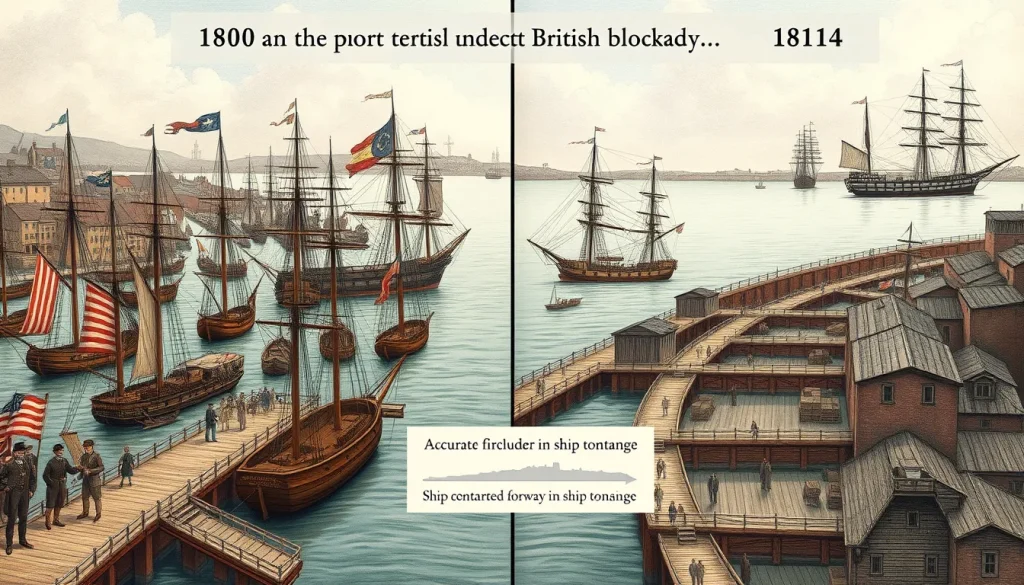
Once the war began, the United States attempted to leverage its trade as a weapon, maintaining an embargo against Britain and later expanding restrictions. The Royal Navy responded with a blockade of the American coast, which was implemented incrementally and became increasingly effective by 1814. The blockade virtually eliminated American overseas trade: the tonnage of ships entering U.S. ports fell by nearly 90 percent between 1811 and 1814 (Irwin and Davis). American privateers, in turn, preyed on British merchant shipping, capturing an estimated 1,554 British prizes worth $45.5 million according to one contemporary estimate (Kert). The British also employed convoys and insurance rates soared, raising costs for both sides.
The financial strain of the war was considerable. The U.S. government, denied revenue from customs duties, which fell sharply, turned to loans and Treasury notes. By December 1814, the U.S. public debt exceeded $105 million, up from about $45 million in 1812 (Kert, Arthur). To raise funds, Congress passed new taxes in 1813 and 1814, including excise duties and a direct tax on property and slaves, but these were unpopular and yielded less than needed. The U.S. Treasury faced growing difficulty securing loans, as credit weakened and interest rates rose. In Britain, although the war was a minor sideshow compared to the Napoleonic conflict, the financial burden added to an already enormous national debt, which had risen from £451.7 million in 1800 to £840.5 million in 1814 (Kert).
The economic disruption also had regional consequences. New England, which opposed the war, continued to trade under British licenses and benefited from the blockade’s exclusion of Southern and Middle States, leading to a concentration of specie in New England banks. Conversely, the Southern and Western states suffered from the inability to export cotton, tobacco, and foodstuffs, causing prices to fall and some planters to resort to overland trade. The war also stimulated some domestic industries, as the blockade protected nascent American manufacturers from British competition. Cotton textile mills, for example, expanded during the conflict, though this growth proved fragile.
Why It Matters
The immediate economic effects of the war were severe for the United States. The collapse of trade led to a depression in shipping-related industries, a decline in customs revenue, and a financial crisis that bordered on bankruptcy for the federal government. However, the war also accelerated the growth of certain domestic industries and prompted the first protective tariff in 1816, which helped shelter American manufacturing in the postwar period. The conflict also demonstrated the vulnerability of the United States to naval blockade, shaping future defense and trade policies.
For Britain, the war was an unwelcome additional drain on resources, but it ultimately preserved British maritime supremacy. The Royal Navy’s effectiveness in blockading American ports and protecting British commerce was proven, and the war reinforced Britain’s reliance on naval power and convoys. The American privateering campaign, though damaging, did not decisively disrupt British trade, and the British economy recovered quickly after 1815. The war also had significant effects on British North America (Canada), where the conflict disrupted trade but also brought military spending that stimulated some local economies, particularly in the Atlantic provinces.
In the longer term, the economic memory of the war influenced American policy for decades. The experience of financial distress and the need for a stable national bank led to the chartering of the Second Bank of the United States in 1816. The tariff of 1816 established a pattern of protectionism that persisted throughout the nineteenth century. Moreover, the war encouraged the shift of American economic activity toward domestic manufacturing and westward expansion, as the United States sought to reduce its dependence on transatlantic trade.
Definition
The economic effects of the War of 1812 refer to the monetary and commercial consequences of the conflict for the United States, Great Britain, and British North America. These effects include changes in trade volumes, prices, government finance, industrial production, and long-term economic structure. The war was fought partly over economic issues, and its outcome had significant economic repercussions that historians continue to study.
Background
Before the war, the United States was a neutral trading nation that had benefited greatly from the wars between Britain and France. Between 1792 and 1800, U.S. re-exports grew from about $1 million to nearly $40 million (Irwin and Davis). However, British and French interference with neutral shipping increased after 1805, leading to the Embargo Act and other restrictive measures. By 1812, the United States was still economically dependent on overseas trade, but it also had a growing domestic manufacturing sector, particularly in textiles.
On the eve of war, the British economy was already strained by twenty years of conflict with France. The Orders in Council and counter-blockades had disrupted continental trade, and the Royal Navy was stretched across the globe. The United States hoped to use economic pressure to force Britain to respect neutral rights, while Britain viewed the American war as a nuisance that needed to be contained without diverting too many resources from the European theater.
How It Worked
Economic warfare during the War of 1812 operated through several mechanisms. The U.S. government imposed embargoes and non-importation laws, attempting to deny Britain American goods and to protect American shipping from capture. Britain responded with a naval blockade, which by 1814 extended from New England to the Gulf of Mexico, preventing American ships from leaving port and neutral ships from entering. This blockade, combined with the earlier trade restrictions, reduced U.S. imports and exports drastically. American privateers and navy ships attacked British merchant vessels, driving up insurance rates and making British trade more expensive. On both sides, governments financed the war through borrowing, taxation, and, in the British case, through the existing financial system that had been developed during the Napoleonic Wars.
The disruption of trade had multiplier effects: merchants lost cargoes, shipbuilders lost orders, and customs revenue fell. Prices for imported goods rose, while prices for American agricultural exports fell due to lack of markets. The U.S. government, lacking revenue, issued Treasury notes and took out loans, but credit became increasingly hard to obtain as the war dragged on and as the banking system was strained. In Britain, the blockade and privateering increased the cost of shipping and insurance, but the overall British economy remained strong, and the war did not substantially alter Britain’s industrial trajectory.
Competing Viewpoints
Historians disagree about the extent and significance of the economic effects. A traditional interpretation, rooted in early American nationalism, held that the trade disruptions of 1807–1815 stimulated American industrialization by protecting infant industries from British competition. However, modern quantitative studies have challenged this view. Douglas Irwin and Joseph Davis (2003), using new industrial production data, found that trend growth in American industrial production was little changed over the period, suggesting that the disruptions did not decisively accelerate industrialization. Instead, they argue that the disruptions may have merely shifted resources from trade-dependent sectors like shipbuilding to domestic infant industries such as cotton textiles, and that the post-war flood of imports in 1815 threatened those gains until the Tariff of 1816 provided protection.
Other scholars, such as Faye Kert, emphasize the severe costs to merchants and consumers on both sides, arguing that the war’s economic impact was a major factor pushing both governments toward peace. Kevin O’Rourke’s macroeconomic analysis places the war in the context of the broader trade blockades between Britain, France, and the United States, showing that the welfare losses were significant for all parties. The debate also touches on whether the war accelerated the United States’ economic independence from Britain, or whether it was a temporary setback. Some scholars argue that the war’s end and the subsequent economic adjustment were more important than the war itself in shaping American economic development.
Role in the War of 1812
Economic issues were central to the outbreak, conduct, and conclusion of the War of 1812. The United States declared war in June 1812 citing impressment, the Orders in Council, and British interference with neutral trade as grievances. The war was fought, in part, to secure free trade and sailors’ rights. During the conflict, economic warfare was a major strategic tool for both sides. The United States used embargoes and privateering, while Britain used its naval blockade to strangle American commerce. Financial constraints influenced military operations; for instance, the U.S. government had difficulty financing the war, which limited its ability to sustain offensives. The economic strain also contributed to the peace negotiations at Ghent; both sides were weary of the costs, and the Treaty of Ghent, signed in December 1814, largely ignored the economic issues that had caused the war, returning to the status quo ante bellum.
Consequences and Historical Interpretation
The most notable economic consequence of the war was the acceleration of American protectionism. The Tariff of 1816, enacted to protect domestic industries from the post-war influx of British goods, marked the beginning of a sustained protective tariff policy. The war also prompted the establishment of the Second Bank of the United States in 1816, as the financial chaos of the war had exposed the weaknesses of the existing banking system. In the longer term, the war shifted the American economy from a reliance on foreign trade toward domestic manufacturing and internal improvements, a trend that continued throughout the nineteenth century.
For Britain, the war’s economic effects were relatively minor compared to the Napoleonic conflict, but it did reinforce the importance of naval supremacy and convoy systems. The war also had lasting effects on British North America: the Atlantic colonies (Nova Scotia and New Brunswick) enjoyed an economic boom during the war due to military spending and privateering, but suffered a depression after 1815 as peace resumed and American competition returned.
Historians continue to interpret the economic effects of the war in light of broader debates about the causes of American industrialization, the effectiveness of economic sanctions, and the role of trade in early American foreign policy. The war’s economic consequences remain a rich field for research, with new data and methods providing fresh insights.
Primary Sources
Contemporary accounts and official documents provide insight into the economic effects of the war. The U.S. Embargo Act (1807) and the Non-Intercourse Act (1809) are primary legislation that illustrate the policy of economic coercion. President James Madison’s war message to Congress (1 June 1812) enumerates the economic grievances. The Treasury reports of Secretary Albert Gallatin and later George Campbell document government finances, loans, and tax proposals. British sources include the Orders in Council (1807), and the records of the Royal Navy, which detail blockade operations. Merchant letters, insurance rate tables, and newspapers from the period also capture the experience of commercial disruption. For the peace treaty, the Treaty of Ghent (1814) contains provisions related to trade and navigation.
These sources are valuable for understanding the economic impact, but they must be read with attention to bias. Official documents may justify policies, while merchant accounts may exaggerate losses. The data on trade and finances are often incomplete or inconsistently recorded. Scholars thus combine these primary sources with quantitative analysis to reconstruct the economic history of the war.
Further Reading
- Irwin, Douglas A., and Joseph H. Davis. “Trade Disruptions and America’s Early Industrialization.” NBER Working Paper 9944, 2003.
- Kert, Faye M. “The Fortunes of War: Commercial Warfare and Maritime Risk in the War of 1812.” The Northern Mariner/Le Marin du nord 8, no. 4 (1998): 1–16.
- O’Rourke, Kevin H. “War and Welfare: Britain, France and the United States 1807–14.” SSRN Working Paper 922285, 2006.
- Hickey, Donald R. The War of 1812: A Forgotten Conflict. University of Illinois Press, 1989.
- Stagg, J.C.A. Mr. Madison’s War: Politics, Diplomacy, and Warfare in the Early American Republic. Princeton University Press, 1983.
References
- Irwin, Douglas A., and Joseph H. Davis. “Trade Disruptions and America’s Early Industrialization.” NBER Working Paper 9944, 2003. https://doi.org/10.3386/w9944
- Kert, Faye M. “The Fortunes of War: Commercial Warfare and Maritime Risk in the War of 1812.” The Northern Mariner/Le Marin du nord 8, no. 4 (1998): 1–16. https://www.cnrs-scrn.org/northern_mariner/vol08/nm_8_4_1-16.pdf
- Arthur, Brian. “The Royal Navy and economic warfare in North America, 1812-1815.” PhD diss., University of Greenwich, 2009. https://doi.org/10.1016/j.jaad.2009.11.691
- O’Rourke, Kevin H. “War and Welfare: Britain, France and the United States 1807–14.” SSRN Working Paper 922285, 2006. https://doi.org/10.2139/ssrn.922285
- Encyclopedia.com. “War of 1812.” https://www.encyclopedia.com/history/united-states-and-canada/us-history/war-1812
FAQ
Did the War of 1812 spur American industrialization?
According to Irwin and Davis (2003), the trade disruptions did not decisively accelerate industrialization, but they may have shifted resources from trade-dependent industries to domestic ones like cotton textiles. The post-war Tariff of 1816 helped stabilize these gains.
What were the main economic effects on American trade?
The British blockade and American embargoes reduced U.S. shipping sharply, cutting imports and exports, raising prices for imported goods, and lowering prices for American exports. The tonnage of ships entering U.S. ports fell by nearly 90 percent between 1811 and 1814.
How did the war affect government finances?
The U.S. government faced rising expenditures and falling customs revenue, leading to a public debt increase from about $45 million in 1812 to over $105 million by December 1814, and necessitating new taxes and loans. Britain also saw its national debt rise during the period.

Leave a Reply