
Short Answer
During the War of 1812, disease proved a far deadlier enemy than British muskets or naval cannon. Roughly three-quarters of all American war deaths resulted from illness, not battle, with typhoid, pneumonia, dysentery, and malaria taking a massive toll on soldiers and sailors. This article examines the types of disease that ravaged the armies of the United States, Great Britain, and their Canadian allies, the environmental and organizational conditions that fostered contagion, and the conflict’s lasting impact on military medicine.
Historical Context
The War of 1812 (1812–1815) pitted the young United States against the British Empire and its colonial forces in British North America. Military campaigns were fought along the U.S.–Canadian border, in the Great Lakes region, on the Niagara frontier, and even in the Chesapeake Bay area, but many armies spent months in camps plagued by poor sanitation, inadequate provisions, and harsh weather. Medical knowledge at the time remained rooted in pre- germ-theory ideas; the role of microorganisms in spreading infection was unknown. Military surgeons still practiced ‘heroic’ medicine, such as bleeding, blistering, and induced vomiting, which often harmed patients. The U.S. Army’s medical department, established during the Revolution, had lapsed into a decentralized and ill-equipped system by 1812, while British and Canadian forces also struggled with long supply lines and unfamiliar wilderness conditions. Disease thus became a central factor shaping the course of the war, influencing troop morale, campaign timing, and strategic decisions.
What Happened
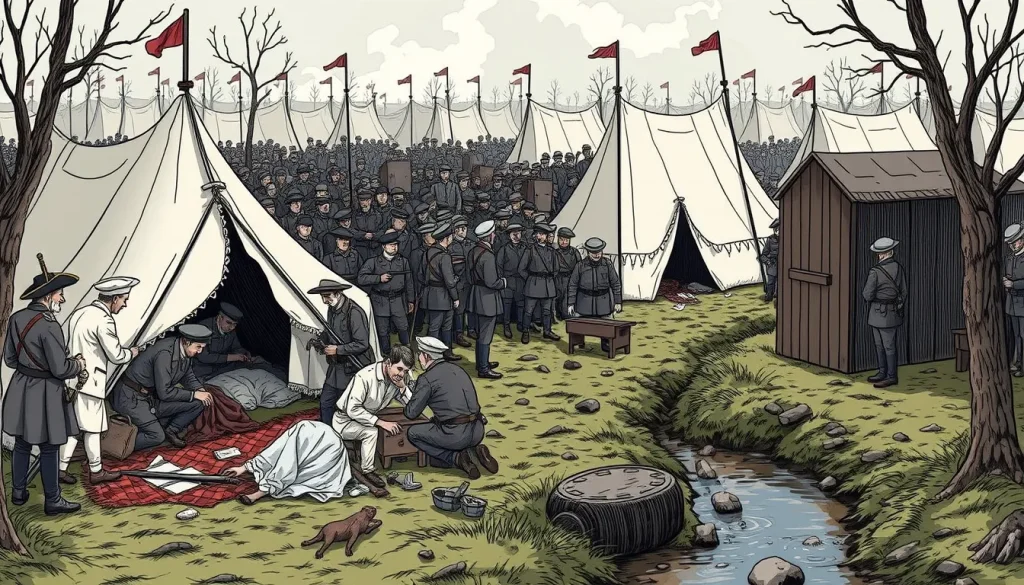
From the first campaigns, illness decimated American ranks. At Greenbush, New York, in late 1812, an average of 100 men fell ill each week with diarrhea, dysentery, intermittent fever, and typhus, according to U.S. Army surgeon James Mann, who was placed in charge of medical services for the Northern Army. Mann reported that four of the first seven deaths he witnessed were from typhus, and two others from chronic tuberculosis. Across the war, disease outbreaks were widespread and severe. Common ailments included typhoid, pneumonia, malaria, measles, diarrhea, dysentery, smallpox, and yellow fever in southern theaters. Sanitation was primitive: latrines were often dug too close to cooking areas and water sources, and the sick were left in tents with healthy soldiers because no separate hospital facilities existed. The absence of standardized medical supplies forced surgeons to improvise, and many enlisted men refused to report illnesses out of fear of being left behind or punished.
Both American and British forces suffered, though the exact figures for British and Canadian troops are less precisely recorded. The British 104th Regiment of Foot, deployed in North America, experienced significant illness, as did American regulars and militia. A 2020 dissertation by Joseph R. Miller emphasizes that daily environmental conditions, including food insecurity, inadequate clothing, and exposure to wet and cold, were more decisive than combat in determining soldier health and unit effectiveness. For the 1814 Niagara campaign, Miller argues that the ability to deliver sufficient calories to soldiers was essential to military success on both sides. The war also took a heavy toll on Indigenous peoples involved in the conflict, though their health experiences are less documented in American and British records.
Why It Matters
Disease had immediate strategic consequences. The American invasion attempts of 1812 failed not only because of militia refusal to fight outside U.S. territory but also because illness crippled the army before it could reach Canada. At Greenbush, 200 men were left behind when the army moved toward Montreal in November 1812, directly impacting troop strength. Over the course of the war, disease caused more than twice as many deaths as combat, shaping every campaign. The high mortality rate also spurred institutional reforms: as the war continued, Congress created the position of Surgeon General, set professional qualifications for surgeons, improved camp sanitation regulations, standardized medicine chests, and established a system of permanent and mobile hospitals. These reforms laid foundations for future military medical practice. Historians have increasingly argued that environmental and logistical management—not battlefield tactics—was the deciding factor in the war’s outcome. Miller’s dissertation contends that commanders who prioritized health, such as by rotating veteran units and protecting supply lines, were more effective. The war’s medical failures also influenced public memory, with soldiers’ memoirs frequently emphasizing the suffering of camp life over heroic charges.
Definition
In the context of the War of 1812, ‘disease in armies’ refers to the endemic and epidemic illnesses that afflicted soldiers, sailors, and camp followers, resulting in incapacitation, chronic debility, and death. These diseases were caused by a combination of environmental conditions (e.g., contaminated water, poor sanitation, exposure), poor nutrition, and lack of effective medical care. They included both communicable diseases, such as typhoid and dysentery, and climate- related illnesses like pneumonia and malaria.
Background
Before 1812, medical understanding was dominated by the miasma theory, which held that disease spread through ‘bad air’ from filth and decaying matter. While this theory led to some attempts to improve sanitation, it did not account for microorganisms, so treatments often targeted symptoms through bloodletting, purging, and blistering, which weakened patients. The U.S. Army’s medical department had been reduced after the Revolution, and in 1812 it lacked a centralized authority, with individual regiments responsible for hiring their own surgeons, often without proper qualifications. The War Department had no standardized system for medical supplies or hospital organization, leaving surgeons like James Mann to improvise with minimal staff and resources. British and Canadian forces, while better organized in some respects, faced similar challenges of supply and wilderness warfare that exacerbated illness.
How It Worked
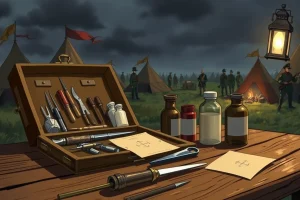
Disease spread rapidly in the encampments and on the march due to overcrowding, poor personal hygiene, and contaminated water. Latrines were frequently located too close to tents and water sources, and soldiers often had no access to soap or clean clothing. Rations were often inadequate, leading to malnutrition and weakened immune systems. Medical treatment was primitive and often harmful. Surgeon James Mann described his practice, which included administering drugs such as opium and alcohol for pain, and quinine for malaria, but also bleeding patients to reduce ‘excess blood’ and inducing vomiting or blistering to ‘draw out’ infection. Mercury was used for syphilis, a toxic remedy that could be fatal. Hospitals, where they existed, were often overcrowded, with infectious and non-infectious patients mixed together. The organization of medical staff was poor; Mann noted that his role as hospital surgeon was ill-defined, and he had no clear authority to hire nurses or orderlies. Over time, the U.S. Army improved: in 1813, Congress created the post of Surgeon General and set exams for surgeons, and a better system of mobile ‘flying hospitals’ and permanent rear hospitals was established, but these reforms came slowly and unevenly.
Competing Viewpoints
Historians have differing interpretations about the relative importance of disease versus other factors in the war’s outcomes. Traditional military histories focused on battles and leadership, often treating disease as a background factor. In recent decades, scholars have stressed the centrality of environment and health. Joseph R. Miller’s dissertation argues that the management of daily environmental conditions—food, water, alcohol, and rest—was more important than military tactics in determining success. For example, he shows that the British army’s practice of using veteran units for heavy fighting and placing raw recruits in less dangerous posts preserved its strength, while the American reliance on inexperienced militia led to higher disease rates. Other historians, such as James Mann in his own writings, emphasized the lack of organizational structure and scientific knowledge as key problems. The debate also includes whether disease was primarily a result of environmental factors (climate, terrain) or institutional failures (poor logistics, medical neglect). Miller contends that both mattered, but that human agency was critical: proactive commanders could reduce illness by improving camp sanitation and supply lines. The lack of accurate mortality statistics for British and Indigenous forces further complicates comparisons, leading historians to cautiously infer from anecdotal evidence.
Role in the War of 1812
Disease shaped the course of nearly every campaign. In the failed 1812 invasion of Canada, illness at Greenbush and other staging areas weakened American forces before they faced the enemy. The 1813 campaign at Sackets Harbor and York saw outbreaks that delayed operations. The brutal winter of 1813–14 caused widespread pneumonia and exposure among troops, particularly along the Niagara frontier. The 1814 British raids on the Chesapeake, including the burning of Washington, were partly enabled by American forces being weakened by fever and dysentery. In the Northwest, malaria and typhoid plagued armies in the swamps and river valleys. Disease also affected naval crews: sailors on the Great Lakes and ocean suffered from scurvy, typhoid, and dysentery, though the U.S. Navy had a more centralized medical system. The high sick rates forced commanders to abandon planned attacks or retreat. For example, in 1814 the U.S. Army’s advance on Montreal was called off partly because of sickness among the troops. Both sides used alcohol rations as a prophylactic against cold and disease, but excessive use often caused more health problems. Disease also had political implications: it fueled public criticism of the war effort and influenced the peace negotiations at Ghent, as both nations were exhausted by the human toll.
Consequences and Historical Interpretation
The lasting consequences of disease in the War of 1812 were profound. The war prompted permanent reforms in American military medicine: the establishment of a Surgeon General, standardized medical stores, improved hospital systems, and more rigorous training for surgeons. These reforms laid groundwork for the larger medical corps of later conflicts like the Mexican-American War and the Civil War. For the British Army, the war reinforced lessons from earlier campaigns about the importance of sanitation and supply, but it was still slow to adopt new practices. Historians now view the war’s health crisis as a lens into the broader experience of common soldiers, contrasting with earlier ‘great man’ history. James Mann’s detailed medical observations from 1812–14 provide a unique primary source that scholars use to reconstruct the everyday suffering of soldiers. The memory of disease also shaped national narratives: soldiers’ memoirs and letters often described the ‘sickly season’ and the horrors of hospitals, contributing to a less romanticized view of war. Modern historians agree that disease was a decisive factor, even if battle casualties received more attention in the moment. The war’s death toll from disease was a tragic demonstration of the limits of early nineteenth-century medicine and a catalyst for change.
Primary Sources
The most valuable contemporary account is Medical Sketches of the Campaigns of 1812, 13, 14 by James Mann, M.D., published in 1816. Mann served as a hospital surgeon in the Northern Army and recorded detailed observations of diseases, treatments, and hospital organization. His work includes statistics on troop sickness and mortality, as well as a dissertation on dysentery. Another important source is the official correspondence of the U.S. Army’s Medical Department, which is partially preserved in the National Archives and Records Administration. Surgeons’ case reports and orderly books from the war are also available in archives such as the U.S. Army Heritage and Education Center. Mann’s book, digitized by the Brock University Digital Repository, offers a first-hand view of how medical practice functioned during the conflict, including the challenges of establishing hospitals in frontier conditions. However, like all primary sources, Mann’s observations are limited by his own medical theories—he accepted miasma and advocated heroic treatments—and by his geographic focus on the northern campaigns. He also wrote as a U.S. Army officer, so British, Canadian, and Indigenous perspectives are absent.
Further Reading
- The Medical Department of the United States Army in the War of 1812 by Mary C. Gillett (U.S. Army Medical Department, Office of Medical History) – a comprehensive institutional history.
- Medical Sketches of the Campaigns of 1812, 13, 14 by James Mann (1816) – the primary source described above.
- Joseph R. Miller, “The Men Were Sick of the Place”: Soldier Illness and Environment in the War of 1812 (Ph.D. diss., University of Maine, 2020) – recent scholarship on environment and health.
- Articles and resources from the U.S. National Park Service on military medicine during the war.
References
- U.S. National Park Service, “Wounded Soldiers Contend with Crude Treatments,” last updated August 15, 2017, https://www.nps.gov/articles/military-medicine.htm.
- Joseph R. Miller, “The Men Were Sick of the Place”: Soldier Illness and Environment in the War of 1812 (Ph.D. diss., University of Maine, 2020), https://digitalcommons.library.umaine.edu/etd/3208.
- Mary C. Gillett, “Early Campaigns in the North, 1812 to 1813,” in The Medical Department of the United States Army in the War of 1812 (U.S. Army Medical Department, Office of Medical History), https://achh.army.mil/history/book-rev-gillett1-ch8/.
- James Mann, Medical Sketches of the Campaigns of 1812, 13, 14 (Dedham, MA: H. Mann and Co., 1816), http://hdl.handle.net/10464/3831.
FAQ
What was the deadliest disease in the War of 1812?
No single disease was universally deadliest; typhoid, dysentery, pneumonia, and malaria were all common. Historians note that the combination of unsanitary camps and inadequate treatment made many diseases lethal.
How did disease affect the outcome of the war?
Disease weakened armies, forced cancellations of campaigns, and drained morale. It influenced strategic decisions on both sides and contributed to the war's high death toll, though no single battle was lost solely due to illness.
What medical reforms came out of the War of 1812?
The U.S. Congress established a Surgeon General, set professional standards for surgeons, standardized medicine chests, and improved hospital organization, including flying hospitals. These changes laid the foundation for future army medical care.

Leave a Reply