
Short Answer
War profiteering and private commerce were central to the War of 1812, as private merchants, shipowners, and smugglers exploited the conflict for profit, sometimes at the expense of national war aims. The war’s economic pressures—blockades, trade restrictions, and demand for military supplies—created opportunities for both legitimate enterprise and illicit gain. This article examines how private commerce operated during the war and how it shaped the conflict’s outcome and legacy.
Historical Context
The War of 1812 (1812–1815) grew out of long-standing disputes over maritime trade, impressment, and trade restrictions. The United States, seeking to protect its neutral trading rights, faced British Orders in Council and French decrees that disrupted commerce. In response, the U.S. Congress passed the Embargo Act of 1807 and subsequent non-intercourse acts, which severely curtailed trade. These policies had already created a culture of smuggling and economic evasion along the Canadian border and the Atlantic coast. When war broke out in June 1812, the U.S. had a small regular navy and a weak federal budget, relying heavily on private merchants and armed privateers to supplement naval power. Britain, commanding the world’s largest navy, imposed a blockade of American ports, which cut off transatlantic trade but also stimulated smuggling and privateering. The geographic sprawl of the war—from the Great Lakes to the Gulf Coast—made it difficult to enforce commercial restrictions, and both sides depended on private enterprise for food, clothing, weapons, and other military supplies.
What Happened
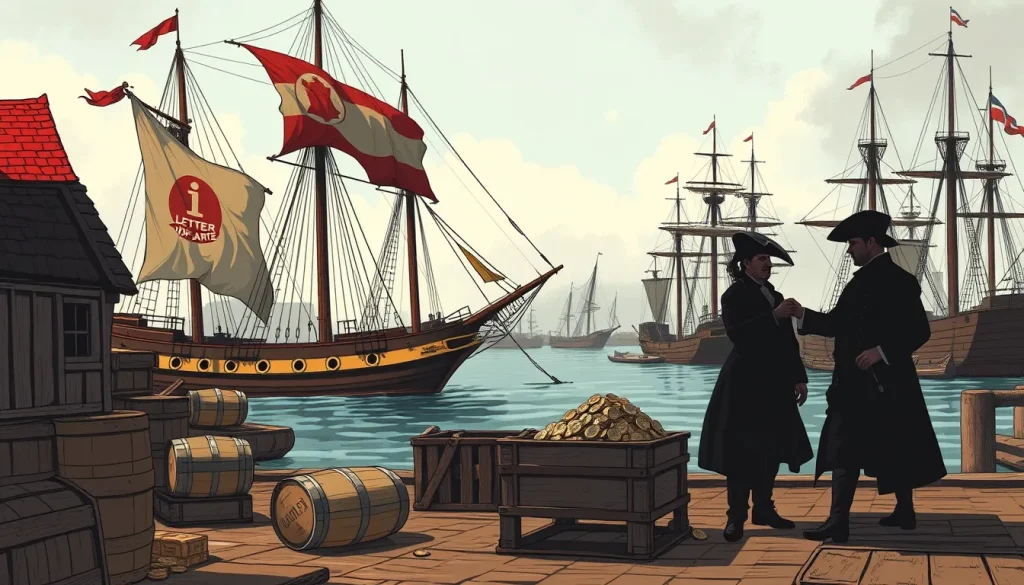
Private commerce and profiteering took several forms during the War of 1812. American privateers, issued letters of marque by the federal government, conducted a decentralized naval war against British merchant shipping. Between 1812 and 1815, over 500 American privateers sailed from ports like Baltimore, Salem, and New York, capturing hundreds of British ships and cargoes worth millions of dollars. Privateering was a business venture, financed by investors who hoped to profit from prize money; it attracted not only seasoned sailors but also merchants seeking rapid returns. The British also relied on privateers, though less successfully, and the Royal Navy itself purchased provisions from civilian contractors.
Smuggling was rampant along the porous U.S.–Canadian border. Merchants traded openly between the United States and British North America despite the wartime prohibition. Goods such as flour, lumber, and manufactured items crossed the Niagara River, the St. Lawrence, and Lake Champlain, often with the tacit approval of local authorities. Some American merchants even sold supplies directly to British forces in Canada, earning high prices but undermining the American blockade. Conversely, British merchants profited from supplying American towns that faced shortages.
Government contracting for military supplies also presented opportunities for fraud and overpricing. The U.S. War Department and Quartermaster General’s Department issued contracts for uniforms, food, and munitions, but oversight was weak. Contractors sometimes delivered substandard goods, inflated prices, or failed to deliver altogether. Similar problems occurred on the British side, where contractors for the navy and army often charged exorbitant rates. Contemporary newspapers and official reports frequently denounced these practices as unpatriotic profiteering. One notable case involved the supply of gunpowder and ordnance, where quality and price were contested.
Why It Matters
The activities of private commerce and profiteering had immediate and lasting effects. Privateers helped offset the Royal Navy’s numerical superiority, capturing or destroying hundreds of merchant ships and disrupting British trade. This private naval effort contributed to American morale and forced Britain to allocate resources to convoy protection. Smuggling, however, undermined the official war effort by providing the enemy with supplies and keeping the border economy intertwined. The British blockade, combined with domestic profiteering, exacerbated inflation and shortages in the United States, leading to public outrage and congressional inquiries. The war ended in February 1815 with the Treaty of Ghent, which restored prewar boundaries and trade relationships, but many of the economic issues—such as the need for a better-regulated merchant marine and the question of profit from warfare—persisted. Historians have interpreted these events through the lens of political economy: the war highlighted the tension between private profit and public service, and foreshadowed later debates over military contracting and profiteering that continued into the twentieth and twenty-first centuries.
Definition
War profiteering is the act of making excessive or unethical profits from wartime activities, often by overpricing goods, fraud, or exploiting shortages. Private commerce includes all economic activity conducted by private individuals or firms, which during war includes licensed privateering, smuggling, and supplying military forces. In the 1812 era, these terms were understood differently from modern usage; profit from war was often seen as a natural consequence of enterprise, but excessive gains at the cost of national effort were condemned.
Background
The War of 1812 occurred in an era when governments relied heavily on private contractors and merchants to supply their armies and navies. The British and Americans both had traditions of privateering, which were legally sanctioned through letters of marque. The economic policies of embargoes and blockades intended to pressure the enemy also created conditions for smuggling and black-market trade. The state had limited administrative capacity to monitor distant supply chains, making fraud and overpricing difficult to detect. The war thus became a laboratory for the interaction between public military objectives and private commercial interests.
How It Worked
Privateers were privately owned armed ships granted a letter of marque that authorized them to attack enemy vessels. The owners and crews split the value of captured ships and cargoes, known as prizes. In the United States, privateering commissions were issued by the federal government, and prize courts adjudicated the legality of captures. Smuggling operated through informal networks of merchants, boatmen, and Indigenous intermediaries, crossing rivers and lakes that bordered the two nations. Trade with the enemy sometimes passed through neutral ports, such as those in the Caribbean, using false papers and flag-of-truce vessels. Government contracts were awarded to individual merchants or firms, often without competitive bidding, and could be based on personal connections. Prices were set at prevailing market rates, which soared due to the blockade and wartime demand, allowing contractors to reap extraordinary profits if they could deliver.
Competing Viewpoints
Contemporaries held conflicting assessments of private commerce during the war. Many American politicians and citizens celebrated privateers as patriotic defenders of the nation, arguing that they were essential to the war effort because the U.S. Navy was too small. Others, however, saw privateering as little more than licensed piracy, encouraging greed and undermining naval discipline. British officials viewed American privateers as pirates and sought their capture. Similarly, smuggling was condemned by both governments—the United States tried to enforce its embargo and wartime non-importation laws, while Britain sought to prevent supplies from reaching American privateers and the army. Yet local residents often tolerated or participated in smuggling because it brought goods and money. Historians have debated the actual net benefit of privateering, with some arguing that it effectively harassed British commerce, while others emphasize that it siphoned resources away from the regular navy and exposed American shipping to retaliation. The concept of profiteering also carried moral weight; accusations that merchants sold to the enemy for profit were common in the press and letters of the era.
Role in the War of 1812
Private commerce played a decisive role in the war’s logistics and outcomes. American privateers captured around 1,300 British prizes, though estimates vary, and their activities forced Britain to convoy merchant ships and divert warships from other duties. The British blockade, in turn, cut off most U.S. transatlantic trade, but privateers and smugglers provided some economic relief. Smuggling across the Canadian border was particularly active in 1813–1814, as both sides sought food and military stores. American merchants sold provisions to British forces in Canada, and British merchants supplied American towns. This trade not only sustained both armies but also blurred the front line, making it difficult for commanders to secure exclusive supply. The U.S. government’s reliance on private contractors for everything from gunpowder to beef led to well-documented cases of fraud and poor quality. For example, several contractors were charged with delivering shoddy shoes or diluted gunpowder. On the British side, the navy’s provisioners were also known to engage in corrupt practices. These behaviors eroded public confidence and contributed to the anti-war sentiment in New England, where shipping interests opposed the conflict from its outset.
Consequences and Historical Interpretation
Immediate consequences of war profiteering included higher prices, shortages, and public outrage. The U.S. Congress held investigations into military contracting, leading to legislative reforms in 1814–15, though with limited effect. The war’s end in 1815 reopened normal trade, and the private economy returned to peacetime pursuits. Long-term consequences included a shift toward more centralized government contracting in later conflicts, though this was incremental. Historians have used the War of 1812 to explore the relationship between private gain and public warfare. Some interpret the era as a case study in the inefficiency of privatized warfare, arguing that privateering and smuggling prolonged the conflict and benefited only a few. Others contend that privateers were a rational complement to the new republic’s limited navy and that the economic costs of profiteering were outweighed by the strategic benefits of harassing British commerce. The moral question of profiteering—whether it is ever acceptable to profit from war—was raised during this period and resonates into the twenty-first century, as modern legislation like the War Profiteering Prevention Act of 2007 demonstrates.
Primary Sources
Key primary sources for the study of war profiteering and private commerce include letters of marque and the prize court records of the U.S. District Court. The National Archives and Records Administration holds the federal records of privateer commissions. Contemporary newspapers such as Niles’ Weekly Register and Baltimore’s Federal Republican published privateer manifests and attacks on profiteers. The Annals of Congress and congressional documents contain reports on contract fraud, for example, the Report of the Select Committee on the Causes of the Decline of the Navy (not to be confused with unrelated inquiries). British sources include the Admiralty Records (ADM) in the UK National Archives, which detail prize captures and naval purchases. The correspondence of merchants like Samuel Smith and Thomas Wilson offers direct testimony. Many of these documents are available in published editions, such as the American State Papers: Naval Affairs, and online databases.
Further Reading
- The War of 1812: A Forgotten Conflict, Donald R. Hickey (University of Illinois Press, 2012)
- The War of 1812: Conflict for a Continent, J.C.A. Stagg (Cambridge University Press, 2012)
- Privateers of the American Revolution (on privateering traditions) or for 1812: Privateers and Privateering by Gardner Weld Allen (1910)
- The Business of War: Military Enterprise and Military Revolution in Early Modern Europe, David Parrott (Cambridge University Press, 2012) – for broader context of private enterprise in warfare
- Canadian Museum of History and The War of 1812 Website for primary source exhibits
References
- Annals of Congress (13th Cong., 2nd sess.) – reports on contract fraud.
- Hickey, Donald R. The War of 1812: A Forgotten Conflict. University of Illinois Press, 2012.
- Stagg, J.C.A. The War of 1812: Conflict for a Continent. Cambridge University Press, 2012.
- Allen, Gardner W. Privateers and Privateering. New York: Hearst’s International Library, 1910.
- Parrott, David. The Business of War. Cambridge University Press, 2012.
- U.S. Senate. War Profiteering Prevention Act of 2007, S. Rept. 110-66 (for comparative modern context).
FAQ
How did privateers contribute to the War of 1812?
American privateers captured hundreds of British merchant ships, disrupting British commerce and supplementing the small U.S. Navy. They were a major economic factor despite being privately owned and profiting from prizes.
Why did smuggling flourish during the War of 1812?
The war created severe shortages and high prices for goods on both sides of the U.S.-Canadian border. The frontier was long and poorly policed, and local merchants often traded with the enemy to meet demand, despite legal prohibitions.
What was the public reaction to war profiteering?
Contemporary newspapers and politicians regularly condemned profiteering as unpatriotic, particularly when contractors supplied poor quality goods or when merchants sold to the enemy. Congressional inquiries were launched, but enforcement remained difficult.


Leave a Reply