
Short Answer
Congress during the War of 1812 played a central and often contentious role in the conflict, from its first formal declaration of war under the Constitution to its struggles to finance and oversee a deeply unpopular war. Facing no established wartime precedent, the legislative branch debated, amended, and occasionally blocked executive proposals while also passing essential laws for military expansion, taxation, and loans. The war divided Congress along partisan lines—Republicans largely supported it, Federalists opposed it—and these divisions shaped the conflict’s course and its legacy.
Historical Context
By 1812, the United States had chafed for nearly a decade under British maritime restrictions and impressment. President Thomas Jefferson’s embargo of 1807–1809 had failed to coerce Britain or France, and James Madison inherited a deteriorating diplomatic situation. Within Congress, a group of young, pro-war legislators known as the War Hawks—including Henry Clay of Kentucky, John C. Calhoun of South Carolina, and Peter B. Porter of New York—demanded action. They cited British Orders in Council, seizure of American ships, impressment of American sailors, and British support for Indigenous resistance in the Northwest. The political landscape was sharply divided: the Federalist Party, centered in New England, opposed a war they saw as ruinous to trade, while Republicans, though split, ultimately supplied the votes for a declaration.
What Happened
On June 1, 1812, President James Madison sent a war message to Congress recounting British aggressions. The House Committee on Foreign Affairs, chaired by Peter B. Porter, reported in favor of war, and after five days of debate the House voted 79 to 49 on June 4; the Senate concurred on June 17 by a vote of 19 to 13. Madison signed the declaration on June 18, 1812—the first congressional declaration of war in American history. Every Federalist voted against it, and roughly a quarter of Republicans either opposed or abstained.
Once at war, Congress faced the immense task of raising men and money. In 1812–1813, it authorized expanding the regular army, calling state militias, and creating a volunteer force. To pay for the war, Congress passed direct taxes on distilled spirits, slaves, and real property, and authorized borrowing through Treasury notes and loans. The national bank issue resurfaced: a Republican-backed bank bill passed in 1814 but was vetoed by Madison because it lacked government subscription; a second proposal died only with peace. Congress also debated—and sometimes rejected—executive proposals for embargoes and conscription, asserting its own authority.
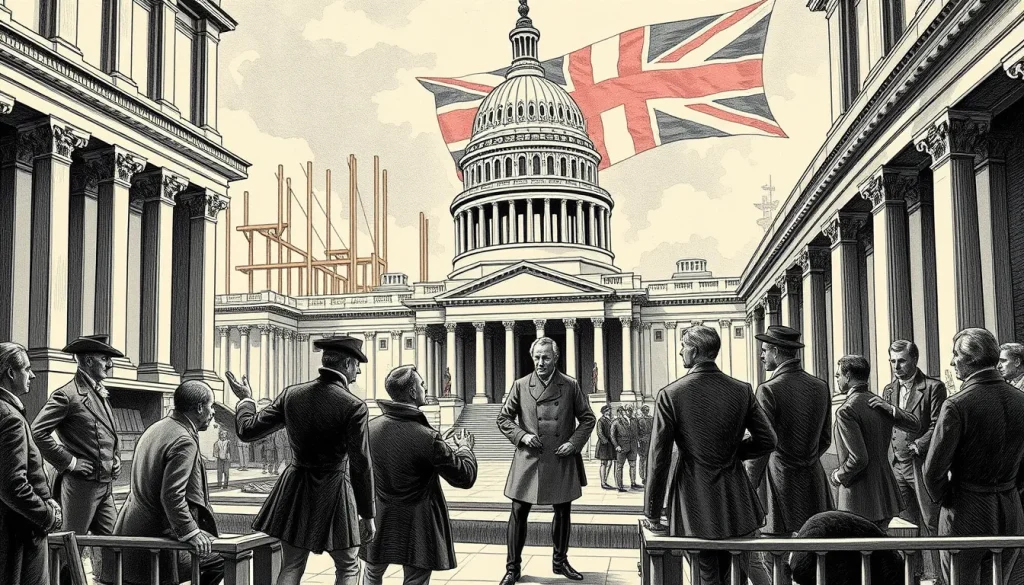
The war’s course brought direct consequences to Congress. In August 1814, British forces burned the Capitol and the President’s House. Congress convened in special session in October 1814, meeting in temporary quarters at the Patent Office and Blodgett’s Hotel near today’s Gallery Place. The session debated military failures, the Hartford Convention’s demands, and the Treaty of Ghent negotiations. On September 23, 1814, the House passed a resolution to investigate the causes of enemy successes, reflecting frustration with the administration.
Why It Matters
Congress’s wartime actions set precedents for executive-legislative relations during national emergencies. The declaration itself affirmed Congress’s constitutionally exclusive power to war, but the war also showed how a president could lead diplomacy while Congress controlled funding and oversight. The partisan strife exposed deep fissures—Federalist accusations of “Mr. Madison’s War” and secessionist murmurs at Hartford—yet the war ended with a peace treaty that most Americans accepted, and the Republican Party emerged stronger. Historians see the war as a turning point: it consolidated national identity, weakened the Federalists, and established patterns of congressional budgeting and investigation that persist.
Definition
In this context, “Congress” refers to the elected legislature of the United States—the House of Representatives and the Senate—acting under the Constitution’s Article I powers to declare war, raise armies, provide a navy, levy taxes, borrow money, and regulate commerce. Its role during the War of 1812 encompassed both the initial decision for war and the ongoing oversight and support of military and financial measures.
Background
Before 1812, Congress had never declared war. It had, however, passed many embargoes and non-intercourse acts under Jefferson and Madison, demonstrating legislative control over foreign commerce. The Federalist and Republican parties had developed distinct constitutional and economic philosophies: Federalists favored a powerful central government and pro-British trade, while Republicans championed states’ rights and agrarian interests. The war crisis intensified these divisions, with New England Federalists refusing to support the conflict and even supplying the enemy in some cases.
How It Worked
Congress operated through committees, floor debates, and votes. The Speaker of the House, Henry Clay from 1811 to 1814, used his influence to steer legislation. Key committees—Foreign Affairs, Ways and Means, Military Affairs, and Naval Affairs—drafted bills. The president sent messages and recommendations, but Congress amended and sometimes rejected them. Money bills originated in the House, as required. Partisanship was intense: Federalists used procedural delays, asked for roll-call votes, and published protests. The war effort required constant legislative action: raising troop levels, creating officer corps, authorizing privateers, and passing revenue acts.
Competing Viewpoints
Federalists argued the war was unconstitutional (since it was offensive, not defensive), commercially ruinous, and beneficial only to France. They championed negotiations and even contemplated a separate New England peace. Republicans, including War Hawks, contended that national honor and rights compelled war, that Britain was an aggressor, and that submission would invite further indignities. Within the Republican ranks, some (like John Randolph of Virginia) denounced the war as motivated by a desire to conquer Canada. The Hartford Convention (1814–1815) summarized Federalist grievances, but its proposals were modest and quickly overshadowed by news of peace.
Role in the War of 1812
Congress’s role evolved from the decision to declare war, to financing it, and finally to investigating its failures. It authorized an increase in the regular army from about 12,000 to 35,000 men, approved militia calls, and created a force that struggled to meet its targets. It raised funds through loans, treasury notes, and internal taxes—direct taxes that proved unpopular. The bank bill, if passed, might have stabilized finance, but Madison’s veto and congressional wrangling meant the government relied on loan subscriptions and shaky paper. Congress also passed the Non-Intercourse Act of 1813, restricting trade with Britain, and debated—but never implemented—a nationwide conscription proposal. The investigative committee of 1814 laid groundwork for later oversight.
Consequences and Historical Interpretation
The war’s conclusion left Congress with a new sense of institutional confidence but also bitter partisan memories. The Federalist Party’s reputation never recovered, and the postwar “Era of Good Feelings” saw a one-party system. Historians assess Congress as initially decisive but later hesitant, often more focused on partisan advantage than on coherent strategy. Some scholars, like William Barlow, emphasize that Congress rarely granted the president all he asked and often altered executive proposals. Others, like the U.S. Capitol Visitor Center, highlight how the war shaped congressional identity and mission. The burning of the Capitol itself became a symbol of both national vulnerability and recovery, with Congress rebuilding the structure in subsequent years.
Primary Sources
Key primary sources include President James Madison’s war message of June 1, 1812, which listed the grievances that led to war. The House Committee on Foreign Affairs report of November 29, 1811, summarized those grievances in stark terms. Congressional debates are recorded in the Annals of Congress, which contain speeches by Peter B. Porter, John Randolph, Henry Clay, and others. The official Senate and House journals record votes and resolutions. The National Archives holds the original declaration of war and related legislative files. The U.S. Capitol Visitor Center’s exhibition “Congress and the War of 1812” displays many of these documents. Each source—speeches, reports, roll calls—reflects the author’s political stance, so they must be read critically.
Further Reading
- Barlow, William Ray. Congress During the War of 1812. Ph.D. diss., Ohio State University, 1961.
- Menon, Varun K. “The War That Congress Waged.” Pennsylvania History Review 23, no. 1 (2016).
- U.S. Capitol Visitor Center. “Congress and the War of 1812.” Exhibition. Washington, DC.
- National Park Service. “Summer 1812: Congress Stages Fiery Debates over Whether to Declare War on Britain.”
- National Archives. “1812: Congress’s First Declaration of War Under the Constitution.” Educational resources.
- Hickey, Donald R. The War of 1812: A Forgotten Conflict. University of Illinois Press, 1989.
References
- Barlow, William Ray. “Congress During the War of 1812.” PhD diss., Ohio State University, 1961. DocsLib. https://docslib.org/doc/9459587/congress-during-the-war-of-1812
- Menon, Varun K. “The War That Congress Waged.” Pennsylvania History Review 23, no. 1 (2016). University of Pennsylvania. https://repository.upenn.edu/phr/vol23/iss1/4
- U.S. Capitol Visitor Center. “Congress and the War of 1812.” Exhibition. https://www.visitthecapitol.gov/exhibition/congress-and-war-1812
- National Park Service. “Summer 1812: Congress Stages Fiery Debates over Whether to Declare War on Britain.” https://www.nps.gov/articles/mr-madison-s-war.htm
- National Archives. “1812: Congress’s First Declaration of War Under the Constitution.” https://www.archives.gov/files/legislative/resources/education/1812/3-handouts.pdf
- Hickey, Donald R. The War of 1812: A Forgotten Conflict. Urbana: University of Illinois Press, 1989.
FAQ
Why did Congress declare war in 1812?
Congress declared war due to British impressment, seizure of ships, Orders in Council restricting trade, and support for Indigenous attacks on the frontier. President Madison presented these grievances on June 1, 1812, and after limited debate Congress approved the declaration.
How did Congress fund the War of 1812?
Congress passed internal taxes (on spirits, slaves, property), issued Treasury notes, borrowed through loans, and attempted to create a national bank. The bank bill was vetoed by President Madison in 1814, and the war was largely financed through loans and paper money that depreciated.
What happened to Congress when the Capitol was burned?
In August 1814, British troops burned the Capitol and the White House. Congress convened in temporary quarters at Blodgett's Hotel and the Patent Office, while considering proposals to move the capital. The destruction deepened the crisis but also led to a rebuilt Capitol, which became a symbol of national resilience.



Leave a Reply