
Short Answer
Communication during the War of 1812 relied on a patchwork of postal routes, military expresses, newspapers, and naval signals. The slow and often unreliable transmission of orders and news shaped military campaigns, diplomatic negotiations, and public opinion across the United States, British North America, and the Atlantic world. Although the war lasted only two and a half years, its communication difficulties prompted innovations in mail delivery and highlighted the strategic importance of timely information.
Historical Context
In the early nineteenth century, no telegraph or rapid transport existed. Overland mail moved by horseback riders, stagecoaches, and wagons along rough roads that turned to mud in rain. Water travel—by sailing ships, boats, and canoes—was often faster but dependent on weather and winds. The United States postal system, established by the Post Office Act of 1792, had expanded but remained uneven, particularly on the western frontier. Newspapers were the primary mass medium, with over 370 published in the United States and a dozen in Upper Canada, and they commonly reprinted articles from other papers to disseminate news. The war itself arose amid deep political divisions: the Federalist press opposed the conflict, while Republican papers supported President James Madison. The British Royal Navy’s blockade of the American coast disrupted ocean mail, forcing the use of neutral vessels and cartel ships flying flags of truce. These conditions defined the communication environment in which the war was fought.
What Happened
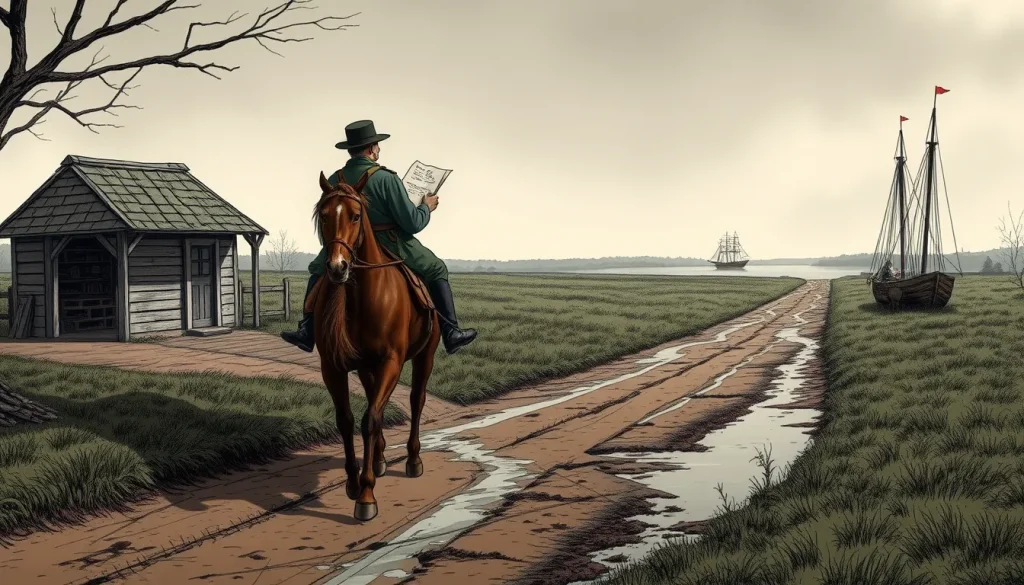
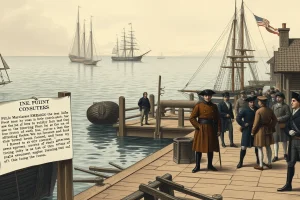
At the war’s outset, the U.S. government dispatched the declaration of war by military express. On 18 June 1812, Secretary of the Navy Paul Hamilton sent a letter to Commodore John Rodgers at New York, apprising him that war had been declared; the express carried the message quickly, but many frontier commanders learned of the conflict weeks later. The lack of adequate communication was a significant cause of early defeats in the West, including the surrender of Detroit and the River Raisin Massacre. To address the problem, the government developed special mail routes and military courier systems. A Government Express Mail service was established between Washington and key military posts, and the Post Office introduced new rates, including a war surcharge in 1815—the first tax on postal charges. The 1815 surcharge rates remained in effect for only thirteen months, replaced by restored 1799 rates in April 1816, which lasted just one month. Free mail privileges for soldiers were also revised. Meanwhile, newspapers played a vital role. For example, after the American capture of York (present-day Toronto) on 27 April 1813, a storm delayed naval dispatches, but reports reached Buffalo by 2 May, were printed in the Buffalo Gazette on 4 May, and were republished in the Boston Weekly Messenger by 14 May. The spread of news also relied on regular exchanges between journals; official reports appeared in Washington’s National Intelligencer and were copied elsewhere. In occupied Canada and Spanish Florida, military authorities arranged special mail handling. At Sandwich (modern Windsor) after its recapture in 1813, an adjutant general’s letter was sent by military express to Detroit and then entered the U.S. mail. The British also used cartel ships to exchange prisoners and carry correspondence under flags of truce. Ocean mails, however, remained vulnerable to the blockade and to privateers, though the latter primarily targeted merchant shipping. By the war’s end, the communication network had expanded, driven by military necessity.
Why It Matters
Immediate effects of slow communication were profound. Delays in transmitting orders hindered operations, such as the loss of Fort Michilimackinac before news of war reached its garrison. The Battle of New Orleans, fought on 8 January 1815, occurred after the Treaty of Ghent had been signed on 24 December 1814, but before word of peace reached the combatants. Diplomatically, the lag between events and news complicated negotiations. Longer-term, the war spurred improvements in the U.S. postal system: the first contract steamboat mail route and the first contract canal mail service were introduced during the conflict. Postal expansion, begun as a war necessity, resulted in vastly improved communication in the West. Historians interpret the war as a catalyst for recognizing that effective command and public morale depended on timely information. The challenges of wartime communication also highlighted the power of the press, which shaped regional perceptions of the conflict and contributed to a nascent national identity, albeit divided along partisan lines.
Definition
Communication during the War of 1812 refers to the systems and methods used to exchange information—including military orders, diplomatic dispatches, personal letters, and news reports—between individuals and institutions across the United States, British North America, and the Atlantic world. It encompassed official couriers, postal services, newspapers, naval signals, and informal channels such as flags of truce.
Background
Before the war, the United States had a functioning postal network that carried letters and newspapers, but its reach and speed were limited. Roads were poor, and mail often traveled at the same pace as stagecoaches, which took days to travel between major cities. The British North American colonies relied on similar systems, with the imperial postal service connecting settlements. Newspapers had become a powerful political force, with editors eagerly reprinting articles from distant journals. The embargo of 1807 and subsequent trade restrictions had disrupted shipping, forcing mail to rely more heavily on overland routes. The war’s outbreak added urgency to these limitations.
How It Worked
Official military communications were carried by dedicated couriers or “military expresses,” who rode horses or used fast ships. For instance, the Secretary of the Navy’s announcement of war to Commodore Rodgers was carried by express. On the frontier, military couriers often traveled by canoe and then transferred letters to regular post offices. The Post Office Department operated regular stagecoach and horseback routes, with rates determined by distance. During the war, the government also contracted steamboat service for mail on certain routes—the first such contract—and used canal boats on the Dismal Swamp Canal for waterway mails. Newspapers formed a distribution network of their own: editors exchanged papers, and stories were copied with or without attribution, allowing news to leapfrog over long distances. Naval communication relied on signal flags and dispatch vessels, though messages between ships and shore were often delayed. For prisoner correspondence and exchanges, flag-of-truce ships and cartel vessels carried letters under formal arrangements.
Competing Viewpoints
Contemporaries disagreed about the reliability and effectiveness of communication. American officials frequently blamed slow communications for military reverses, while British commanders similarly complained about the difficulty of coordinating operations across the Atlantic. Politically, Federalist newspapers in New England and elsewhere condemned the war and often distrusted government dispatches, while Republican papers heralded American victories and defended the administration. The British blockade forced reliance on neutral carriers, but even those were subject to capture. Some observers argued that the postal system’s expansion during the war proved its value, while others contended that the costs and inefficiencies outweighed benefits. Historians have noted that communication delays affected both sides, but the United States, with its vast frontier, faced particular challenges.
Role in the War of 1812
Communication directly influenced major events. The failure to transmit news of war declaration to the Northwest led to the capture of Fort Michilimackinac and the subsequent defeat of American forces at Detroit. The slow spread of news also affected public perception: the Battle of York’s victory was celebrated weeks after the fact, and casualty lists were often outdated. During the Treaty of Ghent negotiations, commissioners relied on dispatches that took weeks to cross the Atlantic; the final treaty was signed without news of the Battle of New Orleans, leading to the unnecessary battle. Military express routes and postal improvements enabled faster movement of orders, but their capacity was limited. The war demonstrated that information was as vital as troops and supplies.
Consequences and Historical Interpretation
The war’s communication challenges led to concrete reforms. The 1815 war surcharge on postal rates, though short-lived, marked the first federal postal tax and reflected the fiscal strains of war. After peace, the postal service reorganized, with rates restored and eventually rationalized. Contract steamboat service, first used during the war, became a staple of the system. Historians view the wartime experience as a pivotal moment in the development of American communication infrastructure, as it accelerated the use of steam power and improved roads. The conflict also cemented the role of newspapers as a national medium, even as partisan reporting intensified. The legacy includes not only technological improvements but also an understanding that in modern warfare, rapid communication is essential.
Primary Sources
Among the most useful contemporary sources are the collections of official correspondence published during and immediately after the war. John Russell’s The History of the War, between the United States and Great Britain (1815) compiles the diplomatic correspondence, declarations of war, and official reports of battles, drawn chiefly from public documents. Newspapers such as the Boston Weekly Messenger and the Buffalo Gazette provide contemporary accounts of the Battle of York and the dissemination of news. U.S. postal records, including contracts and rate schedules, are documented in exhibits such as that compiled by R. F. Frajola, which illustrates special mail routes and war surcharges. The Maryland State Archives’ compilation of newspaper reports offers insight into how different political factions reported the conflict. These sources each carry biases—official reports often favored commanders, while newspapers were deeply partisan—but together they illuminate the channels and challenges of wartime communication.
Further Reading
- Russell, John. The History of the War, between the United States and Great Britain, which Commenced in June, 1812, and Closed in February 1815. Hartford: B. & J. Russell, 1815.
- Frajola, R. F. “War of 1812 Special Mail Routes and Rates.” Exhibit, RFrajola.com. Accessed [year]. https://www.rfrajola.com/FrajolaWarof1812.pdf.
- Maryland State Archives. “Glorious News!: How Maryland Newspapers Reported the War of 1812.” Documents for the Classroom, MSA SC 5500/191. https://msa.maryland.gov/msa/speccol/sc5500/sc5572/000001/000000/000191/images/glorious_news_msa.pdf.
- Juliusson, David. “Spreading the News in 1813.” Friends of Fort York Foundation, July 17, 2007. https://www.fortyorkfoundation.ca/newsletter/spreading-the-news-in-1813/.
References
- Frajola, R. F. “War of 1812 Special Mail Routes and Rates.” Accessed 2025. https://www.rfrajola.com/FrajolaWarof1812.pdf.
- Maryland State Archives. “Glorious News!: How Maryland Newspapers Reported the War of 1812.” Accessed 2025. https://msa.maryland.gov/msa/speccol/sc5500/sc5572/000001/000000/000191/images/glorious_news_msa.pdf.
- Juliusson, David. “Spreading the News in 1813.” Friends of Fort York Foundation, July 17, 2007. https://www.fortyorkfoundation.ca/newsletter/spreading-the-news-in-1813/.
- Russell, John. The History of the War, between the United States and Great Britain, which Commenced in June, 1812, and Closed in February 1815. Hartford: B. & J. Russell, 1815.
FAQ
How did the declaration of war reach military commanders?
It was sent by military express and through the postal system, but frontier officers often learned of the war weeks later, leading to early defeats such as the fall of Fort Michilimackinac.
What role did newspapers play in wartime communication?
Newspapers were the primary means of disseminating news to the public. Editors reprinted reports from other papers, allowing stories to travel across states and colonies, though partisan biases colored the coverage.
How did slow communication affect the Treaty of Ghent?
The treaty was signed on December 24, 1814, but word did not reach the United States until after the Battle of New Orleans (January 8, 1815), so the fighting continued unnecessarily until the news arrived.

Leave a Reply