
Short Answer
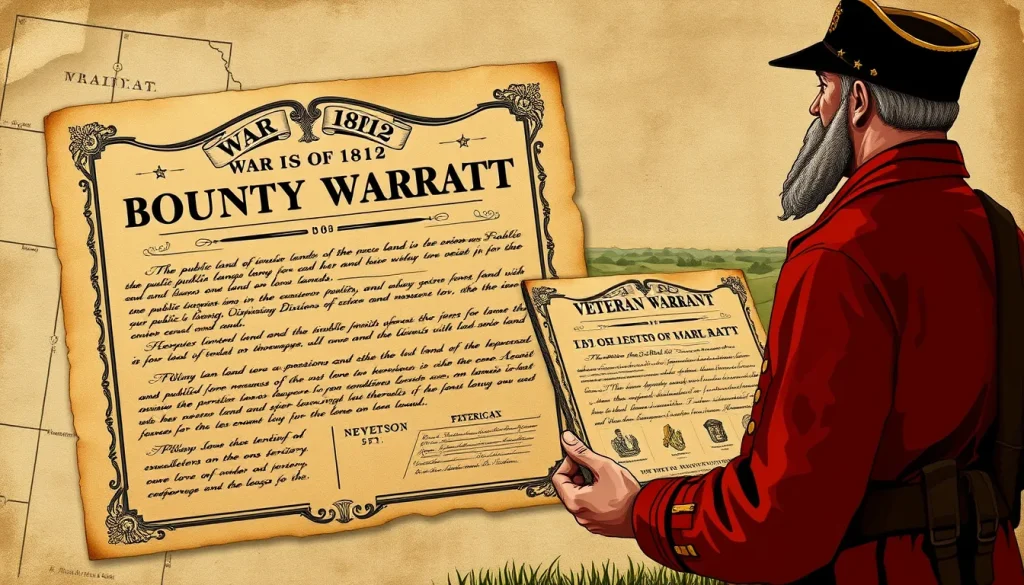
A War of 1812 bounty land warrant was a certificate issued by the United States government entitling an eligible veteran of the War of 1812 to a grant of free land from the public domain. Authorized by a series of congressional acts between 1811 and 1814, these warrants were intended both to encourage enlistment and to compensate soldiers who served for extended periods. The warrants represented a tangible link between military service and the nation’s vast western territories, but their actual use often differed from the government’s aims, with many being sold to speculators and the land itself often being taken from Indigenous peoples. This article explains what these warrants were, how they functioned, and their lasting consequences.
Historical Context
In the early Republic, the United States government had limited revenue and often lacked the cash resources to pay soldiers adequately. The precedent set after the Revolutionary War, when Congress authorized bounty land warrants to compensate Continental soldiers, established a pattern of using the vast public domain as a form of payment. By the time of the War of 1812, the nation’s public land system had grown, with millions of acres in the Northwest and Louisiana territories awaiting survey and sale. The war itself, fought against Great Britain, raised urgent needs for troops, especially for regulars who would serve for extended periods. Congress turned to the time-tested method of land bounties to encourage enlistment and reward service.
What Happened
Starting with an act of December 24, 1811, and followed by acts of January 11 and May 6, 1812, Congress authorized the issuance of military bounty land warrants to noncommissioned officers and soldiers who served for five years or until discharged. Each eligible veteran, or his heirs, was entitled to 160 acres of public land. To fulfill this promise, Congress set aside six million acres of public lands, with two million acres each in the Territories of Michigan, Illinois, and Louisiana (the latter now comprising present-day Arkansas). The act of May 6, 1812, provided for the survey of these lands. After the war, an act of December 10, 1814, doubled the acreage to 320 acres for those enlisting after that date, creating the so-called “Double Bounty Warrants.” The General Land Office (GLO) retained the actual warrant certificates; veterans received notifications that a warrant had been issued in their names. The warrant could then be used to locate a specific parcel of land, which would result in a patent conveying title. Restrictions initially prevented the assignment or transfer of warrants until a patent was granted, though this was eventually relaxed. Because early survey reports deemed Michigan lands unsuitable, an 1816 act substituted 500,000 acres in Missouri and added 1.5 million acres in Illinois, keeping the total at six million acres. Later legislation in 1842 allowed warrants to be used on any public land open to entry, and subsequent acts in 1850, 1852, and 1855 expanded eligibility to include more veterans and their heirs. The 1855 act, for example, granted 160 acres to any veteran (or widow or minor children) of any war since 1790 who had served at least 14 days or fought in a battle. More than 260,000 claims were filed under the 1855 act. Overall, between 1776 and 1855, the federal government issued over 500,000 bounty land warrants encompassing more than 61 million acres.
Why It Matters
The bounty land warrant program had profound effects. For the government, it was an effective means of raising troops without immediate cash expenditures. For veterans, it offered the potential for land ownership, but in practice many warrants were sold to speculators at reduced prices rather than used by the veterans themselves. The program contributed to the rapid settlement of public lands and the westward expansion of the United States, but it also led to the dispossession of Native American nations, whose lands were taken to fulfill these grants. The system became a precursor to the Homestead Act of 1862, which made public lands available to all citizens, but without the military service requirement. Historical interpretations emphasize both the democratic promise of land for service and the exploitative realities of speculation and Indigenous displacement.
Definition
A War of 1812 bounty land warrant was a legal document issued to an eligible veteran of the War of 1812, or his heirs, entitling him to a specified number of acres of public land. The warrant was not itself the land title; it was a certificate that could be exchanged for a patent (deed) to a specific parcel.
Background
The concept of military bounty lands originated during the American Revolution, when the Continental Congress promised land to soldiers. After the war, the federal government set aside vast tracts in Ohio and other public land states for this purpose. The War of 1812 posed a similar challenge: the country needed soldiers but had little money. Congress therefore revived the bounty system, passing authorizing acts between 1811 and 1814.
How It Worked
To receive a warrant, a veteran or his heirs had to apply to the War Department (later the Pension Office). If approved, the General Land Office (GLO) issued a warrant, but retained it in their records. The veteran received a notification confirming the issuance of a numbered warrant. The veteran then had to locate a parcel of land from those available in the designated military districts, or later, any public land open to entry. The warrant would be presented to a local land office, and upon verification, a patent would be issued, conveying title. Until 1852, warrants could not be assigned or transferred; after that, they could be sold.
Competing Viewpoints
Some historians view the bounty land warrant system as a beneficial reward for military service, providing a pathway to land ownership for deserving soldiers. Others point out that the program was frequently abused, with veterans often selling their warrants for a fraction of their value to speculators, who concentrated large holdings. Additionally, the program’s reliance on lands that belonged to Native American nations is seen as a form of theft. The government’s official intent to reward service is contrasted with the practical outcomes of speculation and displacement.
Role in the War of 1812
The bounty land warrant was a critical recruitment tool. The promise of 160 acres, later 320, helped the United States raise the regular army forces needed to fight the war. By tying the land grant to a five-year enlistment, Congress aimed to build a stable force. The warrants also served as a reward for those who served, and after the war, they became a tangible acknowledgement of the veterans’ sacrifice.
Consequences and Historical Interpretation
The bounty land warrant program contributed significantly to the settlement of the American West, moving millions of acres into private hands. It also established a precedent for government land giveaways, culminating in the Homestead Act. However, it also facilitated land speculation and the displacement of Indigenous peoples. Modern historians argue that the program’s promise of free land was often illusory for the veterans themselves, many of whom never claimed their land or sold their warrants for cash. The system also left behind vast records, now preserved in the National Archives, which are invaluable for genealogical and historical research.
Primary Sources
The most direct primary sources are the warrants themselves and the accompanying notifications, preserved in the National Archives and Records Administration (NARA) on microfilm publication M848, War of 1812 Military Bounty Land Warrants, 1815–1858. These records include the warrant number, veteran’s name, rank, regiment, and often the date and location of the land patent. Applications and supporting documents, such as affidavits, are found in NARA Record Group 15, which includes files for bounty-land applications based on service between 1812 and 1855. The acts of Congress authorizing the warrants (specifically those of December 24, 1811; January 11, 1812; May 6, 1812; and December 10, 1814) are also primary sources, available in the U.S. Statutes at Large. Researchers can access these records through NARA’s online catalogs and microfilm, though many are not fully digitized.
Further Reading
- U.S. National Archives and Records Administration, “Bounty-Land Warrants for Military Service, 1775–1855,” research guide (available online).
- Seiken, Jeffrey. “Object 2: Bounty Land Warrant,” U.S. Department of Veterans Affairs History (website).
- Kent, Carolyn Yancey. “Military Land Grants,” Encyclopedia of Arkansas (entry).
- Smith, David A. “Preparing the Arkansas Wilderness for Settlement: Public Land Survey Administration, 1803–1836.” Arkansas Historical Quarterly 71 (Winter 2012): 381–406.
- Wilm, Julius. Settlers as Conquerors: Free Land Policy in Antebellum America. Stuttgart: Franz Steiner Verlag, 2018.
References
- National Archives and Records Administration. “War of 1812 Military Bounty Land Warrants 1815–1858.” Microfilm publication M848. https://www.archives.gov/files/research/military/army/dc/m848.pdf
- Seiken, Jeffrey. “Object 2: Bounty Land Warrant.” U.S. Department of Veterans Affairs History. https://department.va.gov/history/object-2-bounty-land-warrant/
- Kent, Carolyn Yancey. “Military Land Grants.” Encyclopedia of Arkansas. https://encyclopediaofarkansas.net/entries/military-land-grants-6978/
- National Archives and Records Administration. “Bounty-Land Warrants for Military Service, 1775–1855.” https://www.archives.gov/research/military/bounty-land-1775-1855.pdf
- Council of State and Local Historical Societies. “Military Bounty Lands (1812).” https://cosl.org/History/MilitaryBountyLands
FAQ
Who was eligible for a War of 1812 bounty land warrant?
Noncommissioned officers and soldiers who served for five years or until discharged, or their heirs, were entitled to warrants. Later acts expanded eligibility to other veterans and widows.
Could veterans sell their bounty land warrants?
Initially no. Until 1852, warrants were non-assignable and could not be transferred except by inheritance. After the 1852 act, veterans could sell them, and many did so to land speculators.
What is the difference between a warrant and a patent?
A warrant was the certificate entitling the holder to a certain amount of land. A patent was the final deed of title, issued after the warrant was used to locate a specific parcel.



Leave a Reply