
Short Answer
Tecumseh’s Confederacy, a pan-Indigenous alliance formed to resist American expansion, met its end after its leader was killed at the Battle of the Thames on October 5, 1813. This event marked the collapse of the most organized Indigenous resistance in the Northwest Territory and profoundly altered the balance of power in the region during the War of 1812. The confederacy’s demise opened the door for American settlement and the forced removal of Indigenous nations in the following decades.
Historical Context
Tecumseh, a Shawnee chief, and his brother Tenskwatawa (the Prophet) built the confederacy around a spiritual revival that began in 1805. They united diverse Indigenous nations, including Shawnee, Potawatomi, Ojibwe, and others, in a common cause to halt U.S. land acquisitions. In 1808 they established Prophetstown near present-day Lafayette, Indiana. After the Battle of Tippecanoe in 1811, where Governor William Henry Harrison destroyed Prophetstown, the confederacy shifted its focus to military resistance. When the War of 1812 erupted, Tecumseh allied with the British, hoping that a British victory would preserve Indigenous lands. He played a pivotal role in the capture of Detroit in August 1812.
What Happened
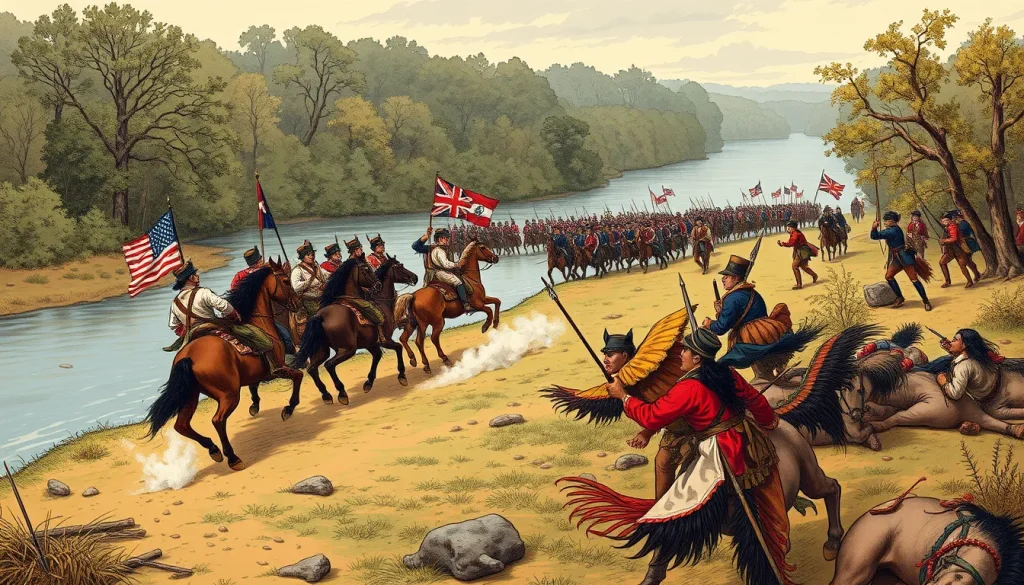
Following the U.S. naval victory on Lake Erie in September 1813, British General Henry Proctor abandoned Detroit and retreated toward Upper Canada against Tecumseh’s objections. On October 5, 1813, American forces under General William Henry Harrison caught the British and their Indigenous allies near the Thames River. In the ensuing Battle of the Thames, Tecumseh was killed, and his warriors immediately lost cohesion. The American cavalry charged and routed the British regulars, while the Indigenous fighters, upon learning of Tecumseh’s death, dispersed into the surrounding forests. The confederacy effectively dissolved within hours. Tenskwatawa, the Prophet, survived but never regained his former influence. Over the following months, various Indigenous leaders negotiated separate peace agreements. The Treaty of Greenville (1814) and the Treaty of Spring Wells (1815) ceded large portions of the Northwest Territory to the United States, formalizing the loss of Indigenous land.
Why It Matters
The collapse of Tecumseh’s Confederacy removed the last major obstacle to American expansion into the Northwest. It allowed the United States to consolidate control over present-day Ohio, Indiana, and Michigan, paving the way for settlement and the eventual removal of Indigenous peoples in the 1830s. The confederacy’s fall also weakened British influence, as Britain largely abandoned its former allies. For Indigenous communities, Tecumseh’s death symbolized the end of a unified resistance. His legacy as a warrior and orator endured, becoming a focal point of Indigenous pride and a symbol of resistance against colonial encroachment.
Definition
Tecumseh’s Confederacy was a loose alliance of Indigenous nations in the Great Lakes and Ohio Valley, united under the leadership of Tecumseh and his brother Tenskwatawa. Its purpose was to stop American westward expansion and maintain Indigenous ownership of lands in common.
Background
The confederacy grew from the religious teachings of Tenskwatawa, who in 1805 preached a return to traditional ways and rejection of European influences. Tecumseh transformed these teachings into a political and military movement. By 1810, he had recruited many tribes, establishing a network that spanned from the Great Lakes to the Gulf of Mexico.
How It Worked
Tecumseh traveled extensively, delivering speeches that emphasized that Indigenous lands were collectively owned and could not be sold by individual nations. He maintained a decentralized structure, with local chiefs leading their own bands but deferring to Tecumseh for military strategy. During the War of 1812, the confederacy cooperated with British forces, providing warriors for combined operations such as the capture of Detroit.
Competing Viewpoints
Historians debate the degree of unity within the confederacy. Some argue it represented a cohesive political entity, while others view it as a fragile coalition bound by Tecumseh’s personal prestige. The impact of Tecumseh’s death is also disputed: some contend that the confederacy would have disintegrated regardless due to American military superiority, while others believe his continued leadership might have sustained resistance longer. Many scholars emphasize that the confederacy’s survival depended heavily on Tecumseh’s diplomatic abilities.
Role in the War of 1812
The confederacy played a crucial role in the western theater, tying down American forces and supporting British operations. Tecumseh’s warriors participated in the Siege of Detroit, the defense of the Detroit frontier, and raids into Ohio and Indiana. Their presence bolstered British territorial claims and forced American commanders to divert troops from other fronts.
Consequences and Historical Interpretation
After Tecumseh’s death, the confederacy’s military power vanished. The U.S. government negotiated treaties with individual Indigenous nations, extracting massive land cessions. By the early 1830s, the forced removal of most Indigenous peoples from the region had begun. Historians interpret Tecumseh’s confederacy as a significant, albeit unsuccessful, attempt at pan-Indigenous unity. It is remembered as a powerful symbol of resistance, although some modern scholars caution against romanticizing its achievements, noting the diverse interests and internal dynamics that limited its effectiveness.
Primary Sources
Key primary sources for understanding the aftermath include General William Henry Harrison’s official dispatch to the U.S. Secretary of War, describing the Battle of the Thames and Tecumseh’s death. British correspondence from Major General Henry Proctor and officials in Upper Canada records the loss of Indigenous support and the retreat. Treaty documents such as the Treaty of Greenville (1814) and the Treaty of Spring Wells (1815) are essential for tracing U.S. land acquisitions. These sources, while valuable, often reflect the perspectives of military leaders and governments, so they must be analyzed alongside Indigenous oral traditions and later testimonies.
Further Reading
- Tecumseh: A Life by John Sugden (1999)
- Tecumseh and the Prophet: The Shawnee Brothers Who Defied a Nation by Peter Cozzens (2020)
- The Shawnee by Charles Callender (in the Handbook of North American Indians)
- Battle of the Thames – American Battlefield Trust (web resource)
- Dictionary of Canadian Biography – Tecumseh entry (web resource)
References
- “Tecumseh – Dictionary of Canadian Biography.” Accessed [date]. https://www.biographi.ca/en/bio/tecumseh_5F.html.
- “Tecumseh – The Canadian Encyclopedia.” Accessed [date]. https://thecanadianencyclopedia.ca/en/article/tecumseh.
- “Battle of the Thames.” American Battlefield Trust. Accessed [date]. https://www.battlefields.org/learn/war-1812/battles/battle-thames.
- “Tecumseh.” HISTORY.com. Accessed [date]. https://www.history.com/articles/tecumseh.
- “Tecumseh.” Wikipedia. Accessed [date]. https://en.wikipedia.org/wiki/Tecumseh.
FAQ
Why did Tecumseh's Confederacy collapse after his death?
The confederacy was heavily reliant on Tecumseh's leadership, charisma, and diplomatic skills. His death at the Battle of the Thames caused the various Indigenous nations to disperse, and without a central figure to unite them, the alliance dissolved. Subsequent treaties and pressure from the U.S. government further fragmented Indigenous resistance.
What happened to Tenskwatawa after Tecumseh's death?
Tenskwatawa survived the Battle of the Thames and later lived among various Indigenous communities. He attempted to revive his religious movement but never regained his former influence. He died in 1836 in Kansas, where the Shawnee had been relocated.
How did the collapse of the confederacy affect Indigenous peoples in the region?
The collapse led to the loss of land and political power. Individual nations were forced to make separate treaties with the United States, ceding massive territories. Within decades, most Indigenous peoples were removed to lands west of the Mississippi, a process culminating in the Indian Removal Act of 1830.


Leave a Reply