
Short Answer
The War of 1812 (1812–1815) was fought between the United States and the British Empire, including British North America. Most American soldiers were not regular army but militiamen or volunteers serving in state-based units, while British and Canadian forces also relied on local militia and Indigenous allies. Researching these service records is essential for genealogists and historians because they document a vast mobilization that touched hundreds of thousands of people. This article provides a structured approach to locating and interpreting War of 1812 militia service records.
Historical Context
The United States declared war on Great Britain in June 1812 amid disputes over impressment, trade restrictions, and British support for Indigenous nations on the frontier. The U.S. regular army was small—only about 12,000 men—so the government relied heavily on state militias and short-term volunteer units. More than 450,000 Americans served in such units during the conflict, typically for a few months to a year. On the British side, the regular army and Canadian militia, along with Indigenous allies, defended British North America. Each political entity generated its own records, which now reside in national, state, and local archives. Understanding the distinctions between regular troops, volunteers, and militia is crucial for choosing the right record set.
What Happened
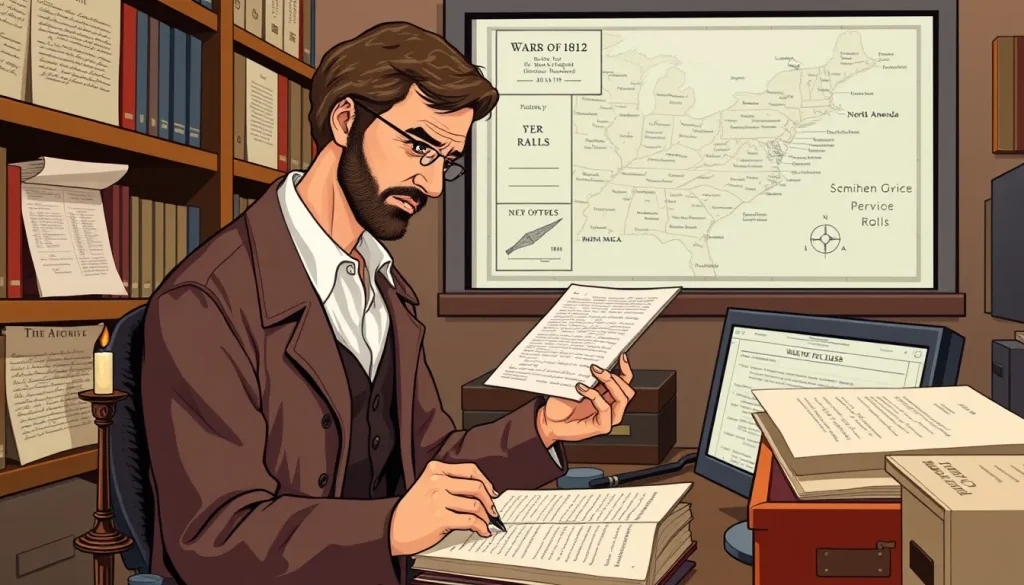
Researching War of 1812 militia service involves a logical sequence: first identify the soldier’s name and possible residence, then determine whether he served in a state militia, a federal volunteer unit, or the regular army. For American service, the primary federal records are compiled military service records (CMSRs) and pension files. For British/Canadian service, records are held at Library and Archives Canada and The National Archives (UK). The process includes searching online indexes, requesting microfilm or digitized copies, and consulting state archives for militia rolls not federalized. The steps below outline the most effective methods.
Why It Matters
These records are of immense value for genealogical research, providing personal details such as age, residence, physical description, and family information. They also support historical studies of wartime mobilization, social composition of forces, and the experiences of ordinary soldiers. For Indigenous peoples and African Americans who served, these records can be among the few documentary traces, though biases and gaps remain. Later historians have used service and pension records to analyze recruitment patterns, morale, and the war’s impact on communities.
Definition
In the context of the War of 1812, “militia service” refers to military duty performed by citizens in state or provincial militia forces, as opposed to regular army enlistment. Militias were local defense forces composed of able-bodied men, often required by law to serve for short periods. “Volunteer” units were often state militia regiments that volunteered for federal service, sometimes for specific campaigns. Records of militia service include muster rolls, pay rolls, descriptive rolls, and compiled service records created later by the War Department.
Background
The American militia system derived from colonial precedents and was codified by the Militia Act of 1792, which required every able-bodied white male citizen aged 18 to 45 to enroll. In practice, states organized and equipped militia units, and the federal government could call them into national service during emergencies. During the War of 1812, many militiamen served under state authority guarding coasts and borders, while others were federalized as volunteers for longer terms. In British North America, the colonial militias were also important, especially in Upper Canada (now Ontario) and the Maritimes, where regular British troops were supplemented by local forces.
How It Worked
To research an American militia member, start with the 1810 or 1820 census to establish residency, then search free online indexes such as NARA’s compiled service record index (M602) on FamilySearch or Fold3. If you find a match, order the CMSR from the National Archives using NATF Form 85. Parallel searches should cover pension files (indexed in M313) and bounty land warrant applications, which often contain rich genealogical details. For state militias that never entered federal service, consult the appropriate state archives; many have online catalogs. For Canadian soldiers, use Library and Archives Canada’s digitized collections, including nominal rolls and paylists (RG 9, 1B7), and the War of 1812 database on the LAC website. British regulars and militia are covered in UK National Archives records, such as muster books and pay lists (WO 10–WO 17).
Competing Viewpoints
Historians differ on the reliability and completeness of these records. Compiled military service records were assembled from original muster rolls in the 1890s, and errors or omissions are possible; they are not original but index-like summaries. Pension files, while detailed, only exist for veterans or widows who successfully applied under various acts, so many soldiers have no pension record. Some scholars argue that federal sources overrepresent volunteers who served long enough to be recorded, while short-term militiamen may appear only in state rolls. Additionally, Indigenous allies and African American soldiers, often marginalized, may be recorded with incomplete names or no unit designations, requiring careful interpretation.
Role in the War of 1812
Militia and volunteer forces played a decisive role in many campaigns. American militiamen fought at battles such as Queenston Heights (1812), Lundy’s Lane (1814), and the defense of Baltimore (1814), though they also experienced notable failures, such as the surrender of Detroit. Canadian militia, supported by British regulars and Indigenous warriors, successfully defended key posts and contributed to major victories. The war also saw large-scale mobilization by Indigenous nations, who fought as allies on both sides but were often not formally enrolled in militia records, posing unique research challenges.
Consequences and Historical Interpretation
The wartime service of militia and volunteers left a lasting legacy in both the United States and Canada. In the United States, the war’s outcome boosted national confidence and produced veterans who later received pensions and bounty lands, creating a substantial documentary trail. In British North America, the militia’s role helped shape emerging Canadian identity and led to the creation of commemorative records. Historians have used these records to study the social profile of the forces, the home front, and the war’s regional impacts. The records also illustrate the limits of federal power over state militias, a controversy that continued into later American history.
Primary Sources
The most important primary source for American volunteer service is the Index to Compiled Service Records of Volunteer Soldiers Who Served During the War of 1812 (NARA M602), which is available on FamilySearch and Fold3. The actual CMSRs are at NARA and can be ordered. Pension files, indexed in M313, are now largely online via Fold3 and FamilySearch. For bounty land, the Bureau of Land Management’s General Land Office Records site provides free patent images, while NARA holds case files. For Canadian service, War of 1812: Upper Canada Returns, Nominal Rolls and Paylists (RG 9 1B7) has been digitized and is available through Library and Archives Canada’s website. British service is documented in War Office records such as muster books and pay lists (WO 10–17) at The National Archives (UK). Each source has limitations: CMSRs are summaries, pension files reflect eligibility rules, and state rolls are often fragmentary.
Further Reading
- Claire Kluskens, “War of 1812 Military Service, Bounty Land, and Pension Records: A Step-by-Step Guide to Basic Federal Sources,” National Archives and Records Administration.
- George K. Schweitzer, War of 1812 Genealogy (1983).
- Eric Eugene Johnson, The Ultimate Guide in Researching War of 1812 Veterans (Heritage Books, 2024).
- Library and Archives Canada, “War of 1812” research guide and online databases.
- The War of 1812 Website (warof1812.ca) for regimental history and unit details.
References
- National Archives and Records Administration, “Volunteer Military Service during the War of 1812 (1812–1815),” reference report RR# 910, https://www.archives.gov/files/dc-metro/know-your-records/genealogy-fair/2012/handouts/war-of-1812-volunteer.pdf.
- Claire Kluskens, “War of 1812 Military Service, Bounty Land, and Pension Records: A Step-by-Step Guide to Basic Federal Sources,” https://twelvekey.com/wp-content/uploads/2020/05/war_of_1812_basic_guide_2020_05_19.pdf.
- FamilySearch Wiki, “Beginning War of 1812 Research,” https://www.familysearch.org/en/wiki/Beginning_War_of_1812_Research.
- New York Public Library, “War of 1812 – Military Records for Genealogy Research,” https://libguides.nypl.org/military-genealogy/1812.
- David Allen Lambert, “Star-Spangled Genealogy: War of 1812 Research Guide,” Family Tree Magazine, https://familytreemagazine.com/records/military/war-of-1812-genealogy/.
FAQ
Where can I find War of 1812 militia service records online?
For U.S. volunteer soldiers, search the M602 index on FamilySearch or Fold3. For actual records, order from NARA using NATF Form 85. Pension files are largely available on Fold3. For Canadian service, use Library and Archives Canada's database of nominal rolls and paylists.
What is the difference between a regular army soldier and a militia volunteer in terms of records?
Regular army soldiers were in the U.S. Army permanently and have records in NARA's regular army series. Militia volunteers were often state militia units that served in federal service, and their compiled records are in M602. State-only militiamen who never entered federal service have records only in state archives.
How do I research a British or Canadian militiaman from the War of 1812?
For British forces, search the UK National Archives for muster books and pay lists (WO 10–17). For Canadian militia, Library and Archives Canada holds nominal rolls and paylists in RG 9 1B7, digitized on the LAC website. Also check the War of 1812 database at LAC.


Leave a Reply