Short Answer
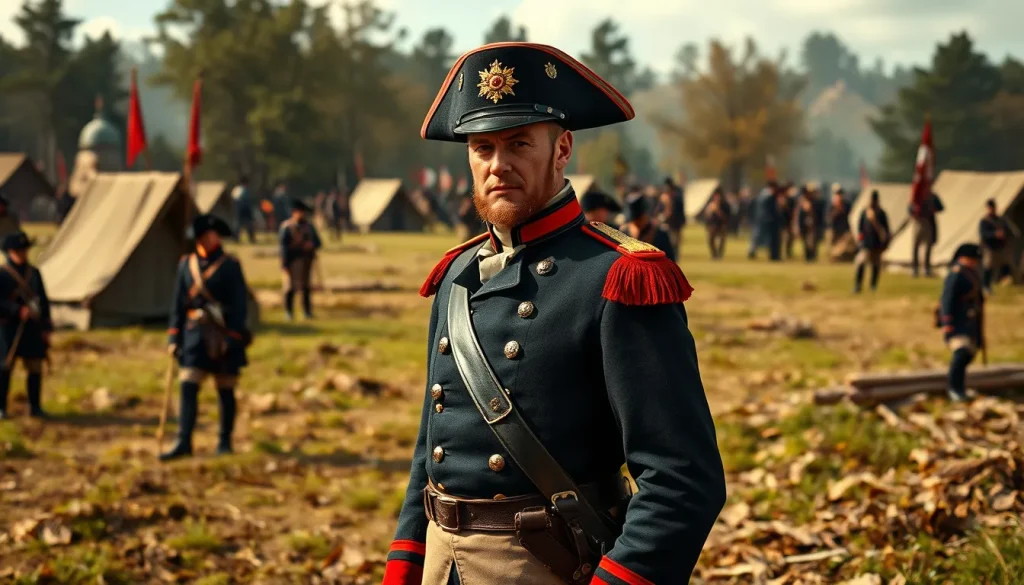
Charles-Michel d’Irumberry de Salaberry (1778–1829) was a French-Canadian officer in the British Army who rose to prominence during the War of 1812 as the commander of the Canadian Voltigeurs, a provincial light infantry corps. He is best remembered for leading the defence against an American invasion at the Battle of the Châteauguay on 26 October 1813, a victory that helped protect Montreal and secured his place as a Canadian military hero. His career illustrates the crucial role played by French Canadian soldiers in the British defence of Canada during a conflict that tested the loyalties and military capacity of the colony.
Historical Context
The War of 1812 arose from a combination of long-standing Anglo-American tensions, including British restrictions on neutral trade, impressment of American sailors, and British support for Indigenous nations resisting American expansion. When the United States declared war on Great Britain in June 1812, the British North American colonies, particularly Upper and Lower Canada, became potential battlegrounds. The colonial population included a large French Canadian majority in Lower Canada, many of whom were descendants of the former French empire and had been under British rule since 1763. The British Crown relied on a combination of regular British and Canadian troops, colonial militia, and Indigenous allies to defend the provinces. The threat of an American invasion created a pressing need for locally raised units that could supplement the regular army, and the Canadian Voltigeurs—raised in 1812—became one of the most effective such units. Salaberry’s leadership of this corps, and his successful defence of the Châteauguay River, demonstrated the strategic importance of Lower Canada in the war and the willingness of French Canadians to fight for the British Crown.
What Happened
Salaberry’s wartime career was defined by a series of defensive actions along the border between Lower Canada and the United States. In November 1812, he commanded a force that helped repel an American attack at Lacolle Mills. In September 1813, he defended the village of Odelltown. The most significant engagement came in late October 1813, when Major General Wade Hampton led an American division of about 3,700 men toward Montreal via the Châteauguay River. Salaberry, with roughly 1,800 troops consisting of regulars, Voltigeurs, militia, and Indigenous warriors, established a fortified position near the river. On 26 October, the Americans launched a flanking movement but were stopped by Salaberry’s defensive lines and the difficult terrain. Hampton withdrew back to the United States, marking the end of the American offensive from that direction. Combined with the British victory at Crysler’s Farm a few days later, the Battle of the Châteauguay effectively thwarted the American attack on Montreal and solidified Salaberry’s military reputation. He saw no further major action and retired from active command in early 1814.
Why It Matters
The Battle of the Châteauguay was a critical moment in the War of 1812 because it prevented the capture of Montreal, a major supply centre and gateway to the Great Lakes. Salaberry’s victory also had important political and social implications. It demonstrated that French Canadian soldiers could fight effectively for the British Crown, and it helped foster a sense of distinct Canadian identity within the broader imperial framework. For Salaberry himself, the battle brought recognition: he received an Army Gold Medal, was appointed a Companion of the Order of the Bath in 1817, and was named to the Legislative Council of Lower Canada. Historians have debated the tactical quality of the battle, with some noting that Hampton’s cautious leadership and the difficult terrain contributed as much as Salaberry’s dispositions. Nevertheless, the victory remains a cornerstone of Canadian military history, and Salaberry is celebrated as a national hero in Quebec and across Canada. His career also highlights the complexities of colonial Canada, where loyalty to the British Crown coexisted with a distinct French Canadian identity.
Early Life
Charles-Michel d’Irumberry de Salaberry was born on 19 November 1778 at Beauport, Quebec, into a family with a long tradition of military service. His father, Ignace-Michel d’Irumberry de Salaberry, had served as an officer in the British Army after the British conquest of New France and later became a member of the Legislative Assembly of Lower Canada. Charles was educated in the classics and demonstrated an early interest in the military. At the age of 14, he enlisted as a volunteer in the 44th Foot, and through the patronage of Prince Edward, Duke of Kent, a family friend, he obtained an ensign’s commission in the 60th Foot in 1794.
Role Before the War
Salaberry gained extensive military experience in the Caribbean and Europe before returning to Canada. He served in the invasions of Saint-Domingue, Guadeloupe, and Martinique during the 1790s, and later saw service in Britain and Ireland. He was promoted to captain in 1803 and transferred to the 5th Battalion of the 60th Foot in 1806, under the command of Colonel Francis de Rottenburg, a pioneer in light infantry tactics. Salaberry served as brigade-major during the disastrous 1809 Walcheren expedition in the Netherlands, where he contracted fever. In June 1810, he returned to Lower Canada as aide-de-camp to Major-General Rottenburg, who had been posted there. By July 1811, Salaberry had been promoted to brevet major.
Role During the War
With war threatening in early 1812, Salaberry proposed raising a provincial light infantry corps to defend Lower Canada. Recruiting began on 15 April 1812, and the unit was officially designated the Provincial Corps of Light Infantry, better known as the Canadian Voltigeurs. Salaberry was initially appointed lieutenant-colonel in the militia, but he resented the lack of a regular army rank; after several delays, he received the rank of lieutenant-colonel in the army in March 1813. The Voltigeurs became the most celebrated provincial unit of the war, and Salaberry led them in a series of border actions. In the autumn of 1812, he took command of the border defences along the Richelieu River, repelling an American advance at Lacolle Mills in November. In 1813, he defended Odelltown and then prepared the defensive position on the Châteauguay River, where he achieved his greatest success.
Major Actions
Salaberry’s most significant military achievement was the Battle of the Châteauguay on 26 October 1813. American forces under Major General Wade Hampton, numbering about 3,700 men, advanced from Plattsburgh, New York, intending to reach Montreal. Salaberry, with approximately 1,800 men—including Voltigeurs, regulars, militia, and Mohawk warriors—selected a strong position near the junction of the Châteauguay and English rivers. He deployed his troops in four lines on the west bank, with skirmishers and a small detachment on the east bank. When Hampton’s forces attacked, they were halted by the well-protected defensive position and the musketry of the Voltigeurs. The American attempt to outflank the position was repulsed, and Hampton withdrew, fearing a larger British force than actually present. In addition to this battle, Salaberry also conducted a raid on the American camp at Four Corners in October 1813, though it was abortive. His earlier actions at Lacolle and Odelltown helped secure the lower Richelieu region.
Contemporary Accounts
Contemporary accounts of Salaberry’s leadership come from British officers and colonial officials. His patron, the Duke of Kent, wrote to him after the battle, praising the Canadian militia and Voltigeurs. Lieutenant General Sir George Prevost, governor-in-chief and commander of British forces in North America, issued a dispatch that credited Salaberry with the victory, though Salaberry was angered that Prevost did not give him full recognition for the action. Some later accounts emerged from participants, including a narrative by a British officer involved in the battle. Salaberry’s own correspondence, particularly with the Duke of Kent, provides insights into his career and frustrations, but no extensive memoir survives.
Later Life
Salaberry resigned his command of the Voltigeurs in early 1814, partly as a result of the perceived lack of recognition and his frustration over rank, though the Duke of Kent intervened to keep him in the army. He remained on the army list until 1815, when he was placed on half-pay. He settled near Chambly, Quebec, where he became a wealthy landowner, businessman, and justice of the peace. He married Marie-Anne-Julie Hertel de Rouville in 1812, with whom he had seven children. He entered politics and was appointed to the Legislative Council of Lower Canada in 1817. He also served as a seigneur, succeeding his father as Seigneur of St. Mathias in 1828 after his father’s death. His military service had undermined his health, and he died at Chambly on 27 February 1829, aged 50.
Historical Legacy
Charles de Salaberry is remembered as a national hero in Canada, particularly in Quebec, where his victory at Châteauguay is seen as a defining moment in French Canadian military history. He was designated a National Historic Person by the Historic Sites and Monuments Board of Canada in 1934. Several monuments commemorate him, including statues at the Parliament Building in Quebec City, the Valiants Memorial in Ottawa, and at his burial site in Chambly. Historians have generally praised his tactical skill and his ability to motivate a mixed force of regulars, militia, and Indigenous warriors. Some have also emphasized that the American decision to withdraw was influenced by Hampton’s caution and the difficult terrain, thereby tempering the notion of a purely tactical masterpiece. Nevertheless, Salaberry’s legacy as a symbol of Canadian defence and French Canadian contribution to the War of 1812 remains secure.
Primary Sources
Relevant primary sources for understanding Salaberry’s career include his surviving correspondence, particularly letters exchanged with the Duke of Kent, which shed light on his military advancement and personal concerns. The official dispatches of Lieutenant General Sir George Prevost, which reported the Battle of the Châteauguay, provide contemporary accounts of the engagement, although they have been criticized for being brief on Salaberry’s specifics. The records of the Canadian Voltigeurs, including muster rolls and orders, are held in the collections of Library and Archives Canada. The Dictionary of Canadian Biography contains a detailed entry that synthesizes known documentary evidence. Researchers may also consult the correspondence of other British officers, such as Francis de Rottenburg, that reference Salaberry.
Further Reading
- Grodzinski, John R. "Charles-Michel d’Irumberry de Salaberry." In The Canadian Encyclopedia.
- Hitsman, J. Mackay. The Incredible War of 1812: A Military History. Toronto: University of Toronto Press, 1965.
- Hickey, Donald R. The War of 1812: A Forgotten Conflict. Urbana: University of Illinois Press, 1989.
- Dictionary of Canadian Biography, s.v. "IRUMBERRY DE SALABERRY, CHARLES-MICHEL D'" by an unnamed author.
- Parks Canada. "De Salaberry, Lieutenant-Colonel Charles-Michel d’Irumberry National Historic Person." Plaque text, 1934.
References
- Grodzinski, John R. "Charles-Michel d’Irumberry de Salaberry." The Canadian Encyclopedia. Accessed via thecanadianencyclopedia.ca.
- U.S. National Park Service. "Charles de Salaberry." Last updated April 21, 2015. Accessed via nps.gov.
- Parks Canada. "De Salaberry, Lieutenant-Colonel Charles-Michel d’Irumberry National Historic Person." Accessed via pc.gc.ca.
- "IRUMBERRY DE SALABERRY, CHARLES-MICHEL D'." Dictionary of Canadian Biography. Accessed via biographi.ca.
- American Battlefield Trust. "Charles de Salaberry." Accessed via battlefields.org.
FAQ
What is Charles de Salaberry best known for?
He is best known for commanding the Canadian Voltigeurs and winning the Battle of the Châteauguay in 1813, which helped protect Montreal from American invasion.
Why was the Battle of the Châteauguay important?
It prevented the American army under Wade Hampton from reaching Montreal, and combined with the Battle of Crysler's Farm, it ended the American offensive against the city.
Did Salaberry serve in the British Army or the Canadian militia?
He served in the British Army as a regular officer but also held a rank in the Canadian militia. He was a lieutenant-colonel in the army and raised the Canadian Voltigeurs as a provincial corps.


Leave a Reply