
Short Answer
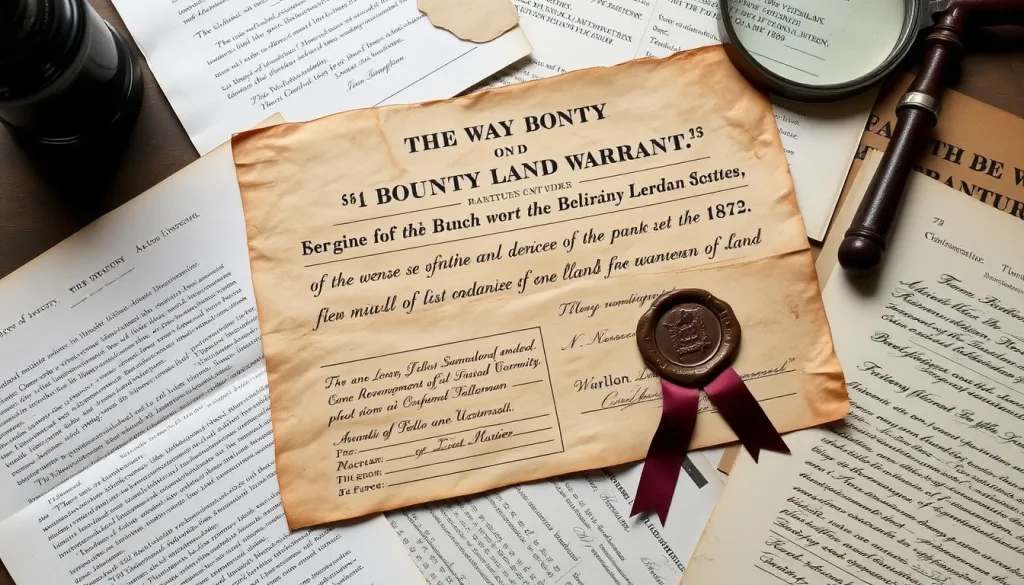
The War of 1812 Bounty Land Records are a set of federal documents created to track land grants offered to veterans of the War of 1812 as an incentive for military service. These records, generated under a series of acts between 1811 and 1855, comprise warrants, applications, and related correspondence that document the service of thousands of American soldiers and their families. They hold significance both as a historical record of the war’s participants and as a rich resource for genealogists and historians studying early American land policy.
Historical Context
The United States began offering bounty land to soldiers during the Revolutionary War as a way to encourage enlistments and reward service. After the Revolution, the practice continued for various conflicts, including the War of 1812. At that time, the federal government controlled vast public lands in the Northwest Territory and other frontier areas. Offering land as payment was attractive because it cost the government little beyond the surveying expenses, while providing a tangible benefit to veterans who often lacked financial resources.
When the War of 1812 broke out, the United States faced the challenge of recruiting sufficient troops, especially for the regular army and volunteer units. Congress used bounty land as a recruitment tool, passing legislation that promised substantial acreage to those who served. The land was located in the territories of Michigan, Illinois, and Louisiana (present-day Arkansas), reflecting the government’s interest in encouraging settlement and strengthening its hold over these frontier regions.
What Happened
The first War of 1812 bounty land acts were passed in late 1811 and early 1812. The act of December 24, 1811, and the acts of January 11 and May 6, 1812, provided that noncommissioned officers and soldiers who served for five years (unless discharged sooner), or their heirs, would be entitled to 160 acres of public land. A total of 6 million acres were set aside—2 million in each of the Territories of Michigan, Illinois, and Louisiana (present-day Arkansas). The act of December 10, 1814, doubled the acreage to 320 acres for soldiers enlisting after that date, and these warrants were known as “Double Bounty Warrants.”
The Secretary of War issued the warrants, but unlike later bounty land warrants, these were not transferable to other parties and were not even delivered directly to the veteran. Instead, they were retained by the General Land Office (GLO), and the veteran received a notification document attesting that a warrant had been issued in his name. Because of unfavorable surveyor reports about land in Michigan, an 1816 act provided additional land in Illinois and Missouri to replace the Michigan allotments. It was not until 1842 that veterans were allowed to use their warrants for any public land in the public domain, and transferability was only permitted in 1852.
Bounty land warrants were redeemed at local GLO offices, where veterans could locate their chosen plot. The GLO then issued patents, the actual deeds of title. The record-keeping process involved multiple copies: the warrants themselves, the notifications, the abstracts of locations, and the final patents. Over time, these records were divided between the records of the Veterans Administration and the General Land Office, which are now part of the National Archives.
Why It Matters
The bounty land records are significant for several reasons. First, they provide a detailed roster of War of 1812 veterans, including their names, ranks, regiments, and service dates. This information is invaluable for genealogists tracing family histories and for historians studying the composition of American forces. Second, the records illustrate the federal government’s early land distribution policies and its efforts to promote westward expansion. The promise of free land shaped recruitment and encouraged settlement in frontier territories, with long-term implications for the development of the American Midwest.
For historians, these records also reveal the social and economic circumstances of veterans—many sold or used their warrants, and the paperwork traces these transactions. Additionally, the records reflect the government’s evolving administrative capacity, from military departments to land offices. Although the bounty land system was discontinued in 1855, the surviving records continue to serve as primary evidence for the lived experience of soldiers and their families after the war.
Definition
War of 1812 bounty land records encompass all federal documents related to the allocation of public land to veterans of the War of 1812. This includes the warrants themselves (certificates granting land rights), the applications veterans submitted to obtain them, the notifications confirming issuance, and the surrendered warrants or patents that transferred title. The records may also contain supporting documents like affidavits, marriage or birth certificates, and witness statements, especially when the veteran or his widow applied under later pension acts.
Background
Bounty land was a long-standing tradition in American military recruitment. The Revolutionary War acts of 1788, 1803, and 1806 set precedents, and the practice was reauthorized for the War of 1812. Unlike pensions, which provided ongoing payments, bounty land was a one-time grant. At the time, the federal government preferred land grants because they cost nothing in cash and served the dual purpose of populating newly acquired territories. The War of 1812 saw the first widespread use of bounty land for a major conflict, setting patterns that would continue through the Mexican War and later Indian wars.
How It Worked
The process began with a veteran’s application, usually submitted to the War Department’s Pension Office (after its creation in 1849, to the Department of the Interior). The applicant had to provide proof of service, including his regiment and dates, which the War Department compared with official muster rolls. Once approved, the veteran received a warrant certificate, but under the early acts these warrants were retained by the GLO. The veteran went to a local land office, selected a parcel within the designated reservations, and the GLO recorded the location. This information was entered in the Abstracts of Military Bounty Land Warrant Locations, and a patent was eventually issued to confirm ownership.
Records were kept by several agencies: the War Department processed applications, the GLO managed the land, and the Treasury Department oversaw the land offices. Because warrants were non-transferable until 1852, the records are relatively straightforward, but after 1852, veterans or their heirs could assign them to others, complicated the records. Surviving records are found in Record Groups 15 (Veterans Administration) and 49 (Bureau of Land Management).
Competing Viewpoints
Scholars and genealogists view the bounty land system from different angles. Some emphasize its role as a successful recruitment incentive and a boon to westward settlement, noting that many veterans used the land to build new lives. Others point out that the quality of reserved land was often poor, and that the system favored speculators rather than veterans, especially after assignment became legal. Additionally, there is debate about whether the bounty land program effectively rewarded service or whether it primarily enriched land speculators and contributed to displacement of Indigenous peoples. The non-transferability and bureaucratic delays also meant that many veterans never received their promised land, or sold their warrants at a discount. These competing interpretations reflect broader debates about federal policy and frontier expansion.
Role in the War of 1812
The bounty land acts directly influenced the War of 1812 by helping to raise and maintain the armed forces. The promise of 160 acres encouraged men to enlist in the Regular Army, and later, the increased 320-acre offer aimed to boost enlistments when the war was going poorly. While volunteer militias were typically not offered federal bounty land—they were state units—many were later covered under the 1850 and 1855 acts, which extended benefits to all veterans of the war. Thus, the records cover the vast majority of American participants, from regular soldiers to the many militiamen who served on the frontiers and in battles like New Orleans.
Consequences and Historical Interpretation
The bounty land records contributed to the settlement of the Midwest, as veterans moved to states like Ohio, Indiana, Illinois, Michigan, and Missouri. They also created a massive administrative burden and led to the development of centralized pension and land offices. For historians, these records are a key source for quantifying the demographics of the American military, including age, occupation, and geographic origin of soldiers. For genealogists, they are indispensable for locating ancestors and understanding their service. Interpretation of the records has evolved, with modern scholars using them to examine issues of equity, land speculation, and the relationship between military service and federal policy.
Primary Sources
The most important primary sources for War of 1812 bounty land records are the case files in the National Archives. These include:
- War of 1812 Bounty Land Warrant Application Files (part of RG 15, Records of the Veterans Administration): contain applications and supporting evidence submitted by veterans or their heirs. Many are now digitized in the National Archives Catalog.
- War of 1812 Military Bounty Land Warrants, 1815–1858 (Microfilm Publication M848, from RG 49, Records of the Bureau of Land Management): reproducing the original warrants and indexes, available on 14 rolls.
- Index to War of 1812 Pension Application Files (M313): this index covers pension claims and also provides filing information for bounty land warrants under acts of 1812, 1850, and 1855.
- Surrendered Bounty Land Warrant Files (also in RG 49): these files document land patents issued based on warrants. They can be located through the General Land Office Records website and the National Archives’ NATF Form 84.
Further Reading
- Claire Kluskens, “War of 1812 Military Service, Bounty Land, and Pension Records: A Step-by-Step Guide to Basic Federal Sources,” National Archives and Records Administration (online guide).
- National Archives and Records Administration, “Bounty-Land Warrants for Military Service, 1775–1855” (informational leaflet RR# 940).
- Virgil D. White, Index to War of 1812 Pension and Bounty-Land Warrant Files, 3 vols. (National Historical Publishing Co., 1992).
- Clifford Neal Smith, Federal Bounty-Land Warrants of the American Revolution, 1799–1835 (American Library Association, 1973) – though focused on the Revolution, it provides comparative context.
References
- National Archives and Records Administration, “Bounty-Land Warrants for Military Service, 1775–1855,” https://www.archives.gov/research/military/bounty-land-1775-1855.pdf.
- National Archives and Records Administration, “War of 1812 Military Bounty Land Warrants, 1815–1858” (microfilm publication M848), https://www.archives.gov/files/research/military/army/dc/m848.pdf.
- Claire Kluskens, “War of 1812 Military Service, Bounty Land, and Pension Records: A Step-by-Step Guide to Basic Federal Sources,” National Archives and Records Administration, https://twelvekey.com/wp-content/uploads/2020/05/war_of_1812_basic_guide_2020_05_19.pdf.
- National Archives and Records Administration, “Pre-World War I U.S. Army Pension and Bounty Land Applications,” https://www.archives.gov/research/military/army/pensions.
FAQ
What were War of 1812 bounty land records?
They are federal documents recording the allocation of land grants to veterans of the War of 1812 as an enlistment incentive. They include warrants, applications, notifications, and land patents.
How can I find if my ancestor received a bounty land warrant?
Search the Bureau of Land Management's General Land Office Records website (glorecords.blm.gov) for free, then request the related application files from the National Archives using NATF Form 85.
Why did the U.S. offer bounty land to War of 1812 soldiers?
To encourage enlistment and compensate soldiers when the government lacked cash. The land grants also aimed to promote settlement in frontier territories like Michigan and Illinois.


Leave a Reply