
Short Answer
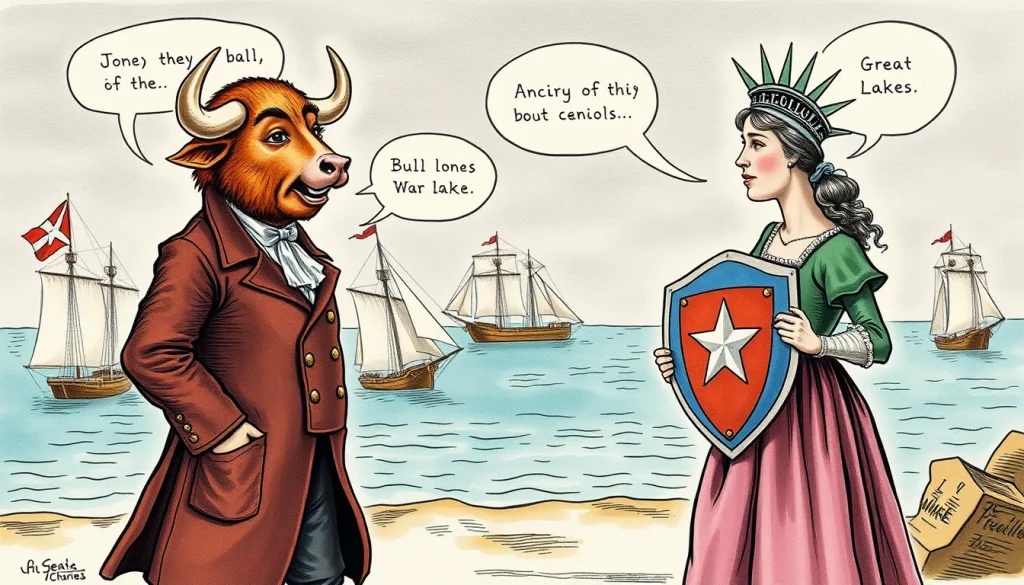
Political cartoons of the War of 1812 are satirical prints produced in the United States and Britain during the conflict (1812–1815). They used allegory, caricature, and emblematic figures such as John Bull, Columbia, and Brother Jonathan to comment on battles, diplomacy, and domestic politics. These prints are historically significant as an early flowering of American political cartooning, particularly through the work of William Charles, and they provide a vivid record of wartime public opinion.
Historical Context
The War of 1812 was fought between the United States and Great Britain over issues including impressment of American sailors, trade restrictions, and British support for Indigenous resistance in the American Northwest. The war was deeply divisive in the U.S., with Federalists often opposing the Republican administration of President James Madison. Print culture was expanding, and the tradition of British caricature, pioneered by figures like James Gillray and Thomas Rowlandson, provided a model for American artists. American printmakers, many of them émigrés from Britain, began to adapt this style to American themes and concerns.
What Happened
Political cartoons of the War of 1812 emerged as a distinct form of American printmaking. The most prolific and influential creator was William Charles, a Scottish-born engraver who settled in Philadelphia in 1814. Charles produced dozens of hand-colored etchings that were sold as single-sheet broadsides. His cartoons often celebrated American naval victories, such as the USS Constitution’s defeat of HMS Guerriere, and ridiculed British setbacks. A typical example is “A Boxing Match, or Another Bloody Nose for John Bull” (1813), which depicts King George III as a pugilist being beaten by Brother Jonathan, with puns referencing the USS Enterprise’s capture of HMS Boxer.
Other notable prints include “John Bull and the Alexandrians” (1814), which mocks the citizens of Alexandria, Virginia, for their humiliating surrender to British forces, and its companion “John Bull and the Baltimoreans,” which celebrates the successful American defense of Baltimore. “Columbia Teaching John Bull His New Lesson” (circa 1813) uses the personification Columbia to lecture John Bull on “Free Trade, Seaman’s Rights” and warns Napoleon of American resolve. These cartoons employed stock characters: John Bull represented British stubbornness and arrogance, Columbia the young American republic, and Brother Jonathan the ordinary American citizen.
The cartoons were produced through engraving on copper plates, often with watercolor added by hand, and sold at print shops in cities like Philadelphia, New York, and Boston. They were also sometimes advertised in newspapers. While they served as propaganda and morale boosters, they also reflected political divisions, with Federalist-leaning prints criticizing the war as ruinous.
Why It Matters
The political cartoons of the War of 1812 are important for several reasons. They constitute the earliest significant body of American political cartooning, influencing later cartoonists and establishing visual conventions such as the use of national personifications. They also document contemporary responses to wartime events, offering insights into public opinion, partisan debates, and the cultural construction of national identity. For historians, they serve as primary sources that must be read critically, with attention to their intended audiences and biases.
Definition
Political cartoons of the War of 1812 are satirical or critical illustrations, usually etchings or woodcuts, that comment on the causes, conduct, and consequences of the Anglo-American conflict. They are characterized by exaggerated figures, national symbols, and text-laden speech bubbles, and were sold as single-sheet prints rather than published in periodicals.
Background
The genre derived from British caricature, which achieved prominence in the late eighteenth century through artists such as James Gillray and Thomas Rowlandson. British-born artisans who emigrated to America, such as William Charles, brought this tradition with them. In the United States, there was a small but growing market for political prints, fed by partisan newspapers and the example of the Revolutionary era’s pictorial satires. The War of 1812 provided abundant subject matter, from naval engagements to the burning of Washington to the Hartford Convention.
How It Worked
Cartoonists first made a drawing, which was then transferred to a copper plate and etched with acid. After printing on paper, watercolor washes were often added by hand. The finished prints were sold individually, typically for a few cents to a few dollars, and could be displayed in homes, taverns, and public buildings. Some were also exported. Production was slow and expensive, limiting output; only a handful of new cartoons appeared each year. Distribution relied on print shops and newspaper advertisements.
Competing Viewpoints
Scholars interpret these cartoons in several ways. Some see them as patriotic propaganda that boosted American morale and shaped a national narrative of plucky resistance against a global power. Others emphasize their role in partisan debates, noting that many prints ridiculed Federalist opposition to the war or lambasted British brutality, while a smaller number criticized the Madison administration. There is also debate about the audience: some argue that cartoons were primarily aimed at urban, literate elites, while others contend they reached a broader public through taverns and street display. Additionally, British cartoonists produced their own depictions of the war, which often portrayed Americans as ungrateful rebels or uncivilized backwoodsmen, complicating the view of the conflict.
Role in the War of 1812
During the war, cartoons functioned as a form of visual journalism, reporting battle results (often with exaggeration), interpreting diplomatic events, and providing commentary on leaders and allies. They helped construct popular images of heroes such as Oliver Hazard Perry and James Lawrence, and villains such as King George III and Napoleon. They also contributed to the creation of American national symbols, notably the personifications of Columbia and Brother Jonathan, which would later evolve into Uncle Sam. In a society where most people never saw a newspaper engraving, the broadside cartoon was a powerful medium for shaping public sentiment.
Consequences and Historical Interpretation
The legacy of these cartoons extends far beyond the war. They established an American tradition of political cartooning that would flourish in the nineteenth century, with Thomas Nast and others following in Charles’s footsteps. They also preserved for historians a rich visual record of wartime attitudes, symbols, and stereotypes. Historians use them as evidence for the “war culture” of the early republic, but they caution that these prints are not neutral documents; they were produced for partisan effect and exaggerate for comic or propaganda purposes. Modern analyses often focus on issues of race, gender, and nationalism, exploring how the cartoons normalized certain identities and vilified others.
Primary Sources
The most important surviving political cartoons of the War of 1812 are held in archival collections, notably the Library of Congress and the Historical Society of Pennsylvania. Key examples include:
- John Bull and the Alexandrians (1814), etching by William Charles, Library of Congress, https://www.loc.gov/item/2002708985/.
- John Bull making a new batch of ships to send to the lakes (1814), etching by William Charles, Library of Congress, https://www.loc.gov/item/2002708986/.
- Columbia Teaching John Bull His New Lesson (c. 1813), drawing by Samuel Kennedy, engraving by William Charles, Library of Congress (via Wikimedia Commons), https://commons.wikimedia.org/wiki/File:Columbia-John-Bull-Napoleon-ca1813.jpg.
- John Bull and the Baltimoreans (1814), etching by William Charles, Historical Society of Pennsylvania, https://digitallibrary.hsp.org/Detail/objects/8533.
These prints are contemporary to the events they depict and provide direct evidence of wartime visual propaganda. Users should note that the Library of Congress holds the deposit copies, and the prints are in the public domain. As sources, they are biased in favor of American perspectives (and generally Republican perspectives), and they often exaggerate for effect; they must be read in conjunction with written records.
Further Reading
- Reilly, Bernard F., Jr. American Political Prints, 1766–1876: A Catalog of the Collections in the Library of Congress. Boston: G.K. Hall, 1991.
- Murrell, William. A History of American Graphic Humor. New York: Whitney Museum of American Art, 1933.
- Lanmon, Dwight. The Art of the American Political Cartoon: 1812–1912 (exhibition catalog). New York: Cooper-Hewitt Museum, 1979.
- Weitenkampf, Frank. Political Caricature in the United States in Separately Published Cartoons. New York: New York Public Library, 1953.
References
- Library of Congress. “John Bull and the Alexandrians / Wm Charles, Ssc.” Accessed 2025. https://www.loc.gov/item/2002708985/.
- Library of Congress. “John Bull making a new batch of ships to send to the lakes / Charles, del et sculp.” Accessed 2025. https://www.loc.gov/item/2002708986/.
- Wikimedia Commons. “File:Columbia-John-Bull-Napoleon-ca1813.jpg.” Accessed 2025. https://commons.wikimedia.org/wiki/File:Columbia-John-Bull-Napoleon-ca1813.jpg.
- Historical Society of Pennsylvania. “John Bull and the Baltimoreans.” Accessed 2025. https://digitallibrary.hsp.org/Detail/objects/8533.
- Reilly, Bernard F., Jr. American Political Prints, 1766–1876. Boston: G.K. Hall, 1991.
FAQ
What are political cartoons of the War of 1812?
They are satirical prints produced during the war that used caricature and allegory to comment on military events, diplomacy, and domestic politics. They were typically etched and hand-colored, sold as single-sheet broadsides.
Who was William Charles?
William Charles (1776–1820) was a Scottish-born engraver who emigrated to the United States and became the most prominent political cartoonist of the War of 1812. He created many of the era's most famous prints, including 'John Bull and the Alexandrians' and 'John Bull and the Baltimoreans.'
What themes did these cartoons cover?
They celebrated American naval victories, ridiculed British setbacks, satirized diplomatic overtures, and engaged with partisan conflicts such as Federalist opposition. They also helped solidify national symbols like Columbia and Brother Jonathan.



Leave a Reply