
Short Answer
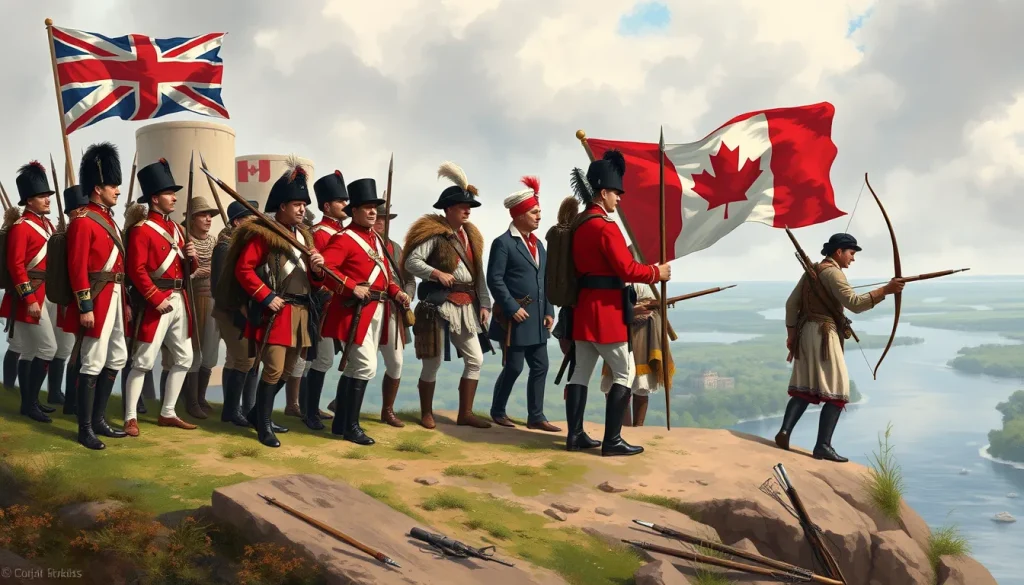
The War of 1812 (1812–1815), fought between the United States and Great Britain, deeply influenced the development of a distinct Canadian identity. The conflict, primarily waged on the borders of British North America, saw American invasions of Upper and Lower Canada met with determined resistance by British regulars, Canadian militia, and Indigenous allies. This successful defense against a larger, expansionist neighbor fostered a growing sense of shared purpose and loyalty to the Crown, laying foundations for what would become Canadian nationhood.
Historical Context
Before 1812, British North America was not a unified nation but a collection of separate colonies with diverse populations and interests. Upper Canada (modern Ontario) had been settled largely by Loyalist refugees from the American Revolution and later American-born immigrants. Lower Canada (modern Quebec) was predominantly French-speaking, with its own culture and institutions. Indigenous nations, including the Shawnee, Ojibwa, and others in the Great Lakes region, maintained their own alliances and aspirations. The United States, driven by westward expansion and grievances against British maritime practices, harbored territorial ambitions toward these colonies. The outbreak of war in Europe between Britain and France exacerbated tensions, culminating in the American declaration of war in June 1812.
What Happened
The war in Canada was characterized by a series of American invasion attempts and British–Canadian counter-offensives. In 1812, British General Isaac Brock, in cooperation with the Shawnee leader Tecumseh, captured Detroit and secured the Northwest. The Battle of Queenston Heights in October 1812, though costly, repelled an American crossing of the Niagara River. Subsequent campaigns saw American forces burn York (modern Toronto) in 1813, and battles at Stoney Creek, Chrysler’s Farm, and Lundy’s Lane in 1814. The war’s end came with the Treaty of Ghent (Dec. 24, 1814), which restored pre-war boundaries. Although the treaty made no territorial changes, the successful defense of the Canadian border left a lasting impression on both sides.
Why It Matters
The war’s outcome secured the future of British North America, preventing annexation to the United States. For Canadians, it created a sense of collective accomplishment and distinctiveness from the American republic. The war elevated figures like Isaac Brock and Laura Secord into national heroes, and events such as the Battle of Queenston Heights became symbolic of Canadian bravery and resolve. However, the war also deepened divisions: French Canadians often remained indifferent to British imperial interests, while Indigenous allies, who contributed significantly to the defense, were later excluded from the peace settlement. The war thus simultaneously fostered a nascent nationalism and sowed seeds of future internal conflict.
Definition
Canadian identity in the context of the War of 1812 refers to the evolving collective self-understanding of the inhabitants of British North America—particularly in Upper and Lower Canada—as distinct from both the American republic and the imperial mother country. It was not a pre-existing national identity but a developing consciousness shaped by wartime experiences, political loyalties, and cultural differences.
Background
Prior to the conflict, the region lacked a shared political or cultural identity. Upper Canada, with its Loyalist heritage, leaned toward a British imperial outlook, while Lower Canada’s French-speaking majority maintained strong attachment to its own language and institutions. Indigenous nations held ancient claims and sovereignty over their lands, often aligning with Britain as a counterweight to American expansion. The war’s background also included British support for Indigenous resistance east of the Mississippi, American impressment of sailors, and trade restrictions—factors that precipitated the conflict.
How the War Shaped Canadian Identity
The war presented a common external threat that temporarily united diverse groups in defense of their homeland. British regulars, colonial militia, and Indigenous warriors fought side by side, despite mutual distrust. The success of these combined forces in repelling invasions—often against superior numbers—engendered a sense of pride and collective accomplishment. The Canadian militia, although comprising a minority of the defenders, were lionized in later narrative, reinforcing the idea that ordinary Canadians had defended their land. The war also solidified loyalty to the British Crown and rejection of republicanism, as American-born settlers who remained neutral or supported the enemy were increasingly marginalized.
Competing Viewpoints
Historians disagree on the war’s long-term impact. Some, such as Pierre Berton, view the war as a nation-building event that gave Canadians a heroic past and a reason for being separate from the United States. Others, including Alan Taylor, argue that the war’s effect was more myth than reality; it left political divisions intact and did not create a unified Canadian identity. Indigenous scholars point out that for Indigenous peoples, the war was a devastating struggle that resulted in forced land cessions and displacement, not incorporation into a Canadian identity. French Canadian perspectives often stress that the war was a “British” conflict imposed on them, and that any subsequent Canadian identity was largely an English-Canadian project.
Role in the War of 1812
The war’s role in shaping identity was twofold. First, it provided a shared military experience that could be appropriated by later nation-builders to craft a unified history. The defense of key positions, such as the Battle of Châteauguay, allowed French Canadians to claim a place in the war’s heroic narrative, even if their participation was often reluctant. Second, the war intensified British and Loyalist symbolism, such as the Union Jack and the Crown, which were intertwined with the emerging Canadian identity. However, the war also reinforced colonial status, as British regulars and British commanders dominated decision-making, while Canadian militias were often under-equipped and subordinate.
Consequences and Historical Interpretation
In the aftermath, the war resulted in a prolonged period of comparative peace along the border, but it also left a legacy of distrust toward the United States. Over the nineteenth century, commemorations of the war—such as the erection of monuments at Queenston Heights and other battlefields—propagated a narrative of Canadian heroism and maturity. However, twentieth- and twenty-first-century scholarship has deconstructed this myth, emphasizing the war’s limited scope, the role of British regulars and Indigenous allies, and the lack of a unified national sentiment at the time. Today, scholars see the war as a significant moment in the construction of a particular Canadian identity, but one that was contested and far from inevitable.
Primary Sources
Key primary sources include the correspondence and proclamations of Major-General Isaac Brock, which reveal British strategies and attitudes toward the Canadian populace. The journal of John Strachan, a prominent Anglican clergyman in York, provides a civilian perspective and later championed the militia’s role. Laura Secord’s account of her journey to warn the British at Beaver Dams, while contested in detail, demonstrates the involvement of ordinary citizens. Official reports from British commanders such as Sir George Prevost and American officers contribute to the military record. Newspaper accounts from Upper and Lower Canada also reflect contemporary public sentiment and the construction of wartime heroics. These sources must be interpreted carefully, as they often promote particular political or imperial agendas.
Further Reading
- Berton, Pierre. The Invasion of Canada: 1812–1813. Toronto: McClelland and Stewart, 1980.
- Berton, Pierre. Flames Across the Border: 1813–1814. Toronto: McClelland and Stewart, 1981.
- Hickey, Donald R. The War of 1812: A Forgotten Conflict. Urbana: University of Illinois Press, 1989.
- Taylor, Alan. The Civil War of 1812: American Citizens, British Subjects, Irish Rebels, & Indian Warriors. New York: Alfred A. Knopf, 2010.
- Wood, William. Select British Documents of the Canadian War of 1812. Toronto: Champlain Society, 1920.
References
- Berton, Pierre. The Invasion of Canada: 1812–1813. Toronto: McClelland and Stewart, 1980.
- Taylor, Alan. The Civil War of 1812: American Citizens, British Subjects, Irish Rebels, & Indian Warriors. New York: Alfred A. Knopf, 2010.
- Hickey, Donald R. The War of 1812: A Forgotten Conflict. Urbana: University of Illinois Press, 1989.
- Strachan, John. The John Strachan Letter Book, 1812–1814. Edited by George W. Spragge. Toronto: Ontario Historical Society, 2001.
- Library and Archives Canada. “War of 1812” collection.
FAQ
Did the War of 1812 create a single unified Canadian identity?
No, the war did not immediately create a unified identity. While it generated a sense of shared defense and loyalty to Britain, French Canadians, Indigenous peoples, and even many British subjects had differing views. The notion of a cohesive Canadian identity emerged later, as commemorations and nation-building used the war's memory.
What role did Indigenous peoples play in shaping Canadian identity during the War of 1812?
Indigenous allies, including Tecumseh's confederacy, were critical in defending British North America and contributed to key victories like the capture of Detroit. However, the peace settlement ignored their land rights, and the war ultimately accelerated their displacement. Their role is often minimized in traditional accounts of the war, highlighting the contested nature of Canadian identity.
How did the War of 1812 affect French-English relations in Canada?
The war had a mixed impact. Some French Canadians, like those at the Battle of Châteauguay, fought for Britain, but many remained indifferent to British imperial goals. The war did not heal linguistic and cultural divisions; rather, it highlighted them, as English Canadians increasingly celebrated a Loyalist-imperial identity that excluded French Canadians.
Leave a Reply