
Short Answer
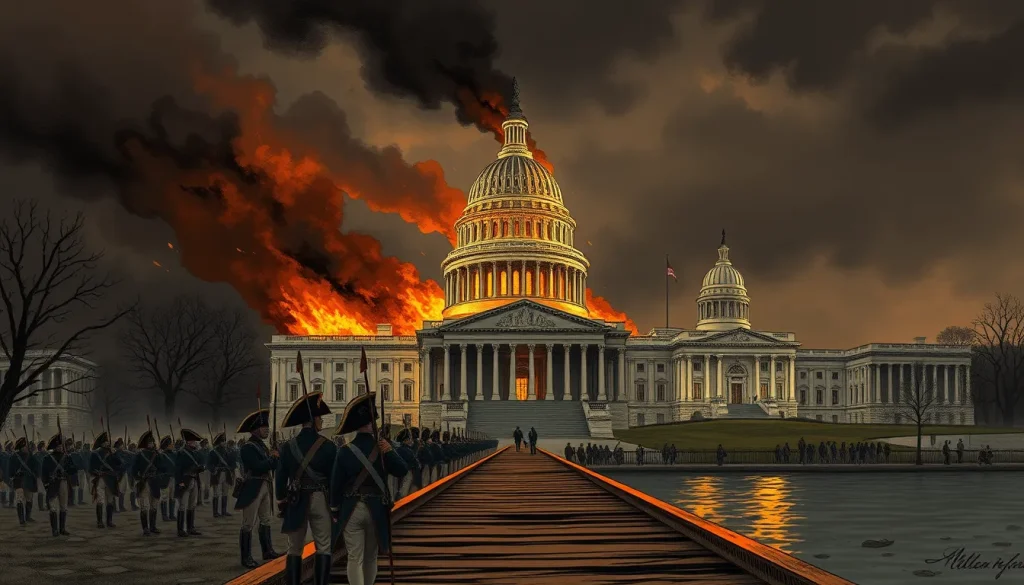
On August 24, 1814, during the War of 1812, British forces under Major General Robert Ross and Rear Admiral George Cockburn entered Washington, D.C., and set fire to the U.S. Capitol, the President’s House, and other public buildings. The attack was a deliberate retaliation for American destruction of public property in Upper Canada, notably the burning of York (Toronto) in 1813. This event marked the only time in U.S. history that a foreign power captured and burned the capital.
Historical Context
The War of 1812 (1812–1815) saw the United States declare war on Great Britain over impressment, trade restrictions, and British support of Indigenous peoples in the Northwest. American forces launched invasions of Canada, and on April 27, 1813, U.S. troops burned the Parliament buildings and other public structures in York, the capital of Upper Canada. This act, along with the destruction of Newark (Niagara-on-the-Lake) in December 1813, outraged British military leaders and fueled calls for retaliation. In 1814, with Napoleon’s defeat in Europe, Britain was able to divert more forces to North America. A British squadron under Rear Admiral George Cockburn had been raiding the Chesapeake Bay region throughout 1813–1814, and in August 1814, a veteran army under Major General Robert Ross was landed in Maryland with the goal of striking at the American capital.
What Happened
On August 19, 1814, Ross’s army of about 4,500 troops landed at Benedict on the Patuxent River. They advanced toward Washington, and on August 24, they met an American force at Bladensburg, Maryland. Despite outnumbering the British roughly two to one, the American defenders—a mix of regulars and militia—were routed by British artillery and Congreve rockets. The road to Washington lay open. President James Madison, cabinet members, and many residents fled the city. At the President’s House, First Lady Dolley Madison oversaw the rescue of a full-length portrait of George Washington before escaping. The British entered the capital around 8 p.m. and systematically set fire to public buildings. They burned the Capitol, which housed the Library of Congress, the President’s House, the Treasury, the War and State Departments, and the Washington Navy Yard. The destruction was focused on government property; private homes and businesses were largely spared. A violent thunderstorm on August 25 extinguished some fires but also hastened the British withdrawal. By nightfall, the British had withdrawn to their ships, ending the occupation after roughly twenty-four hours.
Why It Matters
The burning of Washington was a profound humiliation for the United States. It exposed the nation’s inability to defend its own capital and fueled anti-war sentiment, culminating in the Hartford Convention of Federalist delegates in December 1814. In the longer term, the destruction spurred a determined rebuilding effort. Congress considered moving the capital but ultimately remained. Rebuilding the Capitol and the President’s House became a symbol of national resilience. The loss of the congressional library led to Thomas Jefferson’s offer to sell his personal library, which Congress purchased in 1815, forming the foundation of the modern Library of Congress. Historians interpret the burning as a calculated military retaliation, demonstrating British strategic reach and the consequences of American raids on Canadian settlements.
Prelude
The British Chesapeake campaign of 1814 was part of a broader diversionary strategy to relieve pressure on Canada and to punish the United States. Rear Admiral Cockburn had long advocated for an attack on Washington, believing it would be a stunning blow to American morale. After the Battle of Bladensburg, the path to the capital was clear. President Madison and his cabinet had fled, and no organized defense remained. The British encountered no resistance as they advanced toward the city.
Forces and Commanders
British forces were led by Major General Robert Ross, a veteran of the Peninsular War, and Rear Admiral George Cockburn, who directed naval operations. The British army consisted of approximately 4,500 regulars, including the 4th, 44th, and 85th Regiments, as well as Royal Marines. American forces at Bladensburg were commanded by Brigadier General William H. Winder, with President Madison and Secretary of War John Armstrong exercising nominal oversight. The Americans had a nominal strength of about 7,000, but many were poorly trained militia who broke under British bombardment.
Battlefield and Map Context
Washington, D.C., in 1814 was a young and unfinished capital. The Capitol building consisted of two wings—the Senate (north) and House (south)—connected by a wooden causeway. The President’s House was located about 1.5 miles west. The Washington Navy Yard lay on the Anacostia River to the southeast. The British advanced from Bladensburg along the Bladensburg Road into the city. The main public buildings were concentrated in a small area, making the destruction efficient.
Battle Chronology
August 24, 1814: Battle of Bladensburg fought in the morning; American defeat by early afternoon. British regroup and march toward Washington. Around 8 p.m., British troops enter Washington. First, they burn the Capitol, including the Senate and House chambers and the Library of Congress. Then they advance on the President’s House, set it ablaze, and continue to the Treasury, War Department, and other buildings. Meanwhile, Captain Thomas Tingey, commanding the Navy Yard, burns ships and the yard to prevent capture. During the night, sporadic fires continue. On August 25, a severe thunderstorm strikes, dousing flames and causing a brief tornado. The British, having achieved their objective, withdraw to their ships, marching through the night.
Casualties and Losses
British casualties were minimal, with about 30 killed or wounded, mostly due to an accidental explosion of a powder magazine at Greenleaf Point. American military casualties were also light, but the property loss was enormous. The Capitol was gutted, the President’s House was left a shell, and other public buildings were destroyed. The congressional library, comprising over 3,000 volumes, was lost. Private property was mostly spared, though some looting occurred.
Result
The British successfully completed a punitive raid on Washington, D.C., destroying major public buildings and humiliating the U.S. government. They withdrew after less than a day, as they had no intention of permanently occupying the city. The raid boosted British morale and underscored the vulnerability of the American capital. Militarily, the operation was a tactical success, though it had no direct effect on the outcome of the war.
Strategic Consequences
The burning of Washington did not alter the strategic balance of the war, but it had significant political and psychological effects. In Britain, it was celebrated as retribution for American attacks in Canada. In the United States, it led to criticism of the Madison administration and calls to move the capital. The subsequent rebuilding efforts reinforced the permanence of Washington as the seat of government. The destruction of the Library of Congress prompted the purchase of Jefferson’s library, enriching national cultural resources. The event also galvanized American resolve, contributing to the successful defense of Baltimore shortly afterward.
Primary Accounts
Key contemporary accounts include President Madison’s handwritten notes on the events of August 24, 1814, which describe the Battle of Bladensburg and the burning of the Capitol. Dolley Madison’s letters to her sister give a vivid personal account of the flight from the President’s House. British officers, including Ross and Cockburn, submitted reports detailing the operation. A watercolor by George Munger, depicting the Capitol in ruins, is held by the Library of Congress. These sources vary in perspective; American accounts emphasize loss and violation, while British accounts stress military discipline and the retaliation for prior American destruction.
Primary Sources
Key primary sources include the official report of Major General Robert Ross to Secretary of State for War and Colonies Earl Bathurst, dated August 30, 1814, in which he describes the destruction of public buildings. President James Madison’s “Observations of the Capture of Washington, D.C., by British Troops” (August 24, 1814) is a manuscript memorandum now in the Library of Congress. Dolley Madison’s letter to her sister Lucy Todd, written on August 23–24, 1814, recounts the rescue of the Washington portrait. Captain Thomas Tingey’s letter to Secretary of the Navy William Jones explains the burning of the Navy Yard. The British magazine explosion is noted in several logs. These sources provide eyewitness and official perspectives, but each carries biases—American sources tend to highlight British destruction, while British sources emphasize restraint and justification.
Further Reading
- Hickey, Donald R. The War of 1812: A Forgotten Conflict. University of Illinois Press, 1989.
- Latimer, Jon. 1812: War with America. Harvard University Press, 2007.
- Pitch, Anthony S. The Burning of Washington: The British Invasion of 1814. Naval Institute Press, 1998.
- National Park Service, “Complete the destruction of the public buildings with the least possible delay.” NPS.gov.
- Library of Congress, “Out of the Ashes: A New Library for Congress and the Nation.” LOC.gov.
- U.S. Senate, “A Capitol in Ruins.” Senate.gov.
References
- U.S. National Park Service, “Complete the destruction of the public buildings with the least possible delay,” https://www.nps.gov/articles/burning-the-capital.htm
- U.S. Senate, “A Capitol in Ruins,” https://www.senate.gov/about/historic-buildings-spaces/capitol/capitol-ruins.htm
- Library of Congress, “Out of the Ashes: A New Library for Congress and the Nation,” https://www.loc.gov/exhibits/out-of-the-ashes/online-exhibition.html
- Architect of the Capitol, “A Most Magnificent Ruin: The Burning of the Capitol during the War of 1812,” https://www.aoc.gov/explore-capitol-campus/blog/most-magnificent-ruin-burning-capitol-during-war-1812
- The War of 1812, “The Burning of Washington,” https://thewarof1812.org/battles/the-burning-of-washington/
FAQ
Why did the British burn the U.S. Capitol?
The British burned the Capitol in retaliation for American destruction of public buildings in Upper Canada, particularly the burning of York (Toronto) in 1813. The attack was intended to punish the United States and demonstrate British power.
What buildings were burned in Washington in 1814?
The British burned the Capitol, the President's House (White House), the Treasury, the War Department, the State Department, and the Washington Navy Yard. They also destroyed several naval vessels.
How long did the British occupy Washington?
The British occupied Washington for about one day, entering on the evening of August 24 and withdrawing on the night of August 25, 1814, following a severe thunderstorm.


Leave a Reply