
Short Answer
At the Battle of New Orleans on January 8, 1815, a contingent of Choctaw warriors, led by trader Pierre Juzan, fought alongside Major General Andrew Jackson’s American forces against the British army. Their role as scouts, skirmishers, and flank guards on the swampy left of the American line helped secure one of the most decisive American victories of the War of 1812. The Choctaw participation underscores the multinational and multiethnic composition of Jackson’s army and highlights the complex alliances between the United States and Indigenous nations during the conflict.
Historical Context
The War of 1812 pitted the United States against the British Empire, with major campaigns in the American Northwest, Canada, and the coastal South. After the burning of Washington in August 1814, the British shifted attention to the Gulf Coast, aiming to capture New Orleans and control the Mississippi River. In the preceding Creek War (1813-1814), a civil conflict within the Creek Nation, many Choctaw leaders sided with the United States, fearing the Redstick faction’s ties to the British and Spain. Choctaw chiefs such as Pushmataha signed treaties of friendship, and Choctaw warriors served as auxiliaries in U.S. expeditions, including Major Uriah Blue’s campaign to Pensacola. This alliance continued when Andrew Jackson requested Choctaw support to defend New Orleans.
What Happened
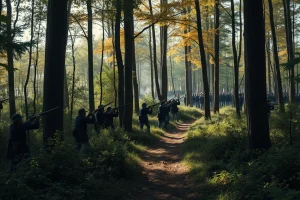
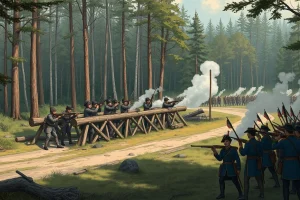
In December 1814, about fifty to sixty Choctaw warriors, organized under Captain Pierre Juzan, left Pensacola and joined Jackson’s army in New Orleans. They were mustered into service on December 17 and served until March 10, 1815. The Choctaw fighters initially patrolled the Chef Menteur Road along the Gentilly Plain to prevent British incursions from Lake Borgne, which the Royal Navy seized on December 14. When the British captured the Villeré Plantation on December 23, Juzan and a group of eighteen Choctaws joined Jackson’s counterattack that evening. In the following days, the Choctaws were stationed on the extreme left flank of the American line, at the edge of a cypress swamp. They frequently engaged British pickets and skirmishers, reportedly killing dozens of British soldiers. On December 28, a party of Tennessee riflemen under Captain John C. Carnell was ambushed by the British; the Choctaws opened fire from the rear, causing heavy British casualties. The Choctaws continued harassing operations until the main British assault on January 8, when they held their position and contributed to the repulse of the British columns. American casualties were minimal, while British losses exceeded 2,000.
Why It Matters
The Choctaw fighters’ participation in the Battle of New Orleans exemplified the vital but often overlooked roles that Indigenous allies played in the War of 1812. Their presence added to the diversity of Jackson’s army, which included Tennessee and Kentucky militia, Louisiana militia, free men of color, and Baratarian pirates. The Choctaws’ knowledge of the swampy terrain and their skirmishing tactics provided a tactical advantage, particularly in anchoring the American left flank. However, despite their wartime service, the Choctaw nation would suffer from U.S. expansion. In 1830, President Andrew Jackson signed the Indian Removal Act, and Choctaws were forced to cede their lands east of the Mississippi. Thus, the story of the Choctaw fighters at New Orleans reflects both the wartime alliance and the subsequent betrayal.
Prelude
The Choctaw alliance with the United States was solidified during the Creek War, when Choctaw leaders like Pushmataha committed warriors to fight the Redstick faction. After the Redstick defeat, the British threat to the Gulf Coast prompted Jackson to call on Choctaw allies once more. Pierre Juzan, a French trader living among the Choctaw with a Choctaw wife, organized a company of warriors. In mid-December 1814, they marched to New Orleans via the military road, arriving in time to bolster Jackson’s defenses.
Forces and Commanders
The Choctaw contingent numbered about 50-60 warriors, led by Captain Pierre Juzan. Juzan was a French trader who had long resided in Choctaw country and was fluent in Choctaw, French, and English. The warriors were mustered into the U.S. Army, granting them official status as soldiers. They joined Jackson’s diverse force of roughly 4,000 men, which included regular U.S. infantry, Tennessee and Kentucky militia, Louisiana militia, free men of color, and Baratarian privateers. On the British side, General Edward Pakenham commanded an army of over 8,000 veterans.
Battlefield and Map Context
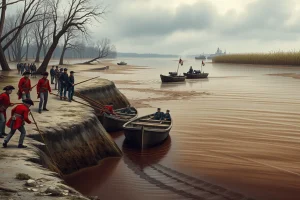
The battle took place on the Chalmette Plantation, about five miles south of New Orleans on the east bank of the Mississippi River. The American defensive line stretched from the river to a dense cypress swamp, which was almost impassable. The Choctaw warriors were positioned at the far left, near the swamp, where they used the natural cover to their advantage. The terrain dictated their tactics: they could move through the swamp and snipe at British troops without being seen.
Battle Chronology
December 14: British capture five American gunboats on Lake Borgne.
December 17: Choctaw warriors are mustered into Jackson’s army.
December 23: British seize Villeré Plantation; Jackson launches an evening counterattack, including Choctaw under Juzan.
December 28: British reconnoiter the American line; a skirmish occurs in the swamp where Choctaw fire causes British casualties.
January 1: Artillery duel.
January 8: British main assault; the Choctaws hold the left flank and fire into the British columns, contributing to the retreat.
Casualties and Losses
Exact Choctaw casualties are not well documented. The American army lost 71 killed, wounded, or missing. British losses were staggering: about 2,034 casualties. Of those, the Choctaw contingent purportedly killed upwards of 50 British soldiers, according to later accounts, though this figure is not officially verified. The Choctaws likely suffered few casualties, given their protected position in the swamp.
Result
The Battle of New Orleans was a decisive American victory. The British withdrew, and the war ended soon after (the Treaty of Ghent had been signed on December 24, 1814, but news had not reached the combatants). The Choctaw warriors played a meaningful role in maintaining the integrity of the American left flank and in harassing British pickets in the days before the battle.
Strategic Consequences
The victory preserved American control of New Orleans and the Mississippi River, and it ended British plans to seize the strategic port. For the Choctaw, the alliance seemed to secure their position as valued allies. However, within fifteen years, the U.S. government, now led by Andrew Jackson, would force the Choctaws off their ancestral lands under the Indian Removal Act of 1830. The Choctaw participation in New Orleans thus highlights the paradox of Indigenous military service in the American republic.
Primary Accounts
Contemporary sources include military muster rolls, Andrew Jackson’s orders and letters, and British officer accounts. Jackson’s dispatches praised his diverse army. The American Battlefield Trust notes that accounts vary on the Choctaws’ exact role, but they were described as effective skirmish fighters. British soldiers recalled the Choctaws as “hellish adversaries” in the swamp. The Choctaw Nation’s own oral histories refer to the battle as “Balbaha Ittibi,” meaning “Foreign-Language-Speaking Battle.”
Battlefield Today
The Chalmette Battlefield is now part of the Jean Lafitte National Historical Park and Preserve. Visitors can see the reconstructed earthworks and a monument. Interpretive programs often mention the role of the Choctaws, and annual reenactments include Choctaw participants from the Choctaw Nation of Oklahoma, the Jena Band of Choctaw Indians, and the Mississippi Band of Choctaw Indians. The site provides a tangible link to the diverse forces that fought there.
Primary Sources
Key primary sources for the Choctaw role include:
– Muster rolls of Captain Pierre Juzan’s company, which list dates of service (December 17, 1814 to March 10, 1815).
– Andrew Jackson’s correspondence, where he acknowledged the contributions of his “Indian allies.”
– British officer memoirs, such as those from the 85th Regiment, which mention the harassing fire from the swamp.
– The National Park Service article by Greg O’Brien provides a synthesis of these sources. It notes that “Purportedly they killed upwards of 50 British soldiers.”
Further Reading
- Greg O’Brien, “Choctaw recruits fight with the U.S. Army,” National Park Service, https://www.nps.gov/articles/choctaw-indians-and-the-battle-of-new-orleans.htm
- “Pierre Juzan,” American Battlefield Trust, https://www.battlefields.org/learn/biographies/pierre-juzan
- “Choctaws and the War of 1812 (Part 2),” Choctaw Nation of Oklahoma, https://www.choctawnation.com/news/iti-fabvssa/choctaws-and-the-war-of-1812-part-2/
- Robert V. Remini, The Battle of New Orleans
References
- Greg O’Brien, “Choctaw recruits fight with the U.S. Army,” National Park Service, https://www.nps.gov/articles/choctaw-indians-and-the-battle-of-new-orleans.htm
- “Pierre Juzan,” American Battlefield Trust, https://www.battlefields.org/learn/biographies/pierre-juzan
- “Choctaws and the War of 1812 (Part 2),” Choctaw Nation of Oklahoma, https://www.choctawnation.com/news/iti-fabvssa/choctaws-and-the-war-of-1812-part-2/
- NCHGS, “The Road to New Orleans,” http://www.nchgs.org/html/road_to_new_orleans.html
FAQ
How many Choctaw fought at the Battle of New Orleans?
Accounts vary, but most sources indicate 50-60 Choctaw warriors under Captain Pierre Juzan. Some say as few as 30, others up to 60.
What role did the Choctaw play?
The Choctaws served as skirmishers and scouts, patrolling the roads and swamps, and on the day of battle held the extreme left flank of the American line, firing on British troops from the cover of the cypress swamp.
Why did Choctaw leaders support the Americans?
During the Creek War, Choctaw chiefs like Pushmataha sided with the U.S. to counter the Redstick faction, and they sought to maintain favorable trade relations and protect their territories. They also saw opportunities for military honor.
Leave a Reply