
Short Answer
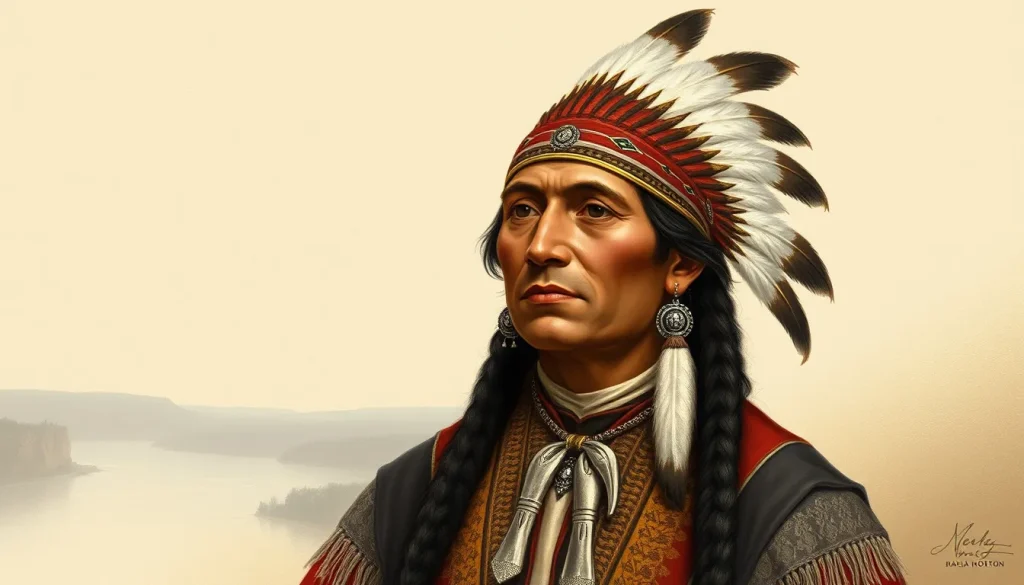
John Norton, also known as Teyoninhokarawen, was a Mohawk leader of Cherokee and Scottish descent who served as a British military captain during the War of 1812. Born around 1770 in Scotland, Norton became a principal Indigenous ally of the British on the Niagara frontier, commanding significant numbers of Six Nations and other warriors in key battles such as Queenston Heights, Stoney Creek, and Beaver Dams. His memoir, written after the war, provides one of the few substantial Indigenous accounts of the conflict from the British-allied perspective.
Historical Context
The War of 1812 pitted the United States against Great Britain, with Upper Canada (present-day Ontario) as a primary battleground. The British relied heavily on Indigenous allies, particularly the Haudenosaunee (Six Nations) of the Grand River, who had settled in the region after the American Revolution. The Grand River lands were granted by the Crown in 1784, but colonial officials and settlers increasingly challenged the extent of the grant, creating tensions. Joseph Brant (Thayendanegea), the prominent Mohawk leader, advocated for Indigenous rights and negotiated with British authorities; John Norton emerged as his successor and protégé. Norton’s unique background—born to a Cherokee father and Scottish mother, educated in English ways, yet adopted into the Mohawk nation—made him an effective intermediary between British military officials and Indigenous communities. As war loomed in 1812, both sides sought Indigenous support, and Norton’s influence proved crucial to the British.
What Happened
When the United States declared war on Britain in June 1812, Norton was living on the Grand River and immediately began recruiting warriors from the Six Nations, Delaware, and other communities to fight for the British. He was commissioned as a captain (later brevet major) and served under Major General Isaac Brock. On 13 October 1812, American forces crossed the Niagara River and captured Queenston Heights. British regulars under Brock were repulsed, and Brock was killed. As the British line wavered, Norton and about 80 Grand River warriors climbed the escarpment and engaged the Americans from the flank, holding them at bay until reinforcements arrived, forcing the Americans to surrender. This action proved decisive.
In 1813, Norton’s warriors continued to serve as scouts and skirmishers. At the Battle of Stoney Creek (6 June 1813), they helped cover the British advance and harassed American lines. At the Battle of Beaver Dams (24 June 1813), Norton and his warriors, along with a small force under Lieutenant James FitzGibbon, ambushed an American column, leading to the surrender of over 500 Americans. Norton also participated in operations around Fort George and Fort Niagara. In 1814, he was present at the Battles of Chippawa, Lundy’s Lane, and Fort Erie, though his role was less prominent as British fortunes fluctuated. Throughout the war, Norton also worked diplomatically to maintain Indigenous support, recruiting warriors and addressing grievances. After the Treaty of Ghent in December 1814, Norton returned to Grand River.
Why It Matters
Norton’s military leadership materially contributed to British victories on the Niagara frontier, preventing an early American conquest of Upper Canada. His ability to mobilize and command Indigenous forces highlighted the indispensable role of First Nations in the defence of British North America. Beyond combat, Norton’s memoir and correspondence provide a rare Indigenous perspective on the war and the broader struggle for Haudenosaunee independence. His post-war advocacy for Grand River land claims, though ultimately unsuccessful, foreshadowed later Indigenous land rights struggles. Historians debate the extent of Norton’s influence and the degree to which his identity as a ‘white chief’ complicated his leadership, but his significance as both a warrior and a chronicler is unquestioned.
Early Life
John Norton was born around 1770 in Scotland to a Cherokee father (John Norton Sr., who had been taken to Britain as a child) and a Scottish mother. His father served in the British Army and returned to North America after the American Revolution, taking his family. John Norton Jr. enlisted in the army in 1784 but deserted in 1789, living among the Cayuga and then the Mohawk. He became fluent in the Mohawk language and culture, and was adopted by Joseph Brant as a nephew, receiving the name Teyoninhokarawen (“open door”). He gained status as a chief and became a key adviser to Brant.
Role Before the War
Before 1812, Norton acted as an interpreter and emissary for the Grand River Mohawks. He travelled widely, including a notable visit to England in 1804–05 to present land grievances to the Crown. In 1809–10 he made a long journey through the United States to visit Cherokee and other communities, documenting his travels in his journal. He worked with Joseph Brant to defend the Grand River land grant against colonial encroachment, often clashing with officials of the Indian Department, especially William Claus.
Role During the War
As war broke out, Norton organized an Indigenous contingent that became an integral part of the British forces. He held the rank of captain and led warriors in numerous engagements. His efforts were not limited to combat; he also managed logistics, recruitment, and diplomacy among the various Indigenous nations. He maintained close relationships with British generals, including Isaac Brock and Gordon Drummond, though he faced distrust from some colonial elites.
Major Actions
- Battle of Queenston Heights (13 October 1812): Norton and his warriors scaled the escarpment and engaged the Americans, enabling the British to regroup and capture the heights.
- Battle of Stoney Creek (6 June 1813): His scouts guided the British night attack and provided covering fire.
- Battle of Beaver Dams (24 June 1813): Norton’s warriors ambushed an American column, leading to its surrender without major British casualties.
- Fort George and Fort Niagara (1813): He covered the British retreat and participated in raids.
- Battles of Chippawa, Lundy’s Lane, and Fort Erie (1814): He led warriors in these major actions, though his role was secondary.
Contemporary Accounts
Norton’s own memoir, written in 1816, is a primary source, but it is necessarily self-serving. British officers’ letters and reports, including those from Isaac Brock and Gordon Drummond, praised Norton’s effectiveness and courage. However, his detractors, such as William Claus, accused him of ambition and misrepresenting his authority. American accounts of the Battle of Queenston Heights often mention the “Indians” as a fearsome presence, and some credit them with the loss of the heights. Norton’s identity as a mixed-race leader also attracted comment; some viewed him as an anomaly, while others saw him as a legitimate Mohawk chief.
Later Life
After the war, Norton travelled to Britain to seek publication of his memoir and to plead for the Grand River land claim. The British government approved the claim, but the Upper Canada government refused to honour it. Norton returned to Canada but faced increasing opposition from colonial authorities who sought to reduce his influence. In 1823, he killed a man in a duel (reportedly over a land dispute) and fled to the American southwest, possibly living in Mexican territory. His exact death date and location are uncertain; he likely died in the late 1820s.
Historical Legacy
John Norton is recognized as a National Historic Person in Canada (designated 2011). His memoir, first published in 1970 by the Champlain Society, is a valued source for historians of the War of 1812 and Indigenous studies. Modern scholarship, particularly Carl Benn’s 2018 annotated edition, has reassessed Norton as a complex and effective leader who navigated between Indigenous and British worlds. He is commemorated at Queenston Heights Park in Niagara-on-the-Lake, Ontario. Norton’s legacy lies in his military contributions and his writings, which preserve an Indigenous viewpoint during a critical period of North American history.
Primary Sources
The most important primary source is Norton’s own memoir, The Journal of Major John Norton, 1816, edited by Carl F. Klinck and James J. Talman (Champlain Society, 1970). This work includes his war narrative and his earlier travels. Carl Benn’s A Mohawk Memoir from the War of 1812 (University of Toronto Press, 2018) provides an annotated edition of the wartime section. Other sources include British military correspondence and the records of the Indian Department, which can be found in Library and Archives Canada. The Canadian War Museum holds a portrait of Norton painted by Mary Ann Knight. These sources are invaluable but carry the biases of their authors; Norton’s memoir must be read critically, as he sought to justify his actions and press his land claims.
Further Reading
- Benn, Carl, ed. A Mohawk Memoir from the War of 1812: John Norton—Teyoninhokarawen. Toronto: University of Toronto Press, 2018.
- Klinck, Carl F., and James J. Talman, eds. The Journal of Major John Norton, 1816. Toronto: Champlain Society, 1970.
- Wilson-Smith, Anthony. “John Norton and the War of 1812.” The Canadian Encyclopedia. Historica Canada, 2016.
- Parks Canada. “Norton, John (Teyoninhokarawen) National Historic Person.” Government of Canada.
References
- “John Norton and the War of 1812.” The Canadian Encyclopedia. Accessed June 2024. https://thecanadianencyclopedia.ca/en/article/john-norton-and-the-war-of-1812.
- “A Mohawk Memoir from the War of 1812: John Norton—Teyoninhokarawen.” Pennsylvania History: A Journal of Mid-Atlantic Studies 91, no. 2 (2024). https://doi.org/10.5325/pennhistory.91.2.0217.
- “The journal of Major John Norton, 1816.” Smithsonian Libraries and Archives. Accessed June 2024. https://www.si.edu/object/siris_sil_14490.
- Parks Canada. “Norton, John (Teyoninhokarawen) National Historic Person.” Accessed June 2024. https://www.pc.gc.ca/apps/DFHD/page_nhs_eng.aspx?id=13011.
- Benn, Carl, ed. A Mohawk Memoir from the War of 1812. University of Toronto Press, 2018. Table of contents via https://doi.org/10.3138/9781487519902-toc.
FAQ
Who was John Norton in the War of 1812?
John Norton, also known as Teyoninhokarawen, was a Mohawk chief of Cherokee and Scottish descent who led Indigenous warriors for the British, playing a key role in several Niagara frontier battles.
What did John Norton do at Queenston Heights?
At Queenston Heights on 13 October 1812, Norton and about 80 Grand River warriors climbed the escarpment, engaged American forces, and held them until British reinforcements arrived, contributing to the British victory.
Why is John Norton historically significant?
Norton was a rare Indigenous military leader who also authored a memoir of the war, providing a unique perspective on both the conflict and Haudenosaunee political struggles.

Leave a Reply