
Short Answer
Civilian life during the War of 1812 encompassed the experiences of noncombatants on both sides of the border as the conflict between the United States and the British Empire swept through frontier regions and coastal areas. This article examines how ordinary people—farmers, merchants, women, children, and Indigenous peoples—coped with military occupation, looting, destruction, and economic disruption, and how their experiences shaped the war’s outcome and its memory.
Historical Context
Before the war, inhabitants of the borderlands between the United States and British North America lived in a world shaped by subsistence farming, trade, and tense international relations. Upper Canada (now Ontario) had a population of roughly 80,000, largely recent American settlers who brought republican sympathies but who also valued peace and stability. The American side of the border, particularly western New York and the Chesapeake region, had its own communities with mixed loyalties and economic ties to Britain. The declaration of war in June 1812 came after years of impressment, trade restrictions, and conflicts with Indigenous peoples, but for many civilians the war’s arrival was sudden and unwelcome. Military campaigns concentrated along the Niagara River, Lake Ontario, and the Chesapeake Bay, making these areas particularly vulnerable. Civilians there faced a unique combination of regular military operations, raiding parties, and the forced requisitioning of supplies.
What Happened
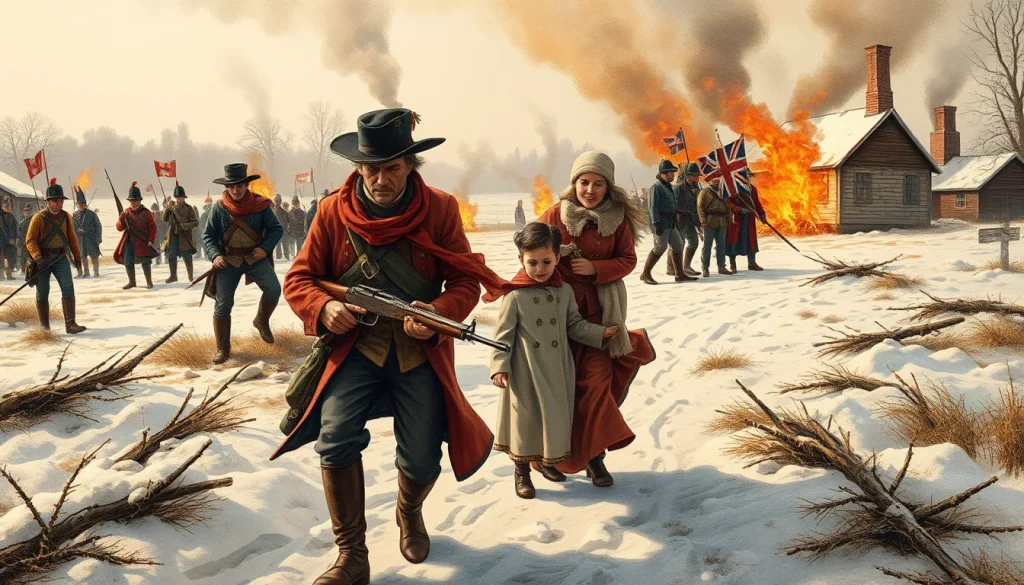
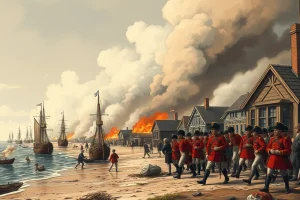
From the outset, civilians were caught between armies. The American invasion of Upper Canada in 1812 sought to win over the local population, but when resistance stiffened, the initial restraint gave way to harsh tactics. By 1813, retaliatory burnings became common. The American capture of York (modern Toronto) in April 1813 resulted in the looting of homes and public buildings, and the explosion of a powder magazine killed many, including General Zebulon Pike. That December, American troops retreating from Fort George burned the nearby village of Newark (now Niagara-on-the-Lake), leaving its inhabitants without shelter in winter. In retaliation, British forces and their Indigenous allies burned Buffalo, Lewiston, and Black Rock on the American side. The Chesapeake Bay saw similar raids, culminating in the burning of Washington, D.C., in August 1814. Civilians in these areas endured not only the destruction of property but also the loss of livestock, crops, and livelihoods. Militia service pulled men aged 16 to 60 away from their farms, and desertions peaked during planting and harvest times. Women took on additional responsibilities, managing farms, households, and sometimes businesses. Some, like Debora Willson, who operated a tavern near Niagara Falls, found themselves negotiating with occupying officers from both sides. The war also created refugees; many Upper Canadians fled to safer inland areas, while American civilians on the frontier sought protection in cities.
Why It Matters
The war left deep scars on communities along the border. Destruction of property and trade dislocations led to years of recovery, and the bitterness fostered by the burnings and looting contributed to a lasting sense of distinct national identity on both sides. Historians argue that civilian experiences played a critical role in shaping the conflict’s outcome and its memory. The resilience and suffering of civilians became foundational myths in Canada, where the defence of British North America is celebrated, while in the United States the war is often remembered for its military failures and the burning of the capital. The legacy of the war also included Indigenous peoples, whose lives were disrupted and whose postwar status declined despite wartime service.
Definition
In the context of the War of 1812, ‘civilian life’ refers to the daily reality of noncombatants who lived within or near active war zones. This includes their routines, economic activities, social relations, and their direct experiences of military operations, such as occupation, requisition, looting, and displacement.
Background
Pre-war civilian life in the borderlands was already challenging, with subsistence farming, limited infrastructure, and occasional Indian conflicts. The outbreak of war transformed these vulnerabilities into immediate peril. The region’s proximity to the military frontier meant that civilian settlements often lay directly in the path of armies and raiding parties. The nature of the war—fought by relatively small regular forces augmented by militia and Indigenous allies—made it difficult to distinguish between combatants and noncombatants, leading to widespread targeting of property.
How It Worked
Civilians adapted to the war in numerous ways. Many fled the front lines, seeking refuge with relatives or in fortified towns. Others remained on their land, trying to sustain farms and businesses under repeated disturbances. Women managed farms, ran taverns, and took over trades. Merchants profited from military contracts, but also faced looting and inflated prices. Militia service drew men away, and those left behind had to cope with labor shortages. Requisitioning of food, horses, and wagons by both armies was common, often with little compensation. In some cases, civilians cooperated with the enemy to survive, while others became actively involved in resistance or even switched sides, as did Joseph Willcocks, who formed the Canadian Volunteers and participated in the burning of Newark.
Competing Viewpoints
Historians differ in their interpretations of civilian suffering. Some emphasize the intentionality of both sides in targeting civilians as a military strategy, viewing it as an early example of total war. Others stress the breakdown of supply lines and discipline, arguing that much of the violence was opportunistic rather than deliberate. There is also debate over the degree of civilian agency: while some civilians were passive victims, others actively aided their own forces or profited from the war. The British and Americans each claimed that the other’s actions exceeded acceptable conduct, but both engaged in reprisals that escalated the violence.
Role in the War of 1812
Civilian life was not merely a backdrop; it was integral to the war’s course. The need to supply armies meant that control of civilian resources was a strategic objective. Raids on civilian settlements aimed to deprive the enemy of support and to break morale. The burning of Newark, for example, was an attempt to deny shelter to British forces, but it had the opposite effect of solidifying resistance. Similarly, the burning of Washington was intended to humiliate the American government but instead galvanized public opinion. Civilians also served as scouts, guides, and informants, and their local knowledge was invaluable to both armies.
Consequences and Historical Interpretation
The immediate consequences of the war for civilians included death, injury, displacement, and economic ruin. Reconstruction took years, and many families never recovered their losses. In the longer term, the war reshaped boundaries and identities: American and Canadian nationalisms grew stronger, and the memory of civilian suffering fed into narratives of resilience. Historians have increasingly focused on civilian experiences to understand the war’s social impact, using diaries, letters, government records, and petitions for compensation. These sources reveal a complex picture of hardship, adaptation, and sometimes profiteering. The war’s legacy for Indigenous civilians was particularly negative, as they lost land and autonomy despite their military contributions.
Primary Sources
Key primary sources include the letters and diaries of civilians such as Elizabeth Campbell, whose account of being driven from her home during the burning of Newark is preserved at the Niagara Historical Society & Museum. Official records, such as the terms of capitulation of York, show attempts to protect private property that were often ignored. American and British military reports, like those from the Chesapeake campaigns, provide details on raiding. The writings of Thomas-René-Verchères Boucher de Boucherville, a Canadian militiaman, vividly describe the devastation along the Niagara. These sources must be read with awareness of their partisan contexts; they are valuable for personal experiences but often reflect the authors’ political loyalties.
Further Reading
- Donald R. Hickey, The War of 1812: A Forgotten Conflict (University of Illinois Press, 1989).
- Alan Taylor, The Civil War of 1812: American Citizens, British Subjects, Irish Rebels, & Indian Allies (Knopf, 2010).
- David S. Heidler and Jeanne T. Heidler, eds., Daily Lives of Civilians in Wartime Early America (Greenwood Press, 2007).
- S. F. Wise, God’s Peculiar Peoples: Essays on Political Culture in Nineteenth-Century Canada (Carleton University Press, 1993).
- National Park Service, ‘Living through Conflicts – War of 1812,’ at nps.gov/subjects/warof1812/living_through_conflict.htm.
References
- National Park Service, ‘Living through Conflicts – War of 1812,’ https://www.nps.gov/subjects/warof1812/living_through_conflict.htm
- David and Jeanne T. Heidler, ‘The Ravages of War: Targeting Civilians in the Anglo-American Conflict,’ NPS, https://nps.gov/articles/ravages-of-war.htm
- ‘Everywhere I saw devastation: Civilian life on the front line during the War of 1812,’ National Post, October 27, 2012.
- Ontario Heritage Trust, ‘Ontario’s military heritage — 1. War of 1812 (Life in a war zone),’ https://www.heritagetrust.on.ca/exhibits/ontarios-military-heritage-1-3
- Donald R. Hickey, The War of 1812: A Forgotten Conflict, University of Illinois Press, 1989.
FAQ
What were the main hardships civilians faced during the War of 1812?
Civilians experienced looting, destruction of homes and farms, shortages of food and goods, and the loss of family members to military service. Many were forced to flee, and women had to take on additional responsibilities.
Why were civilians targeted during the war?
Both American and British forces used the destruction of civilian property as a military strategy to deny resources to the enemy and to demoralize the population. Retaliation for earlier attacks, such as the burning of Newark, led to cycles of violence.
How did the war affect women's roles?
Women took over managing farms, businesses, and households while men served in the military. Some, like Debora Willson, ran taverns that served both armies. These experiences expanded women's responsibilities and in some cases became long-term roles.
Leave a Reply