
Short Answer
The Creek War of 1813–1814 was a conflict within the Creek Nation that became a crucial front of the War of 1812. It erupted as a civil war between the Red Sticks, a militant faction resisting American expansion, and Lower Creek towns that supported the United States. The war drew in American forces under Andrew Jackson, ending with a decisive victory at Horseshoe Bend and the Treaty of Fort Jackson, which forced the Creek Nation to cede over 20 million acres of land.
Historical Context
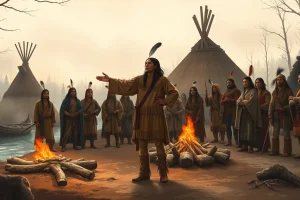
After the American Revolution, settlers surged into Creek homelands in western Georgia and present-day Alabama. Through treaties such as the Treaty of New York (1790) and subsequent agreements, the Creeks ceded land, and the U.S. government implemented a “civilization program” under Indian agent Benjamin Hawkins, promoting agriculture and private property. This program deepened divisions between Upper Creek towns along the Coosa and Tallapoosa Rivers and Lower Creek towns in the Flint and Chattahoochee valleys. The Lower Creeks, many of mixed descent, embraced the changes, while Upper Creek traditionalists resisted. The Shawnee chief Tecumseh visited Creek towns in 1811, urging pan-Indian unity and resistance. His message, reinforced by the comet and earthquakes of 1811–1812, galvanized the Red Sticks, who raised the “red stick” of war. The outbreak of the War of 1812 between Britain and the United States provided both sides with external allies: the British and Spanish offered support to the Red Sticks, while the U.S. government sought to suppress them as part of its broader wartime strategy.
What Happened
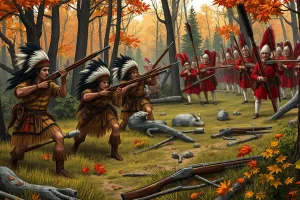
The Creek war began in earnest in the summer of 1813. After the U.S. attack on Prophet’s Town at Tippecanoe, Tecumseh’s allies retaliated against American settlements. The Creek National Council, dominated by Lower Creeks, attempted to punish Red Stick raiders, but internal violence escalated. In July 1813, a Red Stick party returning from Spanish Pensacola with munitions was attacked by Mississippi militia at Burnt Corn Creek. In retaliation, the Red Sticks attacked Fort Mims on August 30, 1813, killing more than 500 men, women, and children, including many Creek descendants. The “Fort Mims massacre” shocked the American frontier and prompted Tennessee, Georgia, and Mississippi to mobilize. Major General Andrew Jackson, commanding the Tennessee militia, moved south. In November 1813, Jackson’s forces destroyed the Creek town of Tallushatchee and defeated Red Sticks at Talladega. Georgia militia under John Floyd struck Autosee and Tallassee, and Mississippi troops with Choctaw allies attacked the Holy Ground. Jackson’s initial campaign stalled due to supply problems and enlistment expirations, but he resumed in January 1814, suffering a repulse at Emuckfau Creek. His decisive campaign began in March 1814. On March 27, 1814, Jackson attacked the Red Stick stronghold at Horseshoe Bend (Tohopeka), a fortified peninsula in the Tallapoosa River. With a combined force of regulars, militia, and allied Cherokee and Lower Creek warriors, Jackson breached the log breastwork and killed over 800 Red Sticks, effectively ending the war. Surviving Red Sticks fled to Spanish Florida. On August 9, 1814, Jackson forced the Treaty of Fort Jackson on the Creek Nation, ceding about 23 million acres—more than half of present-day Alabama—regardless of whether they had supported the Red Sticks.
Why It Matters
The Creek War had immediate and long-term consequences. It removed a significant Indigenous threat to American expansion in the southeast and opened millions of acres to white settlement. Militarily, it secured the southern frontier, freeing American troops and resources for other theaters of the War of 1812, and it catapulted Andrew Jackson to national fame. The war also disrupted the British strategy of allying with Indigenous peoples: the Red Sticks’ defeat undermined British efforts to divert American forces from Canada. For the Creek Nation, the war was catastrophic: an estimated half of the Upper Creek population died or fled, and the Treaty of Fort Jackson alienated both Red Stick and neutral towns, laying groundwork for the forced removal of the Creeks in the 1830s. Historians interpret the Creek War as both a tragic civil war and a pivotal episode in the expansion of the United States, illustrating the collision of Indigenous sovereignty with American settler colonialism.
Prelude
The immediate causes of the Creek War lay in decades of land pressure, internal factionalism, and the destabilizing influence of Tecumseh’s pan-Indian movement. The Red Sticks, led by prophets like Menewa and William Weatherford, emerged as a militant response to the accommodationist policies of the Lower Creek leadership. The U.S. government’s decision to punish Red Stick raids as part of its war effort escalated the internal conflict into a full-scale military campaign.
Forces and Commanders
American forces initially consisted of Tennessee militia under Major General Andrew Jackson, later reinforced by the 39th U.S. Infantry, Georgia militia under Brigadier General John Floyd, and Mississippi troops under Brigadier General Ferdinand Claiborne. They were supported by Cherokee and Lower Creek warriors, including chiefs like Major Ridge. The Red Sticks, predominantly Upper Creeks, fielded warriors from towns along the Tallapoosa and Coosa rivers. Their principal leaders included Menewa (also known as Hothlepoya) and William Weatherford, a mixed-race chief. The British provided limited arms via Spanish Florida, but no significant British troops entered the Creek country.
Battlefield and Map Context
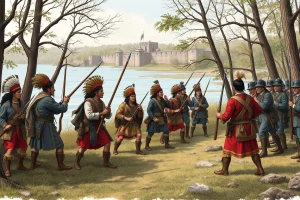
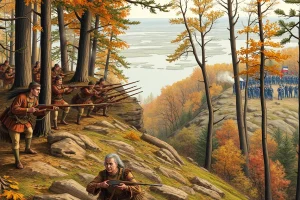
The Creek War was fought in the present-day states of Alabama and Georgia, in a landscape of rivers, forests, and scattered towns. The decisive engagement took place at Horseshoe Bend, a defensive position on the Tallapoosa River near present-day Dadeville, Alabama. The Red Sticks had built a strong breastwork across the neck of the peninsula, using the river as a natural moat. Jackson’s troops crossed the river and attacked from both sides, using artillery and coordinated assaults.
Battle Chronology
- July 27, 1813 – Burnt Corn Creek: Mississippi militia attacked a Red Stick supply party returning from Pensacola.
- August 30, 1813 – Fort Mims: Red Sticks stormed Fort Mims, killing over 500 people.
- November 3, 1813 – Tallushatchee: Jackson’s troops destroyed the Creek town.
- November 9, 1813 – Talladega: Jackson relieved a friendly Creek town and defeated Red Sticks.
- November 29, 1813 – Autosee: Georgia militia attacked and burned the town.
- December 23, 1813 – Holy Ground: Claiborne’s forces attacked a Red Stick camp.
- January 22, 1814 – Emuckfau Creek: Jackson’s camp was attacked and he withdrew.
- March 27, 1814 – Horseshoe Bend: Decisive American victory, killing over 800 Red Sticks.
Casualties and Losses
Exact casualty figures are disputed. At Fort Mims, the death toll is estimated at 500-700, including several hundred Creek descendants. At Horseshoe Bend, American losses were about 50 killed and 160 wounded, while over 800 Red Sticks died, many from drowning or exposure after the battle. Overall, the Creek population suffered severe losses; historian Kathryn Braund estimates that half of the Upper Creek people were either dead or had fled to Spanish territory by the war’s end.
Result
The Creek War ended with an overwhelming American victory. The Red Sticks’ military power was broken, and surviving leaders fled to Florida. The subsequent Treaty of Fort Jackson, signed on August 9, 1814, forced the Creek Nation to cede about 23 million acres to the United States, even from tribes that had allied with the Americans. The treaty also allowed the United States to build roads and military posts through Creek lands.
Strategic Consequences
The defeat of the Red Sticks secured the southern frontier and prevented British and Spanish forces from using the Creeks as a diversion. It freed American regulars and militia for operations elsewhere, such as the Gulf Coast campaign that culminated in the Battle of New Orleans. For the British, the loss of the Creek alliance weakened their position in the south and undermined Tecumseh’s pan-Indian confederacy. The war also accelerated the American policy of Indian removal, as the ceded lands were quickly opened to white settlement.
Primary Accounts
Contemporary sources include Andrew Jackson’s official reports to Tennessee Governor Willie Blount and the Secretary of War, as well as the diary and letters of Major Benjamin Hawkins, the U.S. Indian agent. The narrative of Sam Dale, a frontier scout, provides vivid details of the fighting. The Treaty of Fort Jackson itself is a primary document that outlines the land cessions. These accounts reflect the perspectives of American officials and soldiers, while Creek and Cherokee perspectives are less well documented, but oral traditions and later testimonies provide valuable insights.
Battlefield Today
Horseshoe Bend National Military Park in Alabama preserves the site of the decisive battle, with a visitor center, interpretive trails, and a monument. The park is administered by the National Park Service. Fort Mims, located near Bay Minette, Alabama, is a historic site operated by the Fort Mims Improvement Foundation. The Holy Ground battleground is marked near Wetumpka, Alabama. These sites offer visitors a chance to explore the terrain and learn about the war’s history.
Primary Sources
Key primary sources include: “Andrew Jackson to Willie Blount, March 28, 1814” (Jackson’s report of Horseshoe Bend); “Benjamin Hawkins’s Letters” (official correspondence on Creek affairs); “The Treaty of Fort Jackson, August 9, 1814” (the treaty text); and narratives by participants like John Coffee and Sam Dale. Each source provides a particular viewpoint: Jackson emphasizes military victory, Hawkins describes Creek factionalism, and the treaty demonstrates the coercive nature of the peace. These documents are housed in the National Archives, the Library of Congress, and state archives, and many are available in published collections such as Bassett’s “Correspondence of Andrew Jackson.”
Further Reading
- Braund, Kathryn E. Holland, ed. Tohopeka: Rethinking the Creek War and the War of 1812. Tuscaloosa: University of Alabama Press, 2012.
- Blackmon, Richard D. The Creek War 1813–1814. Washington, D.C.: U.S. Army Center of Military History, 2014.
- Haynes, Robert V. The Creek War. Lexington: University Press of Kentucky, 2010.
- Halbert, Henry S., and Timothy H. Ball. The Creek War of 1813 and 1814. Chicago: Donohue & Henneberry, 1895.
- O’Brien, Greg. Choctaws in a Revolutionary Age, 1750-1830. Lincoln: University of Nebraska Press, 2002.
References
- Braund, Kathryn E. Holland. “Creek War in the Southeast: A civil war and an enemy occupation.” U.S. National Park Service. Accessed June 2023. https://www.nps.gov/articles/creek-war-in-the-southeast-1.htm.
- “Indigenous Peoples – War of 1812.” U.S. National Park Service. Accessed June 2023. https://nps.gov/subjects/warof1812/indigenous-peoples.htm.
- Cusick, James G. “Review of Tohopeka: Rethinking the Creek War and the War of 1812.” Ethnohistory 60, no. 4 (2013): 775–776.
- “The Creek War of 1813-1814.” American Battlefield Trust. Updated January 17, 2024. https://www.battlefields.org/learn/articles/creek-war-1813-1814.
- Blackmon, Richard D. The Creek War 1813–1814. Washington, D.C.: U.S. Army Center of Military History, 2014.
FAQ
What caused the Creek War?
The war was caused by American encroachment on Creek lands, internal factionalism over assimilation, and Tecumseh's pan-Indian message, which galvanized the Red Sticks.
What was the Fort Mims massacre?
On August 30, 1813, Red Sticks attacked Fort Mims in Alabama, killing over 500 settlers, militia, and Creeks, which triggered American military intervention.
How did the Creek War affect the War of 1812?
The American victory secured the southern frontier, freed troops for other fronts, and deprived the British of a key Indigenous ally.
What did the Treaty of Fort Jackson do?
It forced the Creek Nation to cede about 23 million acres, including lands of nations that had fought with the United States, opening Alabama to settlement.


Leave a Reply