Short Answer
The Battle of Tippecanoe was fought on November 7, 1811, in the Indiana Territory near the confluence of the Wabash and Tippecanoe Rivers. Led by Governor William Henry Harrison, American regulars and militia attacked the Native American settlement of Prophetstown, inhabited by the Shawnee brothers Tecumseh and Tenskwatawa. Although often regarded as an American victory, the battle’s strategic effects were ambiguous: it failed to break Tecumseh’s confederacy and instead pushed many Indigenous peoples into an alliance with Great Britain. The battle became a rallying point for American grievances against alleged British support for Indian resistance, helping to set the stage for the U.S. declaration of war in June 1812.
Historical Context
After the American Revolution, the United States expanded aggressively into the Northwest Territory, which encompassed present-day Ohio, Indiana, Illinois, Michigan, and Wisconsin. The Treaty of Greenville (1795) had ceded much of Ohio to the United States, but pressure continued on Indian lands north of the Ohio River. By the early 1800s, settlers and speculators demanded ever more land, and government officials, particularly Indiana Territory Governor William Henry Harrison, negotiated a series of treaties that transferred millions of acres to the United States. The Treaty of Fort Wayne (1809) allegedly acquired three million acres from tribes that many indigenous groups considered unauthorized to cede common land.
In response, two Shawnee brothers, Tecumseh and his brother Tenskwatawa (known as the Prophet), launched a pan-Indian resistance movement. Tecumseh, a skilled orator and warrior, sought to unite tribes from the Great Lakes to the Gulf of Mexico into a confederacy to halt American expansion. Tenskwatawa, a religious leader who experienced visions, attracted followers with a message of cultural renewal and rejection of white influence. In 1808, they established Prophetstown at the junction of the Wabash and Tippecanoe Rivers, which became the political and spiritual center of the movement.
American settlers feared the growing concentration of Indians at Prophetstown, and rumors of an impending Indian war spread. Harrison, who viewed Tecumseh and Tenskwatawa as obstacles to land cessions, sought to disperse the community. Meanwhile, British agents in Canada maintained trade and diplomatic ties with western Indians, providing supplies and encouragement as a check on American expansion. This British connection would become a central point of contention, as Americans argued that Britain fomented Indian hostility along the frontier.
What Happened
In 1811, Harrison obtained authorization from Secretary of War William Eustis to mount an expedition against Prophetstown. Tecumseh was then traveling south to recruit allies among the Creek and Cherokee, leaving Tenskwatawa in command. Harrison assembled a force of about 1,000 men, including the 4th U.S. Infantry, a company of the 7th Infantry, Indiana militia, Kentucky mounted riflemen, and a troop of dragoons. He marched from Vincennes in late September, constructed Fort Harrison near present-day Terre Haute, and continued north through difficult terrain. On November 6, the army arrived near Prophetstown and made camp on a hill about a mile away, near Burnett Creek.
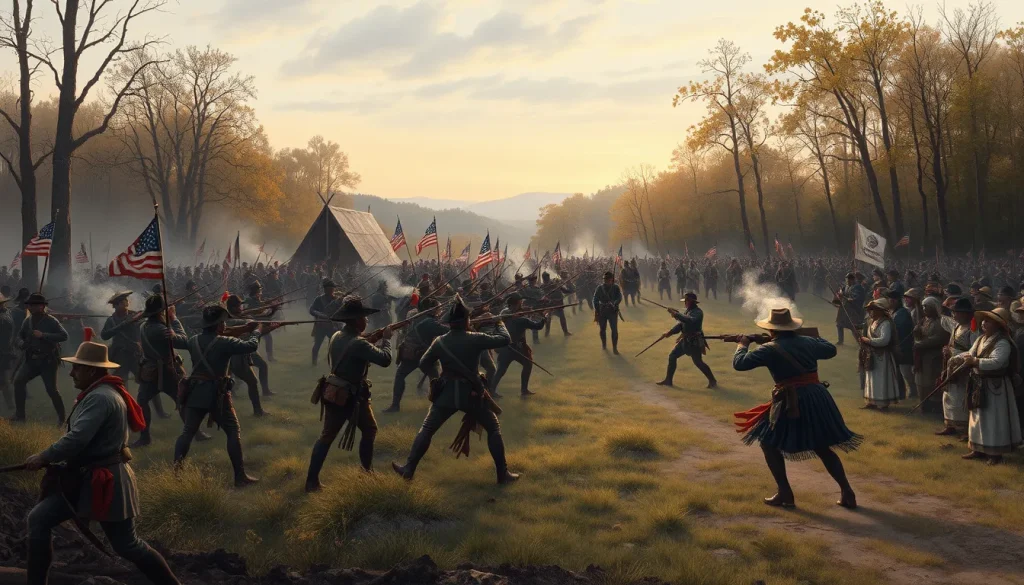
That evening, Tenskwatawa sent a delegation to Harrison proposing a parley the next day. Skeptical, Harrison ordered his men to form a defensive perimeter in a hollow square, with loaded arms and fixed bayonets. At dawn on November 7, Indian warriors launched a surprise attack on the camp, striking from several directions. The initial assault hit the northern and southern flanks. Captain Spier Spencer’s company, the ‘Yellow Jackets,’ held the south, but Spencer and other officers were killed, causing a temporary waver. Harrison, with the aid of mounted reinforcements and regulars, stabilized the line. After two hours of fighting, the warriors withdrew, running low on ammunition. Harrison’s men held their position, and the Indians retreated to Prophetstown.
The next day, November 8, Harrison’s troops destroyed Prophetstown, burning the dwellings and any stored supplies. The American force then marched back to Vincennes, suffering from casualties and illness. The battle was technically an American triumph, but it was costly: the United States lost about 62 killed and 126 wounded, while Indian casualties were estimated at around 125, though exact numbers remain uncertain.
Why It Matters
The Battle of Tippecanoe had profound consequences. First, it exacerbated the conflict between the United States and Tecumseh’s confederacy, turning a resistance movement into a full-scale war. Tecumseh, upon returning to find Prophetstown in ashes, became convinced that peaceful resistance was impossible and solidified his alliance with the British. Throughout 1812 and 1813, his warriors fought alongside British regulars and Canadian militia against American forces, notably at Detroit, Frenchtown, and the Thames.
Second, the battle influenced American public opinion and policy. Although the outcome was not decisive, Republican politicians and newspapers portrayed it as a great victory over the combined forces of Indians and their British instigators. The slogan ‘Tippecanoe’ became shorthand for American grievances against British interference. Many Americans believed that the British had supplied and encouraged the Indians at Tippecanoe, providing evidence of a conspiracy to destabilize the western frontier. This perception helped push the Madison administration and Congress toward war with Britain in 1812.
Historians have debated the battle’s military and political significance. Some argue that it was a costly and reckless operation that inflamed rather than quelled Indian resistance; others see it as a necessary assertion of American authority that exposed British involvement. The memory of Tippecanoe also had a long political afterlife: Harrison’s victory became a key element in his 1840 presidential campaign, with the slogan ‘Tippecanoe and Tyler Too.’ The battle thus contributed to both the coming of the War of 1812 and the political mythology of the American frontier.
Prelude
The immediate prelude to Tippecanoe lay in the Treaty of Fort Wayne (1809), which Tecumseh and Tenskwatawa repudiated as fraudulent. By 1811, Indian raids on frontier settlements had increased, and Harrison, believing that negotiation had failed, prepared for a military show of force. Tecumseh’s absence in the fall of 1811 seemed an ideal moment to strike at the head of the confederacy. Harrison’s expedition was thus a preemptive attack designed to destroy the center of Indian resistance, not simply a defensive action. The Americans were also motivated by fear of a general Indian uprising, encouraged, in their view, by British agents.
Forces and Commanders
The American force was commanded by William Henry Harrison, governor of Indiana Territory and a veteran of the Battle of Fallen Timbers. It comprised approximately 1,000 men: about 400 regulars of the 4th Infantry, a company of the 7th Infantry, and the rest Indiana and Kentucky militia, including mounted riflemen and dragoons. Key subordinates included Colonel John Parker Boyd, Major Joseph Hamilton Daveiss, and Captain Spier Spencer.
The American Indian force was led by Tenskwatawa, the Prophet, in the absence of Tecumseh. Their numbers are uncertain, with estimates ranging from 500 to 800 warriors from various tribes, including Shawnee, Potawatomi, Kickapoo, Winnebago, and others. Tenskwatawa, despite his religious authority, was not a military commander, and many of his warriors were young and relatively inexperienced. They were equipped with muskets and some rifles, but faced ammunition shortages.
Battlefield and Map Context
The battle took place near the modern city of Lafayette, Indiana, on a wooded rise overlooking Burnett Creek, about a mile northwest of Prophetstown. The American camp formed a rough rectangle on the elevated ground, which was bordered on one side by a marshy prairie. The terrain favored the defenders, as the attackers had to cross open ground to approach the camp. Prophetstown itself lay near the confluence of the Wabash and Tippecanoe Rivers, an area of dense woods and fields. The modern Tippecanoe Battlefield preserves the site, including Prophet’s Rock, from which Tenskwatawa is said to have rallied his warriors.
Battle Chronology
On November 6, Harrison’s force arrived within sight of Prophetstown and, after a parley with Tenskwatawa’s emissaries, withdrew to the chosen camp. The troops slept in battle order, but the attack came at dawn, around 4:30–5:00 a.m., on November 7. The warriors first struck the northern picket line, then hit the southern flank with greater intensity. The fighting was intense but lasted about two hours. American artillery (two six-pounder cannons) and disciplined regulars helped repel repeated charges. After the warriors withdrew, Harrison consolidated his position and sent out scouts. The Indians did not renew the attack, and on November 8, Harrison burned Prophetstown. The American column then retreated to Fort Harrison.
Casualties and Losses
Exact casualties are disputed. The American Battlefield Trust reports U.S. losses as 62 killed and 126 wounded, for a total of 189. The Canadian Encyclopedia gives 60 killed and about 140 wounded, totaling 200. Indian casualties are more uncertain; estimates range from 50 to 130 killed and wounded. Some sources claim that the Indians took their dead from the field, making counting impossible. The battle was costly for the Americans, with about 20% casualties, indicating a stiff fight.
Result
The Battle of Tippecanoe was a tactical American victory. The Indians were repulsed, and Prophetstown was burned. However, it was not a decisive victory, as the confederacy remained intact, and Tecumseh returned to rally resistance. In the short term, the battle strengthened Harrison’s political standing and the American claim of a triumph over British-inspired savagery. But it also galvanized Tecumseh’s alliance with Britain and escalated frontier warfare.
Strategic Consequences
The most significant strategic consequence was the acceleration toward war with Great Britain. Americans interpreted the battle as further proof of British meddling in Indian affairs, and the slogan ‘Tippecanoe’ became shorthand for British-supported Indian hostilities. Harrison’s victory, though costly, convinced many in the West that a war against Britain would secure the frontier. In the broader war, Tecumseh and his warriors allied with the British, participating in campaigns that threatened American positions in Detroit and the Northwest. The battle also hardened the resolve of Native American communities, many of whom had hoped to avoid a wider war. For Indigenous peoples, the battle was a turning point that led to the loss of their homeland over the next decade.
Primary Accounts
Several primary documents provide contemporary perspectives on the battle. Harrison wrote an official report to Secretary of War Eustis on November 18, 1811, describing the march, the engagement, and his decision to burn Prophetstown. His report, while detailed, naturally downplays his own miscalculations and criticisms. Another account comes from a soldier of the 4th Infantry, whose diary or letter survives in partial form, offering a lower-rank view of the horrors of the battle. Tenskwatawa’s own account, as recorded later, denied defeat and claimed that his warriors retreated only when ammunition ran low. American newspaper accounts, such as the Niles Weekly Register, used the battle to demonize British involvement. These sources must be used with caution, as each reflects the bias and political aims of its author.
Battlefield Today
The Tippecanoe Battlefield is a National Historic Landmark located near Lafayette, Indiana. The site includes the battlefield itself, a monument erected in 1908, and a museum. Prophet’s Rock, from which Tenskwatawa ostensibly encouraged his warriors, is preserved. Visitors can walk the ground where the American camp stood and learn about the battle through interpretive exhibits. The battlefield is administered by the Tippecanoe County Historical Association, and it offers a tangible link to the events of November 7, 1811.
Primary Sources
Relevant primary sources include:
- William Henry Harrison’s official report to Secretary of War William Eustis, November 18, 1811, detailing the campaign and battle. Available in published documentary editions and at the U.S. National Archives.
- The anonymous diary or letter of a soldier of the 4th Infantry, quoted in contemporaneous newspapers and later collected by historians.
- U.S. government correspondence, including letters between Harrison and Eustis before and after the battle, available in the American State Papers.
- British and Canadian sources, such as the correspondence of British Indian agents like Robert Dickson, which reveal the British perspective on Indian alliances, but were not directly about Tippecanoe.
- Newspaper accounts from 1811 and 1812, especially the Niles Weekly Register, which explicitly connected Tippecanoe to British intrigue.
These sources are biased and incomplete; they reflect the political agendas of their authors. No Indigenous written account of the battle exists, as the Indian side was transmitted orally and later recorded in a few testimonies. Scholars must reconstruct Indigenous participation through American and British reports, which are often condescending or hostile.
Further Reading
- Edmunds, R. David. The Shawnee Prophet. University of Nebraska Press, 1983.
- Jortner, Adam. The Gods of Prophetstown: The Battle of Tippecanoe and the Holy War for the American Frontier. Oxford University Press, 2011.
- Sugden, John. Tecumseh: A Life. Holt Paperbacks, 1999.
- Dowd, Gregory Evans. A Spirited Resistance: The North American Indian Struggle for Unity, 1745–1815. Johns Hopkins University Press, 1992.
- See also: National Park Service article ‘Autumn 1811: The Battle of Tippecanoe’ and Canadian Encyclopedia’s ‘Battle of Tippecanoe.’
References
- National Park Service. ‘Autumn 1811: The Battle of Tippecanoe.’ https://www.nps.gov/articles/tippecanoe.htm
- U.S. Army Center of Military History. ‘Battle of Tippecanoe, 1811.’ https://history.army.mil/news/2014/141100a_tippecanoe.html
- American Battlefield Trust. ‘Tippecanoe Battle Facts and Summary.’ https://www.battlefields.org/learn/war-1812/battles/tippecanoe
- The Canadian Encyclopedia. ‘Battle of Tippecanoe.’ https://thecanadianencyclopedia.ca/en/article/battle-of-tippecanoe
- Edmunds, R. David. The Shawnee Prophet.
- Jortner, Adam. The Gods of Prophetstown.
FAQ
What was the Battle of Tippecanoe?
The Battle of Tippecanoe was an engagement fought on November 7, 1811, between American forces led by William Henry Harrison and Native American warriors of Tecumseh's confederacy, near modern-day Lafayette, Indiana. The Americans defeated the Indians and destroyed Prophetstown.
How did the Battle of Tippecanoe lead to the War of 1812?
The battle fueled American anger by convincing many that the British were inciting and arming Indian tribes against American settlers. This perception, captured in the slogan 'Tippecanoe,' helped push President Madison to request a declaration of war against Britain in 1812.
Who was the Prophet in the Battle of Tippecanoe?
The Prophet was Tenskwatawa, a Shawnee religious leader and brother of Tecumseh. He commanded the Indian forces at Tippecanoe because Tecumseh was away recruiting allies. Tenskwatawa's leadership in battle was criticized, and his warriors lost faith after the defeat.


Leave a Reply