
Short Answer
The First Siege of Fort Meigs (28 April–9 May 1813) was a combined British and Indigenous attempt to capture the American fortification on the Maumee River near present-day Perrysburg, Ohio, during the War of 1812. It is historically significant because the American garrison under Major General William Henry Harrison successfully resisted the siege, forcing the British to withdraw, even though a relief column suffered a devastating defeat. The engagement demonstrated the value of earthwork fortifications and shaped the subsequent campaign in the Northwest.
Historical Context
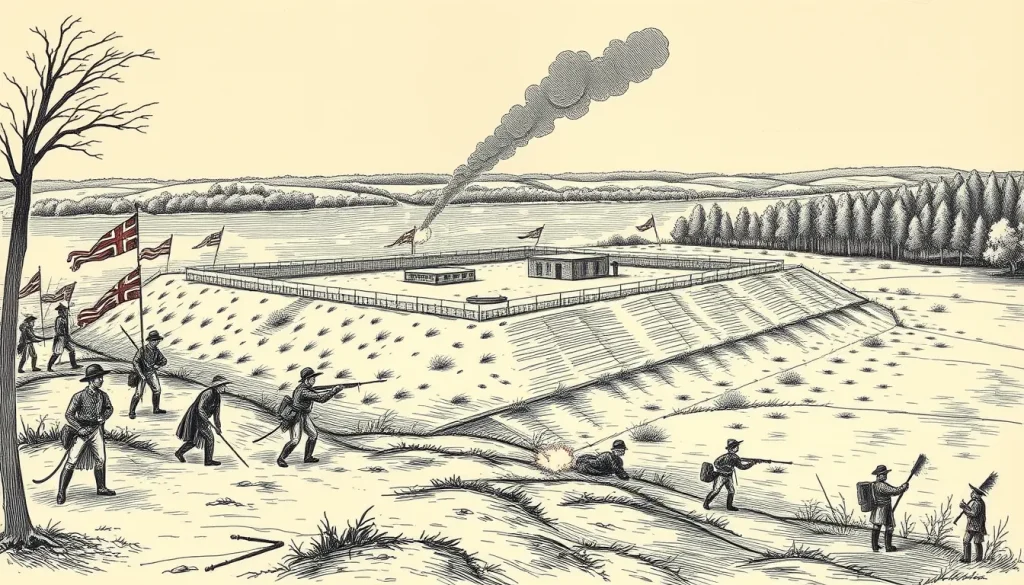
Following the American surrender of Detroit in August 1812 and the defeat at Frenchtown (River Raisin) in January 1813, the northwest frontier lay exposed to British and Indigenous raids. Major General William Henry Harrison, commander of the North Western Army, ordered construction of a fortified post on a bluff overlooking the Maumee River rapids. The fort, named for Ohio Governor Return J. Meigs, was intended as both a defensive stronghold and a staging point for a future American invasion of Canada. Built between February and April 1813 under the supervision of engineer Eleazer Wood, Fort Meigs consisted of earthen ramparts, seven blockhouses, five artillery batteries, and about twenty guns. It was a substantial earthwork fortification, not merely a stockade, and was designed to withstand artillery bombardment.
The British commander in the region, Brigadier General Henry Procter, had consolidated his forces after Frenchtown and received reinforcements. He determined to destroy Fort Meigs to eliminate the American threat to his base at Fort Malden (Amherstburg) and to protect Upper Canada. Procter assembled a mixed force of British regulars, Canadian militia, and Indigenous warriors under the Shawnee chief Tecumseh.
What Happened
Procter’s force arrived at the mouth of the Maumee River on 28 April 1813 and moved upriver. Over the next few days, the British established batteries on both sides of the river and partly surrounded the fort with Indigenous warriors. The bombardment opened on 1 May, but the earthen walls absorbed much of the fire, and American casualties were light. Harrison, expecting relief, sent word to Kentucky militia Major General Green Clay, who was marching toward the fort with about 1,200 men.
On 5 May, Clay’s relief column arrived. Harrison planned a coordinated attack: a detachment of about 800 Kentuckians under Colonel William Dudley would land on the north bank, spike the British guns, and then withdraw to the fort, while another detachment would land on the south bank and reinforce the garrison. The initial assault succeeded in overrunning the British batteries, but Dudley’s men ignored orders to return to the fort and pursued the retreating British into the woods. There, they were ambushed by Tecumseh’s warriors and British regulars. About 650 of Dudley’s men were killed or captured, with Dudley himself among the dead. Meanwhile, the sortie against the southern battery also stalled, and the American attackers were driven back.
Despite this tactical defeat, the garrison held. Procter’s artillery could not breach the fort’s earthworks, and his Indigenous allies were unwilling to storm a fortified position. When Canadian militia began to depart for spring planting, Procter was forced to lift the siege on 9 May and withdraw to Fort Malden. The fort remained in American hands.
Why It Matters
The successful defense of Fort Meigs prevented a British and Indigenous victory that might have secured the Maumee River corridor and threatened the American position in the Northwest. It also protected the staging area for the American campaign that culminated in Oliver Hazard Perry’s naval victory at the Battle of Lake Erie in September 1813 and the subsequent recapture of Detroit. The siege demonstrated the effectiveness of earthwork fortifications and the difficulty of reducing them with field guns. It also exposed the limits of British-Indigenous cooperation in siege warfare: Indigenous warriors excelled in ambushes and open combat but were not suited for prolonged assaults on fixed defenses. For the Americans, the disaster suffered by Dudley’s militia reinforced the reputation of Kentucky militia as brave but undisciplined, a recurring theme in the war. Historians generally view the First Siege of Fort Meigs as a strategic American victory, even though the relief column’s losses were heavy.
Prelude
The Fort Meigs site was selected by Harrison in early 1813 after the setbacks at Detroit and Frenchtown. Construction began on 2 February 1813 and proceeded quickly. By late April, the fort was complete enough to withstand attack. Procter, having received reinforcements including the flank companies of the 41st Foot, left Fort Malden on 26 April with about 550 regulars, 63 fencibles, 464 militia, and roughly 1,200 Indigenous warriors under Tecumseh. The British moved down the Detroit River and Lake Erie to the Maumee, landing at the river’s mouth on 28 April.
Forces and Commanders
American: Major General William Henry Harrison commanded the garrison of approximately 1,100 regulars and militia, with about 20–30 cannons. Relief forces under Brigadier General Green Clay arrived on 5 May, bringing another 1,200 Kentucky militia. Colonel William Dudley led the ill-fated north-bank assault.
British and Indigenous: Brigadier General Henry Procter led approximately 550 British regulars, 63 fencibles, 464 Canadian militia, and about 1,200 Indigenous warriors, predominantly Shawnee and other tribes under Tecumseh’s leadership. Total strength is often cited as around 2,000–2,400.
Battlefield and Map Context
Fort Meigs lay on a bluff on the south bank of the Maumee River, about two miles from the rapids near the modern city of Perrysburg, Ohio. The river provided a transportation route, and the fort controlled the entrance to the Maumee Valley. The terrain was a mixture of forested banks and open ground near the fort. The British placed batteries on both sides of the river to enfilade the fort, while Indigenous fighters took positions in the woods to intercept any American sortie or relief column. The fort’s earthen traverses and blockhouses were designed to minimize casualties from such fire.
Battle Chronology
- 28 April – British and Indigenous forces land at the mouth of the Maumee and begin moving toward Fort Meigs.
- 29–30 April – British troops establish gun batteries on both sides of the river; Indigenous warriors surround the fort and skirmish with pickets.
- 1 May – British artillery opens fire on the fort; the bombardment is heavy but ineffective against the earthworks.
- 4 May – Harrison learns of Clay’s approaching relief column and plans a coordinated attack.
- 5 May – At about 9:00 a.m., Clay’s column lands. The north-bank detachment under Dudley overruns and spikes the British guns but then pursues the retreating enemy into the woods, where they are ambushed. The south-bank detachment is also repulsed. American losses are severe.
- 6–8 May – The siege continues, but British morale dwindles as militia depart and Indigenous allies become impatient.
- 9 May – Procter lifts the siege and withdraws to Fort Malden.
Casualties and Losses
Casualty figures vary by source, but the American relief column suffered the heaviest losses. Of Dudley’s approximately 800 men, roughly 650 were killed or captured, many of the prisoners being killed by Indigenous warriors before Tecumseh intervened. American total casualties are estimated at about 1,000 (killed, wounded, and captured). British and Indigenous casualties were comparatively light, commonly cited as about 15 killed, 46 wounded, and 41 captured for the British regulars and militia, with Indigenous losses not precisely recorded. The American Battlefield Trust lists total estimated casualties as 1,107 (United States 986, United Kingdom 121).
Result
The First Siege of Fort Meigs was an American strategic victory. The fort remained in American hands, and the British withdrew after failing to capture it. The tactical success of the British in the Dudley sortie did not compensate for the failure of the siege. Procter’s withdrawal left the Maumee corridor under American control and set the stage for the later American offensive into Upper Canada.
Strategic Consequences
The successful defense of Fort Meigs secured the American supply line across Ohio and protected the base for the invasion of Canada. It also boosted American morale after earlier disasters. For the British, the failure to eliminate Fort Meigs meant they could not prevent the American concentration near Lake Erie. This ultimately contributed to the American victory at the Battle of Lake Erie (September 1813) and the abandonment of Detroit and Fort Malden. The siege also highlighted the difficulty of coordinating Indigenous forces in prolonged conventional operations, a factor that would shape British strategy for the rest of the war.
Primary Accounts
Official reports by Major General William Henry Harrison and Brigadier General Henry Procter describe the siege from their respective perspectives. Harrison’s report, dated after the siege, emphasizes the fort’s defense and the relief column’s failure due to disobedience. Procter’s report highlights the successful ambush of Dudley’s force but acknowledges the impossibility of storming the fort. A personal letter written by American soldier William Johnson to his wife, dated during the siege, provides a soldier’s view of the bombardment and the relief attempt. There are also later accounts, such as those in the Hard Cider and Log Cabin Almanac (1841), which dramatized the events.
Battlefield Today
Fort Meigs is now a reconstructed historic site in Perrysburg, Ohio. The Ohio Historical Society reconstructed the earthworks and wooden blockhouses in the 1970s, with renovations in 2003. It is the largest reconstructed wooden-walled fort in the United States and a National Historic Landmark. Visitors can see the earthen ramparts, blockhouses, and artillery batteries that recreated the appearance of the fort during the summer of 1813. Interpretive exhibits detail the construction, the two sieges, and the daily life of soldiers. The site is preserved and open to the public.
Primary Sources
Major General William Henry Harrison’s official report (May 1813) – This report to the Secretary of War outlines the siege, the relief plan, and the disastrous attack on the north bank. It is a key American source but may downplay the extent of the defeat.
Brigadier General Henry Procter’s official report (May 1813) – Procter’s account gives the British perspective and claims a victory in the action of 5 May, while noting the decision to withdraw. It is biased but essential for understanding British calculations.
Letter from William Johnson to his wife (during the siege) – This personal letter offers a soldier’s perspective on the bombardment and the relief column. It is preserved by the Ohio History Connection (Ohio Memory project).
Orderly books and diaries of American soldiers – Various diaries and orderly books from participants survive in archives such as the Clements Library and the Ohio History Connection. They provide day-to-day details but must be read critically.
These sources are not free of bias; each was written to inform superiors or to express personal views. Historians cross-reference official reports with private letters and later accounts to reconstruct events.
Further Reading
- Hickey, Donald R. The War of 1812: A Forgotten Conflict. University of Illinois Press, 2012.
- Latimer, Jon. 1812: War with America. Harvard University Press, 2007.
- Berton, Pierre. The Invasion of Canada, 1812–1813. McClelland and Stewart, 2011.
- Gilpin, Alec R. The War of 1812 in the Old Northwest. Michigan State University Press, 2012.
- Fort Meigs Historic Site – Ohio History Connection. https://www.fortmeigs.org/
References
- American Battlefield Trust. “Fort Meigs Battle Facts and Summary.” Accessed September 2023. https://www.battlefields.org/learn/war-1812/battles/fort-meigs.
- Ohio Memory. “Siege of Fort Meigs” (blog). May 10, 2013. https://ohiomemory.ohiohistory.org/archives/1132.
- U.S. Army. “War of 1812 bicentennial: Fort Meigs.” March 14, 2013. https://www.army.mil/article/96316/war_of_1812_bicentennial_fort_meigs.
- History of War. “Siege of Fort Meigs, 1-9 May 1813.” Accessed September 2023. https://www.historyofwar.org/articles/siege_fort_meigs_may_1813.html.
- The War of 1812 Website. “Siege of Fort Meigs.” Accessed September 2023. https://thewarof1812.org/battles/siege-of-fort-meigs/.
FAQ
Why was Fort Meigs built?
Fort Meigs was built by the American forces under William Henry Harrison in early 1813 to defend the northwest frontier after the loss of Detroit and to serve as a staging point for an invasion of Canada.
Who were the commanders at the First Siege of Fort Meigs?
The American garrison was commanded by Major General William Henry Harrison, while the British and Indigenous forces were commanded by Brigadier General Henry Procter and the Shawnee chief Tecumseh.
What was the outcome of the First Siege of Fort Meigs?
The American garrison successfully held the fort, and the British lifted the siege on May 9, 1813. The relief column suffered heavy losses, but the fort remained in American hands.
How did Tecumseh's role affect the siege?
Tecumseh led the Indigenous warriors who ambushed and nearly destroyed the American relief column under Colonel Dudley, but he and his warriors were unwilling to assault the fort itself, which contributed to the British decision to withdraw.


Leave a Reply