
Short Answer
The Northwest Campaign of 1813 comprised the military operations in the Great Lakes and Ohio Valley region during the second year of the War of 1812. Following American defeats in 1812, the campaign centered on the recovery of Detroit and the destruction of British–Indigenous alliances, culminating in the Battle of Lake Erie and the Battle of the Thames. Its outcome permanently altered the balance of power in the Northwest and doomed Tecumseh’s pan-Indian confederacy. The campaign is historically significant because it secured the American frontier and opened the region to expanded settlement.
Historical Context
The war had begun in 1812 with an American invasion of Upper Canada, but the surrender of Brigadier General William Hull at Detroit in August 1812 exposed the entire Northwest frontier. British forces under Major General Isaac Brock, supported by Tecumseh’s confederacy, captured Detroit and Fort Mackinac, giving Britain and its Indigenous allies control of the upper Great Lakes. American efforts to rebuild and regain the lost territory were hindered by poor logistics, militia short enlistments, and divided command. In the autumn of 1812, Governor William Henry Harrison of Indiana Territory was given command of a new Northwestern Army, tasked with retaking Detroit and breaking British influence over Indigenous nations. The stage for 1813 was set by the prolonged winter stalemate and the British fort at Amherstburg as a forward base.
What Happened
The campaign opened with the Battle of Frenchtown (River Raisin) on January 22, 1813. An American force commanded by Brigadier General James Winchester had advanced to the Raisin River in Michigan to establish a foothold. Despite initial success, they were surprised by a combined British, Canadian, and Indigenous force under Brigadier General Henry Procter. The Americans suffered over 300 killed and approximately 500 captured. The subsequent killing of American prisoners by Indigenous warriors became known as the “River Raisin Massacre,” fueling American calls for retribution under the cry “Remember the Raisin.”
Harrison, upon learning of the defeat, withdrew to the Maumee River and constructed Fort Meigs to secure his army and serve as a staging point. In late April, Procter, urged by Tecumseh, launched a siege of Fort Meigs. The fort held, but a relief column of Kentucky militia was ambushed on May 5, suffering about 650 casualties. Procter lifted the siege on May 9 and returned to Detroit. He made a second attempt in late July, but lacking adequate artillery and facing the strengthened fort, he withdrew without a decisive action. Procter then shifted his attention to Fort Stephenson on the Sandusky River. On August 2, an attack failed against the small garrison under Major George Croghan, who inflicted heavy losses on the British.
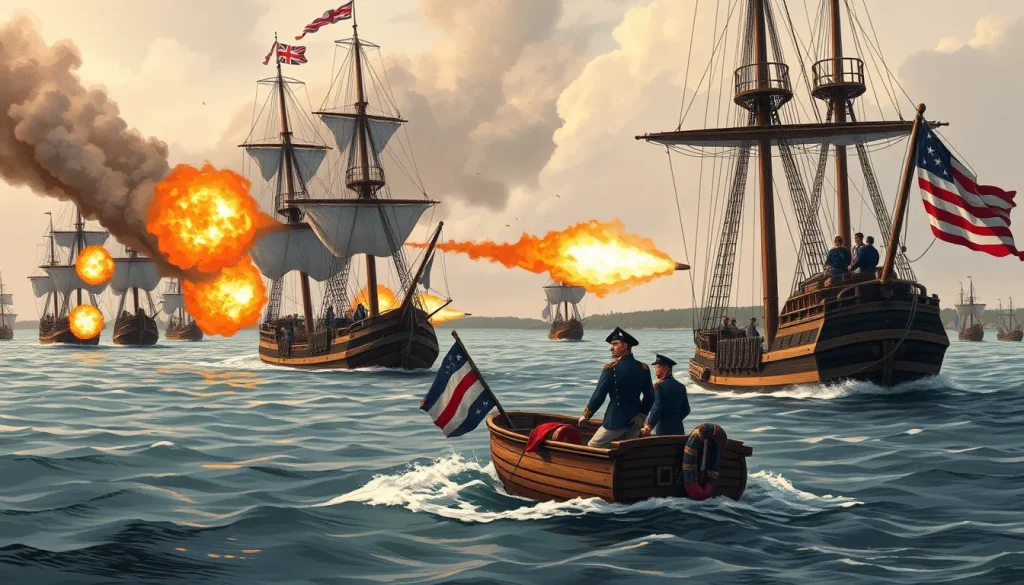
The strategic turning point came on Lake Erie. Master Commandant Oliver Hazard Perry had built a fleet at Erie, Pennsylvania, and in September engaged the British squadron commanded by Commander Robert Barclay near Put-in-Bay. After a fierce three-hour battle, Perry’s force prevailed, giving the United States control of the lake. Perry’s terse dispatch, “We have met the enemy and they are ours,” signaled the end of British naval supremacy. The British commander, Procter, now faced a severed supply line and retreated from Detroit toward the Thames River in Upper Canada.
Harrison pursued with a reinforced army, transported by Perry’s fleet. On October 5, 1813, the Americans caught up with Procter’s retreating column at Moraviantown on the Thames River. In a rapid assault, the British regulars collapsed, and Tecumseh, the charismatic Shawnee leader, was killed. His death shattered the Indigenous confederacy. The victory at the Thames effectively ended organized Indigenous resistance in the Northwest and restored American control over the region.
Why It Matters
The immediate consequences of the campaign were the recovery of Detroit and the recapture of the Michigan Territory, along with the permanent destruction of Tecumseh’s coalition. It also gave the United States a much-needed morale boost and solidified Perry’s status as a national hero. In the longer term, the campaign’s outcome removed the primary barrier to American westward expansion. British hopes of an Indigenous buffer state collapsed, and the Treaty of Ghent in 1814, while restoring pre-war boundaries, could not restore the power of Indigenous peoples in the region. Historians such as Alan Taylor argue that the war in the Northwest was fundamentally about control of land and Indigenous sovereignty, making the campaign’s outcome more significant than the European-style exchanges of territory. The campaign also demonstrated the importance of naval control of the Great Lakes, a lesson that shaped future military operations.
Definition
The Northwest Campaign of 1813 refers to the series of land and naval operations between January and October 1813 in the region west of the Allegheny Mountains and north of the Ohio River, comprising parts of present-day Michigan, Ohio, and Ontario. It included the Battles of Frenchtown, Fort Meigs, Fort Stephenson, Lake Erie, and the Thames.
Background
Following the failures of 1812, American strategy in the Northwest aimed at eliminating British and Indigenous military influence. The campaign’s roots lay in the long-standing tensions over American settlement and British support for Indigenous nations. The British maintained fur trade alliances and supplied arms to tribes resisting American expansion. The American government sought to conquer Canada as a means to pressure Britain and to annex Indian lands.
How It Worked
American strategy revolved around a land-navy combination. Harrison built a trained force, while Perry constructed a squadron to challenge British control of Lake Erie. The key was the ability to move troops and supplies waterborne. The campaign unfolded in phases: first, consolidation and fortification (Fort Meigs); second, naval conflict on Lake Erie; third, pursuit and defeat on land. British and Indigenous forces relied on established fortifications and their alliance with Tecumseh, but the loss of the lake cut their supply line and forced a retreat that proved fatal.
Competing Viewpoints
Interpretations of the campaign vary. American historians often emphasize Perry’s victory and the reclaiming of American territory as a turning point. British and Canadian historians note the logistical hardships and the strategic necessity of retreat. Indigenous historians highlight the irreparable loss to Native nations, viewing the campaign as a disaster that undermined their sovereignty. Some scholars argue that the campaign’s outcome was inevitable given American resources, while others point to contingency, such as the death of Tecumseh, as decisive.
Role in the War of 1812
The Northwest Campaign of 1813 secured the American western front, allowing the United States to concentrate efforts on other theaters such as the Niagara frontier and the Lake Champlain region. It also deprived Britain of a valuable ally and destroyed any hopes of a separate Indigenous state. In diplomatic terms, the campaign strengthened the American bargaining position at Ghent, though the status quo ante bellum was restored.
Consequences and Historical Interpretation
The most far-reaching consequence was the collapse of Indigenous resistance in the Northwest. The death of Tecumseh and the defeat of the British opened the floodgates to American settlement. The campaign also solidified the reputation of William Henry Harrison, who later became president. Historical writing has evolved from an emphasis on heroic battles to a recognition of the campaign’s tragic impact on Native peoples. The term “Remember the Raisin” remains a symbol of the brutal nature of frontier warfare. The 1813 campaign is now understood as a turning point not only in the war but in the long history of American expansion.
Primary Sources
Primary sources for the campaign include Oliver Hazard Perry’s action report of September 10, 1813, describing the Battle of Lake Erie. William Henry Harrison’s dispatches to Secretary of War John Armstrong detail the planning and execution of the campaign. James Winchester’s 1818 book Historical Details Having Relation to the Campaign of the North-Western Army defends his actions at River Raisin. The orderly book of the Lexington Light Infantry, now in the Lilly Library, records orders from August 1812 to February 1813. Contemporary newspapers, including the National Intelligencer, carried accounts and casualty lists. Each source carries its own bias—military officers sought to justify their decisions, while newspapers shaped public opinion.
Further Reading
- Donald R. Hickey, The War of 1812: A Forgotten Conflict (University of Illinois Press, 1989).
- Jon Latimer, 1812: War with America (Harvard University Press, 2007).
- Alan Taylor, The Civil War of 1812: American Citizens, British Subjects, Irish Rebels, & Indian Allies (Knopf, 2010).
- Richard Rozevink and David Bennett, Campaigns of the Army of the Northwest, 1812–1813 (Defiance County Chapter of the Ohio Genealogical Society, 2008).
- Lilly Library, Indiana University, “Old Northwest 1813” digital exhibit.
References
- Hickey, Donald R. The War of 1812: A Forgotten Conflict. University of Illinois Press, 1989.
- Latimer, Jon. 1812: War with America. Harvard University Press, 2007.
- Taylor, Alan. The Civil War of 1812. Knopf, 2010.
- “Old Northwest 1813,” Lilly Library, Indiana University, https://collections.libraries.indiana.edu/warof1812/exhibits/show/warof1812/the-war-1813/old-northwest–1813 (accessed 2023).
- “The Northwest Campaign – War of 1812.” thewarof1812.org, https://thewarof1812.org/campaigns/the-northwest-campaign/ (accessed 2023).
- “War of 1812 – The Campaigns of 1813.” WarHistory.org, https://warhistory.org/article/war-of-1812-the-campaigns-of-1813 (accessed 2023).
FAQ
What was the significance of the Battle of Lake Erie?
The Battle of Lake Erie gave the United States control of the lake, enabling the transport of Harrison's army and cutting off British supplies, leading to the British retreat and the subsequent Battle of the Thames.
How did Tecumseh die?
Tecumseh was killed on October 5, 1813, during the Battle of the Thames. The exact circumstances remain debated, but his death marked the end of the Indigenous confederacy.
Why was the Northwest Campaign of 1813 decisive?
It secured American control of the Northwest, destroyed the British–Indigenous alliance, and opened the region to American settlement, making it a turning point in the war and in American westward expansion.



Leave a Reply