
Short Answer
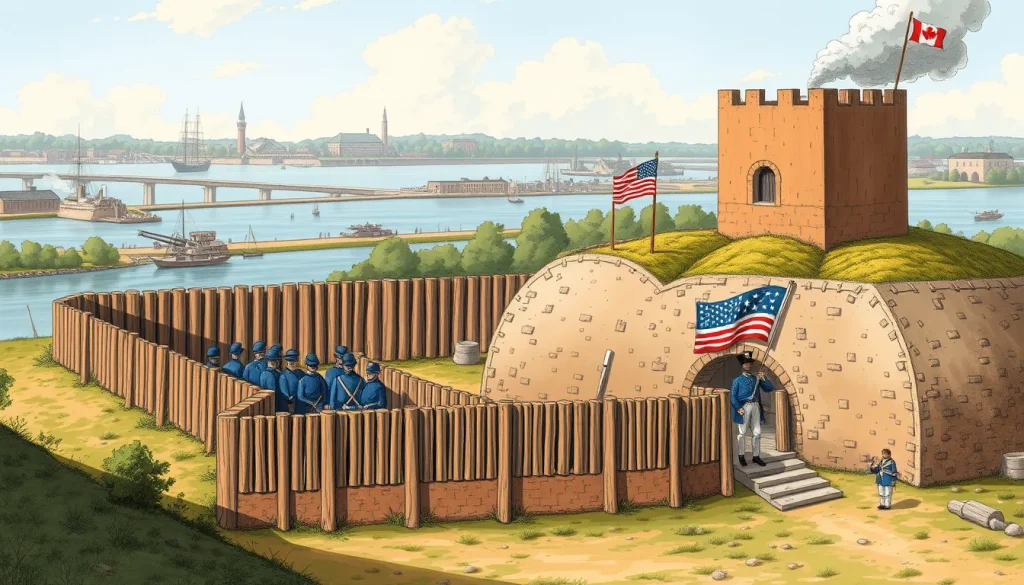
Fort Detroit stood on the north bank of the Detroit River as the primary American military installation in the Michigan Territory during the War of 1812. Originally constructed as Fort Lernoult in 1778–1779 and renamed Fort Detroit in 1805, it became the staging point for an American invasion of Upper Canada in July 1812. Its surrender to British and Indigenous forces under Major General Isaac Brock and Shawnee leader Tecumseh on August 16, 1812, marked one of the most humiliating American defeats of the war and dramatically shifted the balance of power in the Northwest.
Historical Context
Fort Detroit’s history stretched back to the British occupation of the region after the Seven Years’ War. The fort was built in 1778–79 by British Captain Richard Lernoult to defend against an expected American attack during the Revolutionary War. After the Treaty of Paris (1783) ceded Detroit to the United States, the British refused to leave until the Jay Treaty of 1796, when American troops under Colonel Jean François Hamtramck took possession. The fort was renamed Fort Detroit in 1805, the same year a fire destroyed most of the town.
By 1812, the Michigan Territory had become a sensitive frontier. The United States and Great Britain were at odds over impressment, trade restrictions, and British support for Indigenous resistance. President James Madison’s administration planned an invasion of Canada, and Brigadier General William Hull, governor of the Michigan Territory, proposed using Fort Detroit as a base for a western offensive. Hull’s army, the Northwestern Army, arrived at Detroit in early July 1812, intending to cross into Upper Canada and secure the vital British post at Amherstburg.
What Happened
Hull crossed the Detroit River on July 12, 1812, and occupied Sandwich (now Windsor) unopposed. He issued a proclamation to Canadian inhabitants, urging them to remain neutral or embrace American liberty. However, his advance stalled. His supply line stretched back to Ohio through a narrow road that was vulnerable to attack. British and Indigenous forces, led by Tecumseh, ambushed American supply convoys at Brownstown (August 5) and Maguaga (August 9), cutting Hull’s communications. On August 11, Hull withdrew his troops from Sandwich back to Fort Detroit, fearing a full-scale Indigenous assault.
The British seized the initiative. Major General Isaac Brock arrived at Fort Amherstburg on August 13 with reinforcements, determined to attack Detroit despite being outnumbered. Brock sent Hull a summons to surrender on August 15, warning that once battle commenced, the large force of First Nations warriors under Tecumseh would be beyond his control. When Hull rejected the demand, British artillery from Sandwich fired on the fort, and that night about 530 warriors crossed the river by canoe, followed by British regulars and militia at daylight. On the morning of August 16, Brock’s forces advanced toward the fort, while Tecumseh’s warriors moved through the woods. At about 10 a.m., a white flag appeared over the fort. Hull surrendered the entire garrison—approximately 2,188 men—along with 39 cannons, huge stores of arms and ammunition, and the unfinished warship Adams (soon renamed Detroit by the British).
The British occupied Detroit and held it for thirteen months. The defeat opened the entire Michigan Territory to British control. In September 1813, after Master Commandant Oliver Hazard Perry’s victory on Lake Erie, American forces under Major General William Henry Harrison advanced on Detroit. The British, led by Brigadier General Henry Procter, evacuated the fort and retreated into Upper Canada. Harrison’s army occupied Detroit on September 29, 1813, and renamed it Fort Shelby in honor of Kentucky governor Isaac Shelby. The fort was later abandoned and demolished in 1826.
Why It Matters
The surrender of Fort Detroit was a devastating early blow to American morale and a stunning propaganda victory for Britain and its Indigenous allies. It secured the Northwest frontier for the British for over a year, encouraged Indigenous resistance, and exposed the unpreparedness of the American military. Hull was court-martialed and sentenced to death for cowardice and treason, though President Madison commuted the sentence; his reputation was permanently ruined. Historians have long debated Hull’s decision—whether he was a coward, a victim of his fears of an Indian massacre, or simply overwhelmed by logistical problems. The recapture of the fort in 1813, following the Battle of Lake Erie, restored American control but did little to erase the memory of the humiliating capitulation.
Historical Map Context
Fort Detroit was located on a high bank overlooking the Detroit River, at the narrowest point of the river connecting Lake Erie and Lake Huron. The fort was about 4,000 feet north of the town of Detroit, which was walled with a palisade. Its main weakness was that its guns could not easily fire on British ships on the river or on British batteries on the opposite shore at Sandwich. The surrounding terrain was a mix of forest, farms, and open land that allowed approach from the north, east, and south. Maps of the period show the fort oriented inland, with a bastion facing the river and a redoubt system to the rear. The site controlled the river crossing and the vital road connecting Ohio to Michigan, making it a linchpin of the frontier defense.
Modern Location
The former Fort Detroit grounds are now part of the downtown area of Detroit, Michigan. The center of the fort is at the intersection of West Fort Street and Shelby Street, where historical markers commemorate its existence. Today, this is a busy urban district with commercial buildings, hotels, and public spaces. The fort itself was demolished in the 1820s, and no above-ground structures remain. A historic marker and interpretive panels identify the site for visitors.
Events at the Site
In addition to the 1812 surrender, Fort Detroit was the site of several other significant events. It was originally constructed as Fort Lernoult in 1778–1779 and changed hands several times. During the American Revolution, it was a British outpost; it was finally occupied by Americans in 1796. In 1805, the fort survived the town fire that destroyed most of Detroit. During the War of 1812, it was the headquarters for Hull’s army, the scene of the surrender, and later the focus of American recapture in 1813. After the war, the fort was renamed Fort Shelby and remained a military post until 1826, when troops left and the structure was demolished.
Associated People
The fort’s history is linked to several key figures: Brigadier General William Hull, governor of the Michigan Territory, who surrendered the fort in 1812; Major General Isaac Brock, the British commander who accepted the surrender and died later at Queenston Heights; Tecumseh, the Shawnee war leader whose warriors played a critical role in the campaign; Henry Procter, the British officer who later commanded at Fort Detroit; and William Henry Harrison, who recaptured the fort in 1813. Later, the fort’s name honored Isaac Shelby, the Kentucky governor who supported Harrison’s campaign.
Surviving Monuments and Site
No original structures of Fort Detroit survive, but several commemorative elements exist. A historic marker stands near the intersection of West Fort and Shelby Streets in Detroit. The Detroit Historical Museum has artifacts and exhibits related to the fort and the War of 1812. The nearby Fort Wayne, built in 1842 at a different site, is a separate historic site. The site of the original fort is recognized on the National Register of Historic Places, but it is largely covered by modern development. Archaeological investigations have uncovered remnants of the fort’s palisade and other features.
Primary Sources
Key contemporary documents include the terms of capitulation signed between Hull and Brock on August 16, 1812, now held in the Archives of Ontario. Hull’s letters and orders, and his subsequent court-martial testimony, are preserved in the National Archives in Washington, D.C. British official reports from Brock to his superiors, and Tecumseh’s communications (often indirect) illuminate Indigenous perspectives. American newspapers from late 1812 reported the surrender with alarm. The NPS article “He is a coward” quotes an American officer’s disparaging comment and reproduces a letter of surrender. These sources provide firsthand accounts of the surrender, though they are biased by national allegiance and personal motives.
Further Reading
- Donald R. Hickey, The War of 1812: A Forgotten Conflict (University of Illinois Press, 1989).
- Alan Taylor, The Civil War of 1812: American Citizens, British Subjects, Irish Rebels, & Indian Allies (Alfred A. Knopf, 2010).
- Robert Malcomson, Hull’s Michigan Campaign, 1812 (Brassey’s, 2006).
- James H. Marsh, “Capture of Detroit, War of 1812,” The Canadian Encyclopedia.
References
- National Park Service, “He is a coward,” https://www.nps.gov/articles/surrender-of-detroit.htm
- Detroit Historical Society, “Fort Lernoult,” https://www.detroithistorical.org/learn/online-research/encyclopedia-of-detroit/fort-lernoult
- James H. Marsh, “Capture of Detroit, War of 1812,” The Canadian Encyclopedia, https://thecanadianencyclopedia.ca/index.php/en/article/capture-of-detroit-war-of-1812
- American Battlefield Trust, “The Detroit Frontier in the War of 1812,” https://www.battlefields.org/learn/articles/detroit-frontier-war-1812
- National Park Service, “Fort Wayne: Detroit,” https://home.nps.gov/places/fort-wayne-detroit.htm
FAQ
Why did General Hull surrender Fort Detroit without a fight?
Historians debate this. Hull feared a massacre by Indigenous warriors, who he believed outnumbered his troops. He also faced supply shortages and low morale. His defenders argue he saved civilians and soldiers from slaughter; critics, including his own officers, called him a coward.
What happened to the fort after the War of 1812?
After the American recapture in 1813, the fort was renamed Fort Shelby and remained a military post until 1826, when it was abandoned and demolished. The site later became part of downtown Detroit.
Did Tecumseh actually march his warriors around the fort to exaggerate numbers?
The popular story is likely a myth. Contemporary accounts do not confirm that Tecumseh used such a trick. The surrender occurred after Brock's demand and the psychological pressure of the combined British-Indigenous force.



Leave a Reply