Short Answer
Shipbuilding at Sackett’s Harbor (also spelled Sackets Harbor) was a major American naval construction program on Lake Ontario during the War of 1812. From 1812 to 1815, the hamlet on the eastern shore of Lake Ontario in upstate New York became the most active United States naval station, building a fleet that contested British control of the lake. The program was central to the American strategy of securing the upper St. Lawrence River valley and connecting the Great Lakes, and it produced the largest warships of the conflict.
Historical Context
Before the war, Sackett’s Harbor was a small frontier settlement founded in 1801 by Augustus Sacket as a trading post. Its deep, sheltered bay on the east end of Lake Ontario, only forty miles from the British naval base at Kingston, made it a natural location for naval operations. During the Embargo Act of 1807 and the Non-Intercourse Act of 1809, the U.S. Navy stationed the brig USS Oneida at the harbor to suppress smuggling between northern New York and Upper Canada. The army also built fortifications, and by 1812 Sackett’s Harbor had become a modest base with a population of about one hundred.
When war with Great Britain broke out in June 1812, control of Lake Ontario was a decisive objective. The lake formed the primary supply line between the American frontier and the St. Lawrence River, and whichever navy could dominate it would be able to move troops and materiel with relative ease. The British held Kingston, a major shipbuilding center, while the Americans had only the small Oneida and a few armed merchantmen. To challenge British supremacy, the U.S. Navy needed a base with abundant timber and skilled shipwrights. Sackett’s Harbor offered both, and its location just south of the St. Lawrence made it an ideal staging point for operations against British communications. By mid-1812, the navy had contracted local shipbuilder Henry Eckford to expand the force, and the town grew rapidly into a bustling naval community.
What Happened
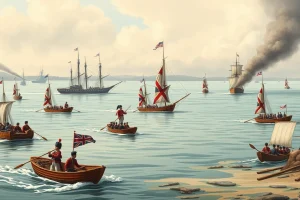
The first test came on 19 July 1812, when a British squadron of five vessels from Kingston attacked Sackett’s Harbor. The Oneida, commanded by Lieutenant Melancthon T. Woolsey, and crude shore batteries exchanged fire for about two hours, damaging the British flagship Royal George and forcing the attackers to withdraw. This skirmish, often called the First Battle of Sackett’s Harbor, demonstrated the vulnerability of the base and the need for a stronger fleet.
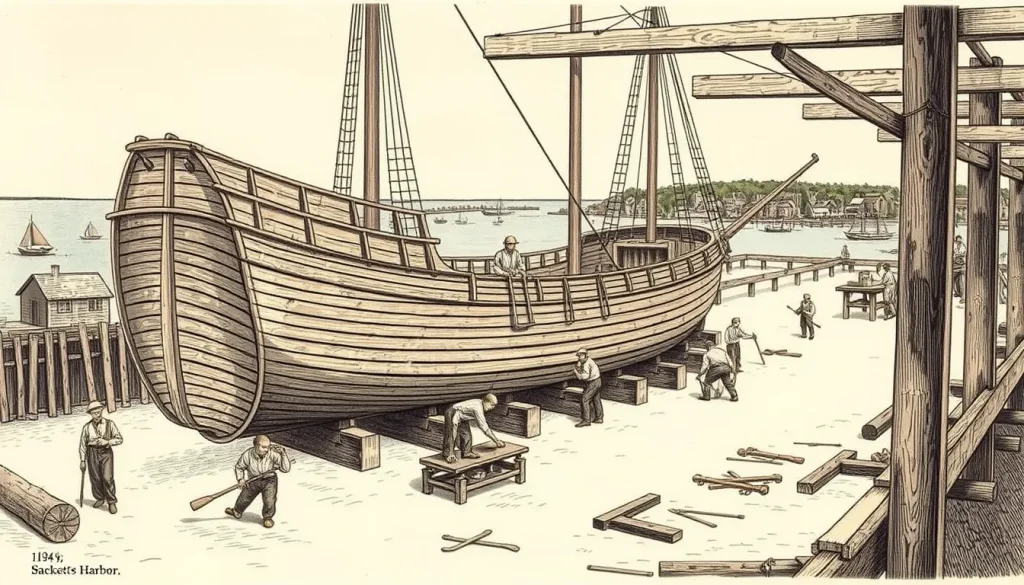
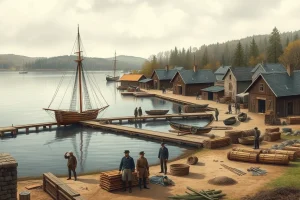
In late 1812, Commodore Isaac Chauncey, commanding the naval forces on Lakes Ontario and Erie, made Sackett’s Harbor his headquarters and brought Henry Eckford with him. Eckford, a master shipbuilder of Scottish-Canadian origin, had already converted and built several vessels for the navy. He established a shipyard on Navy Point, a small spit jutting into Black River Bay, and set to work with remarkable speed. The first major ship, the corvette Madison, was launched after only nine weeks, built of standing timber from the surrounding forests. By the spring of 1813, Chauncey’s squadron had grown to over a dozen vessels, giving him a temporary numerical advantage over the British on Lake Ontario.
The British reacted by reinforcing their own fleet at Kingston under Sir James Lucas Yeo. This sparked a shipbuilding race that continued for the rest of the war. In May 1813, while Chauncey was away supporting an attack on Fort George at the western end of the lake, British forces under Lieutenant General Sir George Prevost and Captain Yeo launched an amphibious assault on Sackett’s Harbor. American militia and regulars under Brigadier General Jacob Brown defended the base. During the confusion of the 29 May 1813 battle, the Americans deliberately burned the unfinished sloop General Pike and many stores to prevent capture, but the British withdrew after failing to secure the ground. The ship was later salvaged, and the base survived.
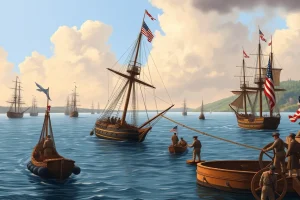
Construction accelerated after this scare. Eckford built or completed the sloops Sylph and General Pike, the brig Jefferson, and a number of smaller vessels. In 1814, he launched the frigate Superior, a 195-foot ship pierced for 64 guns and carrying a crew of 500. It was the largest American warship in service during the conflict. The race culminated in plans for ships of the line: the New Orleans (106 guns) and Chippewa (120 guns), both laid down in early 1815. News of the Treaty of Ghent in March 1815 halted construction, and the New Orleans remained on the stocks, unfinished, until it was scrapped in 1883.
During the war, Sackett’s Harbor also served as the launching point for major operations, including the attack on York (present-day Toronto) in April 1813 and General James Wilkinson’s projected descent on Montreal in 1813. By 1814, the population had swollen to between 5,000 and 12,000, making it the third-largest urban center in New York after New York City and Albany.
Why It Matters
The shipbuilding at Sackett’s Harbor was crucial to American strategy on Lake Ontario. Without the fleet built there, the United States could not have protected its northern frontier nor supported offensive operations such as the raid on York and the siege of Fort George. The race with British Kingston also had a profound effect on the outcome of the naval war on the lake: although the two fleets frequently cruised against each other, they never fought a decisive fleet action, and the contest remained a stalemate for most of the war.
Beyond the immediate military impact, the program transformed Sackett’s Harbor from an obscure village into a hub of activity, with a transient population of shipwrights, sailors, soldiers, and merchants. The end of hostilities left behind a large navy yard, but the ships deteriorated rapidly. By 1825, most of the vessels had decayed or been sold; only the incomplete New Orleans survived as a haunting symbol of the abandoned arms race. The navy yard remained in existence until 1955, ultimately becoming a New York State Historic Site.
Historians have debated whether the massive expenditure on Lake Ontario warships was wasted, since no major engagement occurred. Some argue that the threat of the American fleet forced the British to divert resources and limited their ability to operate on Lake Erie, while others contend that the race merely consumed money and manpower that could have been used elsewhere. The site now serves as a reminder of the intense and ultimately inconclusive naval rivalry that characterized the War of 1812 on the Great Lakes.
Definition
Shipbuilding at Sackett’s Harbor refers to the concentrated American naval construction program carried out at Navy Point and neighboring yards on Black River Bay, on the eastern end of Lake Ontario, during the War of 1812. It involved the design, construction, fitting-out, and repair of warships ranging from lake schooners to ships of the line, under the direction of master shipbuilder Henry Eckford.
Background
The program began as a response to the outbreak of war and the immediate need to counter British naval strength on Lake Ontario. The U.S. Navy had only one dedicated warship on the lake, the brig Oneida, which had been built at Oswego in 1809. After the first British attack in July 1812, the Secretary of the Navy ordered Commodore Chauncey to expand the fleet. The choice of Sackett’s Harbor was practical: its harbor was sheltered, timber was abundant, and it was sufficiently close to Kingston to threaten the British base.
How It Worked
Henry Eckford’s method emphasized speed and improvisation. He organized a large workforce of carpenters, joiners, and blacksmiths, many of whom moved to the town for the duration of the war. Ships were built from green timber cut from the surrounding forests, with frames and planking shaped rapidly. Eckford’s ships were constructed in as little as 35 days for a sloop or 80 days for a frigate, a remarkable feat. The process involved not only ship construction but also the production of rigging, sails, and ordnance, much of which was transported overland from the Hudson River or manufactured on site. The navy also purchased and converted civilian vessels, especially the nine schooners that formed the initial squadron.
Competing Viewpoints
Scholars differ on the effectiveness of the shipbuilding race. Some view it as a brilliant logistical achievement that kept the British from gaining uncontested control of Lake Ontario, thus protecting the American heartland. Others argue that the obsession with building ever-larger ships diverted resources from more urgent fronts, and that the two navies’ caution in seeking battle made the effort largely pointless. A further perspective emphasizes that the race reflected the strategic realities of inland naval warfare, where ship construction speed often outweighed tactical skill. The lack of a major fleet action on Lake Ontario has led many historians to characterize the shipbuilding contest as an “arms race without a war,” but it was nonetheless a significant drain on both sides’ finances and manpower.
Role in the War of 1812
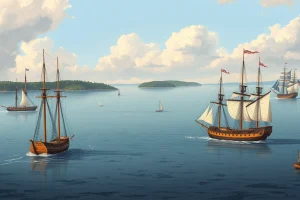
Sackett’s Harbor’s shipbuilding enabled the United States to maintain a credible naval presence on Lake Ontario, deterring large-scale British amphibious operations and supporting American offensives against Upper Canada. The base was the springboard for the attack on York in April 1813 and for the reinforcement of the army at Niagara. Even when the fleet did not fight a decisive battle, its existence forced the British to keep a large force at Kingston to protect their own communications. The construction of the Superior in 1814 gave the Americans a temporary superiority in firepower, though both sides were rapidly building ships of the line before the war ended.
Consequences and Historical Interpretation
The end of the war brought an abrupt halt to construction. The fleet was placed in ordinary, and the unfinished ships were moored or left on the stocks. Over the next decade, most vessels decayed and sank. The New Orleans stood unfinished for 68 years, becoming a landmark. The navy yard remained active for nearly 150 years, first as a base for the naval militia and later as a historic site. Today, the Sackets Harbor Battlefield State Historic Site preserves the navy yard and interprets the story of shipbuilding, emphasizing its impact on the local community and the larger military conflict. Historians continue to assess the program as a classic example of wartime industrial mobilization in a frontier environment.
Primary Sources
The most relevant primary sources include the official correspondence of Commodore Isaac Chauncey and Secretary of the Navy William Jones, which documents the planning, procurement, and command decisions behind the shipbuilding effort. These letters are held in the National Archives and Records Administration, Record Group 45 (Naval Records Collection), and have been published in part in The Naval War of 1812: A Documentary History (edited by William S. Dudley). Another useful primary source is the report of the court of inquiry held after the burning of the General Pike in May 1813, which includes testimony about the decision to torch the ship. The British side is documented in the despatches of Sir James Yeo and Sir George Prevost, available in the Library and Archives Canada. These sources provide firsthand accounts but reflect the perspectives and biases of their military authors, so they must be read alongside the secondary literature.
Further Reading
- Malcomson, Robert. Lords of the Lake: The Naval War on Lake Ontario, 1812–1814. Toronto: Robin Brass Studio, 1998.
- Dudley, William S., ed. The Naval War of 1812: A Documentary History. Vol. 1–3. Washington, D.C.: Naval Historical Center, 1985–2002.
- Hitsman, J. Mackay, and Donald E. Graves. The Incredible War of 1812: A Military History. Toronto: Robin Brass Studio, 1999.
- Palmer, Michael A. “The Naval War on Lake Ontario, 1812–1815.” Naval History 21, no. 1 (February 2007).
- Sackets Harbor Battlefield State Historic Site (official website) – https://parks.ny.gov/visit/historic-sites/sackets-harbor-battlefield-state-historic-site
References
- Martin, Tyrone G. “Lake Ontario’s Little-Known Gem.” Naval History 21, no. 1 (February 2007). https://www.usni.org/magazines/naval-history-magazine/2007/february/lake-ontarios-little-known-gem.
- Rice, Homer M. “Navy Point – World’s Smallest Base.” U.S. Naval Institute Proceedings 61, no. 12 (December 1935). https://www.usni.org/magazines/proceedings/1935/december/navy-point-worlds-smallest-base.
- “Sackets Harbor Shipbuilding Historical Marker.” Historical Marker Database. Accessed May 2026. https://www.hmdb.org/m.asp?m=75748.
- “Sacket’s Harbor during the War of 1812.” Bandy Heritage Center. Accessed May 2026. https://www.bandyheritagecenter.org/Content/Uploads/bandy/files/1812/Sacket’s%20Harbor%20in%20the%20War%20of%201812.pdf.
- “Sackets Harbor Battlefield State Historic Site.” New York State Parks. Accessed May 2026. https://parks.ny.gov/visit/historic-sites/sackets-harbor-battlefield-state-historic-site.
FAQ
Why was Sackett's Harbor chosen as a shipbuilding site?
It offered a deep, sheltered harbor on Lake Ontario, close to the British base at Kingston, and had abundant timber for ship construction. The navy already had the brig Oneida stationed there to enforce trade restrictions.
What was the most powerful ship built at Sackett's Harbor?
The frigate Superior, launched in May 1814, was the largest American warship built during the War of 1812, being 195 feet long and pierced for 64 guns.
Why did the shipbuilding race on Lake Ontario end without a major battle?
Both fleets were cautious, and the strategic stalemate meant that neither side could risk a decisive engagement. The Treaty of Ghent in 1815 ended the war before the ships of the line could be completed.
Leave a Reply