
Short Answer
Prisoners taken at sea during the War of 1812 included sailors, marines, and privateersmen from both the United States and Great Britain, captured during naval battles and single-ship engagements across the Atlantic. These prisoners were held in British prison ships and depots such as Chatham and Dartmoor, while American authorities confined British captives in naval yards and shore facilities. The experience of these men shaped wartime propaganda, diplomatic negotiations, and the broader memory of the conflict.
Historical Context
The War of 1812 (1812–1815) was fought between the United States and the United Kingdom, with the Royal Navy dominating the seas while the U.S. Navy and American privateers posed a significant challenge. Naval captures were frequent, ranging from large frigate duels to the seizure of merchant and privateer vessels. The British also impressed American sailors into service, a major grievance leading to war. When ships were captured, the crews became prisoners of war, subject to the evolving rules of cartel and exchange that governed early nineteenth-century conflict.
Both nations relied on naval power to disrupt trade and protect their interests. The United States had a small regular navy but a large privateer force; Britain possessed the world’s largest navy. Captures occurred throughout the Atlantic, in the Caribbean, and even in European waters. Prisoners were often taken from their ships and transported to ports in Halifax, Bermuda, or Britain, where they awaited exchange or release.
What Happened
From the outset of the war, naval captures led to the detention of crews. For example, after the USS Constitution defeated HMS Java in December 1812, surviving British sailors were taken aboard the American frigate and later paroled or exchanged. Similarly, when HMS Shannon captured USS Chesapeake in June 1813, American prisoners were sent to Halifax. The British tended to send enlisted men to prison ships in England, such as the Nassau at Chatham, while officers were often granted parole on their word of honor.
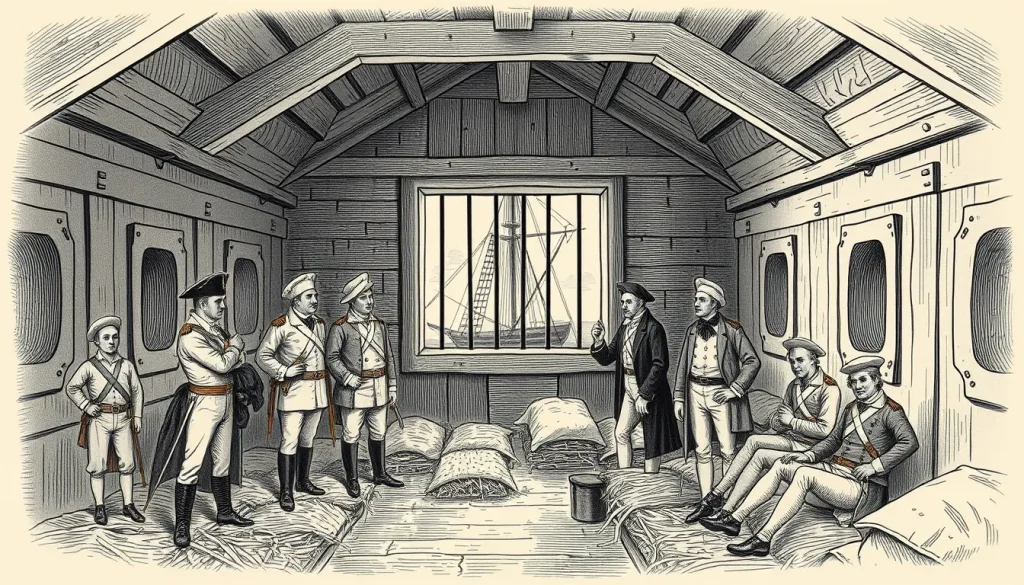
American prisoners faced harsh conditions. Many were confined in the notorious Dartmoor Prison, a granite depot in Devonshire, England, which held thousands of American sailors and marines. Prison ships moored in the Thames and at Chatham also housed captives in overcrowded, unsanitary conditions. The British government maintained detailed registers, now in the National Archives (ADM 103), that list thousands of American prisoners. Conversely, British prisoners in American hands were often held in naval yards, such as Boston or New York, and were generally treated according to prevailing standards, though complaints of inadequate food and shelter arose.
Prisoner exchange was formalized through cartels. In 1812, the United States and Britain agreed to a system of exchange based on rank, though the system often broke down due to disputes over the status of naturalized American citizens and impressment. Many sailors switched sides to avoid imprisonment, and desertion was common. By 1814, the cartel system had largely collapsed, and prisoners accumulated until the war’s end. The Treaty of Ghent (1814) provided for the release of all prisoners of war, and the last American prisoners returned home in 1815.
Why It Matters
The experience of prisoners taken at sea had immediate and lasting effects. Propaganda on both sides exaggerated mistreatment, influencing public opinion and war aims. The Dartmoor Massacre of April 1815, when British guards fired on American prisoners, killed seven and wounded dozens, became a diplomatic incident. Prisoners’ accounts, such as memoirs and newspapers, shaped the memory of the war. The exchange system also set precedents for later conflicts. Historians today use British Admiralty records to study maritime labor, conditions of captivity, and the lives of common seamen.
Definition
Prisoners taken at sea during the War of 1812 were military personnel and civilian mariners captured during naval warfare. They included regular naval sailors, marines, privateersmen, and passengers on armed merchant ships. Their status depended on rank, nationality, and the circumstances of capture.
Background
International law at the time recognized prisoners of war as combatants who could be held until the end of hostilities. The British and American governments negotiated prisoner exchanges through cartels, which specified the value of individuals by rank. However, the imprecise status of American-born sailors who had been impressed into the Royal Navy complicated exchange, as Britain refused to recognize naturalized American citizens, claiming they were British subjects.
How It Worked
After a ship was captured, the crew was taken aboard the captor or a prize crew and transported to a port. Officers were often paroled, giving their word not to escape, while enlisted men were confined in prison ships or depots. The British used hulks (decommissioned ships) such as the Nassau at Chatham and the prison at Dartmoor. The U.S. held British prisoners in facilities like the naval prison at Salem or onboard receiving ships. Rations, sanitation, and medical care varied, but overcrowding and disease were common.
Exchange was conducted either by negotiation between cartel agents or through direct release. Prisoners could also be repatriated in neutral ships. Many prisoners volunteered for service in the enemy’s navy or merchant marine to escape captivity, a practice both sides condoned under certain circumstances.
Competing Viewpoints
American and British accounts of prisoner treatment often conflicted. American newspapers and official reports, such as those of captured officers, depicted British captives suffering from cold, hunger, and abuse. The British countered that American prisoners received the same rations as British soldiers and that conditions were typical of the era. Modern historians, like Matthew Brenckle in his work for the USS Constitution Museum, argue that actual conditions were less brutal than propaganda suggested, but that neglect and mismanagement still caused suffering. The Dartmoor Massacre illustrates how tensions could explode.
Role in the War of 1812
Prisoners taken at sea influenced naval strategy and diplomacy. The threat of capture affected manning and morale. The U.S. Navy’s small size meant that a single frigate loss could capture hundreds, as when HMS Phoebe and Cherub defeated USS Essex in 1814, capturing over 250 men. Prisoner numbers also factored into peace negotiations, as each side sought the release of its nationals. The cartel system failed to keep pace with captures, leading to overcrowding and prolonged detention.
Consequences and Historical Interpretation
The release of prisoners at the end of the war was stipulated in the Treaty of Ghent, but the return was slow. Dartmoor’s prisoners were finally released in 1815. The records kept by the British Admiralty and the U.S. government provide essential data for genealogists and historians. Scholarly interpretation has moved beyond patriotic narratives, emphasizing the shared human experience of prisoners and the administrative realities of war. The legacy of these prisoners lives on in the surviving documents, prisoner accounts, and the memory of sites like Dartmoor.
Primary Sources
Key primary sources include the British Admiralty Prisoner of War registers (ADM 103) held at The National Archives, UK. These record names, ships, and dates of capture for American prisoners at Chatham, Dartmoor, and other depots. The USS Constitution Museum has published an analysis of these records by Matthew Brenckle (2005), available online. Also valuable are published memoirs, such as the journal of Chaplain Assheton Humphreys, and American diplomatic correspondence concerning prisoner exchanges. These sources must be used with an awareness of their administrative or partisan origins.
Further Reading
- Brenckle, Matthew. British and American Naval Prisoners of War During the War of 1812. USS Constitution Museum, 2005.
- Hickey, Donald R. The War of 1812: A Forgotten Conflict. University of Illinois Press, 1989.
- Benn, Carl. The War of 1812. Osprey Publishing, 2002.
- Malcomson, Robert. Lords of the Lake: The Naval War on Lake Ontario, 1812-1814. Naval Institute Press, 1998.
- British Online Archives. Prison Ship Records from the War of 1812. Collection of Admiralty records.
References
- Brenckle, Matthew. British and American Naval Prisoners of War During the War of 1812. USS Constitution Museum, 2005. https://ussconstitutionmuseum.org/wp-content/uploads/2020/05/British-and-American-Naval-Prisoners-of-War-During-the-War-of-1812.pdf.
- British Online Archives. Prison Ship Records from the War of 1812. https://britishonlinearchives.com/collections/58/prison-ship-records-from-the-war-of-1812.
- British Online Archives. Prison Ships and Depots in England – Chatham, 1812-1814. https://britishonlinearchives.com/collections/58/volumes/337/prison-ships-and-depots-in-england-chatham-1812-1814.
- Heritage Books. American Prisoners of War Held At Portsmouth, Stapleton, Gibraltar and Malta during the War of 1812. Transcribed by Eric Eugene Johnson. https://heritagebooks.com/products/101-j5886.
- American Wars. List of American Prisoners Of War 1812-1815. https://www.americanwars.org/1812-pow/american-prisoners-of-war.htm.
FAQ
Where were American prisoners of war held by the British during the War of 1812?
American prisoners were held in various locations, including prison ships like the Nassau at Chatham, and on land at Dartmoor Prison in Devonshire, England. Some were also held in Halifax and Bermuda.
How did prisoner exchange work during the War of 1812?
Exchange was conducted under a cartel system based on rank, where each prisoner had a value (e.g., a captain could be exchanged for a captain). The system was plagued by disputes over citizenship and impressment, and it often broke down.
What was the Dartmoor Massacre?
On April 6, 1815, British guards fired on American prisoners at Dartmoor Prison, killing seven and wounding over thirty, after a dispute over the prison gates. The incident was investigated and became a diplomatic controversy.


Leave a Reply