
Short Answer
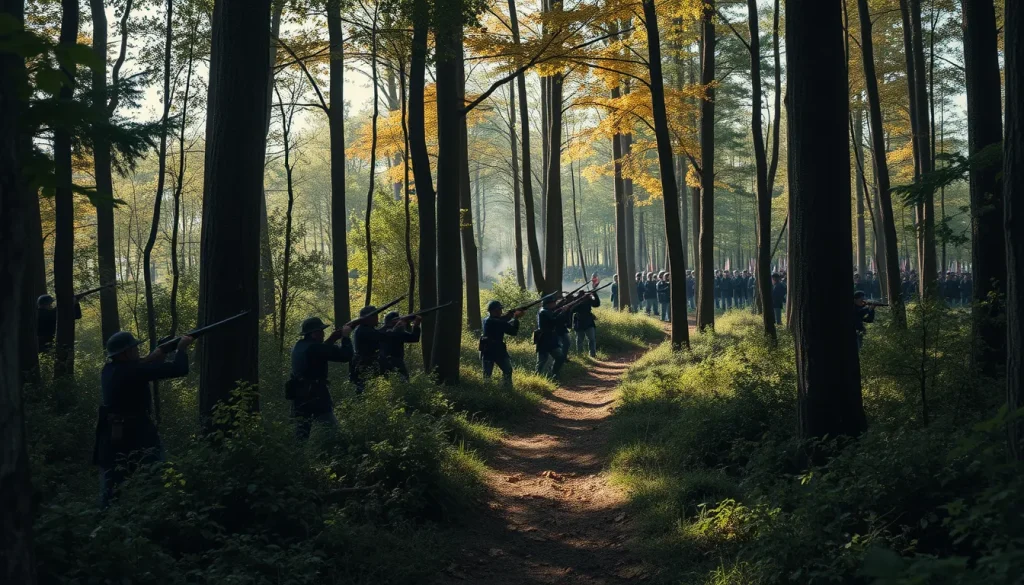
During the War of 1812, the Northwest frontier—encompassing the present-day states of Ohio, Indiana, Michigan, and parts of Upper Canada—was dominated by dense hardwood forests, swamps, and few improved roads. This terrain fundamentally altered how infantry fought, compelling commanders to adapt European-style linear tactics to a landscape that favored concealment, ambush, and short-range engagements. The result was a series of encounters, from Frenchtown to the Battle of the Thames, where woodland conditions proved as influential as the number of troops or the quality of firearms.
Historical Context
The Northwest theater was a secondary front in the War of 1812, yet it carried strategic importance for both American expansionists and British defenders of Upper Canada. The region relied on water routes—the Detroit River, Lake Erie, and the Maumee River—as the only reliable lines of communication and supply. Away from these waterways, the country was an unbroken forest interspersed with marshes and small clearings. Indigenous peoples, many allied with Britain through the Northwest Confederation, knew these woods intimately and used them as operational cover, while American commanders often moved along narrow trails with columns stretched for miles. The U.S. government hoped to end Indigenous resistance and annex Canada, while the British sought to preserve their colony and maintain Indigenous alliances. This geopolitical tension gave forest terrain its military meaning: it was not simply a backdrop but an active factor in every campaign.
What Happened
The first major American attempt to invade Upper Canada collapsed in July 1812 when General William Hull surrendered Detroit to a combined British-Indigenous force under Isaac Brock and Tecumseh. Hull’s supply lines through the forest had been cut, and he feared a massacre at the hands of warriors, a fear reinforced by the threat of British regulars and Indigenous fighters emerging from the woods. In January 1813, American troops under James Winchester engaged British and Indigenous forces at Frenchtown (present-day Monroe, Michigan) on the River Raisin. After winning an initial skirmish, the Americans were surprised and driven from the settlement; following the surrender, wounded prisoners were killed by Indigenous warriors in an event known as the River Raisin Massacre. Forest cover allowed the attackers to approach nearly unseen from open country and to envelop the American positions. Later that spring, William Henry Harrison’s army, numbering over a thousand, marched through forests to relieve Fort Meigs on the Maumee River. British commander Henry Procter attempted to lure the Americans out by feigning withdrawal, but the thick woods made reconnaissance difficult. In August 1813, the American garrison at Fort Stephenson repelled a British assault, in part because the attackers had to cross open ground around a fort built at the edge of the river, but also because the surrounding forest limited the assaulting columns’ ability to deploy in line. The final decisive engagement in the Northwest occurred on October 5, 1813, when Harrison’s American infantry, many mounted as dragoons or mounted riflemen, attacked Procter’s retreating army along the Thames River in Upper Canada. The battle occurred in an open beech forest interspersed with brush and swamp, and the Americans used mounted infantry to break the thin British lines and dispersed Indigenous warriors. Tecumseh was killed during this action. Throughout these events, forest terrain reduced the effectiveness of volley fire, made cavalry charges impractical, and rewarded troops who could shoot from behind trees or fight in small groups.
Why It Matters
Forest terrain mattered because it directly shaped the capabilities of the belligerents. For the British and their Indigenous allies, the woods were an equalizing environment that neutralized American numerical superiority and exposed the vulnerabilities of poorly trained militia. For Americans, the forest forced improvisation, leading to use of light infantry, rangers, and—eventually—mounted infantry. The 1814 campaign, though mostly in Lower Canada, saw British commanders explicitly integrating provincial light infantry with regulars to teach woodcraft, as recalled in later British military commentary. The outcomes in the Northwest influenced both the strategic balance and the broader memory of the war: American reverses at Frenchtown and the fall of Detroit were initial disasters, while the triumph at the Thames secured the frontier and helped preserve Harrison’s reputation. Historians continue to debate whether the terrain itself was more decisive than the leadership and training of the forces, but there is no doubt that commanders on both sides had to adapt or be destroyed.
Definition
The term “forest terrain” refers to the dominant land cover of the Northwest theater: old-growth woodland with a dense canopy, undergrowth, fallen timber, and frequent wetlands. For infantry, this meant drastically reduced fields of fire, obscured enemy movement, and difficulty maintaining formation. In military usage, such terrain is often categorized as “close country,” as opposed to open ground that allows linear tactics and massed volleys.
Background
The forests of the Ohio Country and the western Peninsula of Upper Canada were mixed hardwoods—beech, maple, oak, and hickory—interspersed with conifers. Undergrowth could be thick enough to prevent any movement more than a few yards from the trail. Local knowledge was essential: Indigenous warriors and Canadian militia moved with ease, while regular troops, used to European drill grounds, struggled to keep contact. The few dirt roads and paths were lined with trees that gave ambushes an advantage; columns were forced to deploy by companies rather than battalions, and artillery was nearly unusable off the main highways.
How It Worked
Infantry adapted to forest terrain through several tactical practices. Skirmishing replaced the close-order line: men dispersed and sought cover behind trees, stumps, and low ground. Officers relied on horns or shouted orders because visual signals were impossible in thick cover. Units like the Glengarry Light Infantry Fencibles and various American rifle battalions were trained in woodcraft, moving in open order and firing individually rather than by volley. Ambush and counter-ambush became routine; reconnaissance was carried out by small patrols because the enemy could be within a hundred yards unseen. Fortifications were also terrain-driven: log forts were built at clearings or river confluences, using cleared fields of fire and the forest as a source of timber. Defenders chopped abatis—felled trees with sharpened branches—to slow attackers. The use of mounted infantry emerged in the Northwest at the Battle of the Thames, where American troops rode to close with the enemy but fought dismounted in the woods, effectively combining mobility with the ability to fight in broken ground.
Competing Viewpoints
There are two main interpretive schools concerning how forest terrain shaped infantry combat. One emphasizes the tactical genius of Indigenous and Canadian irregulars, arguing that their forest skills allowed them to overcome disciplined regulars and made conventional British generalship ineffective. The other argues that British regulars, with light infantry training, adapted quickly and that terrain was one factor among many, including logistics, leadership, and diplomacy. In fact, both views capture part of the truth. British officers like Brock and Procter recognized that to succeed they had to coordinate regulars and Indigenous warriors, and that open-order fighting was necessary. American officers, meanwhile, often overestimated the power of volley fire and suffered serious defeats when they ignored woodland conditions. Historians also differ over whether the forest favored the defense so heavily that any attacker, however well trained, would face severe odds; this question remains central to understanding Frenchtown and Fort Meigs.
Role in the War of 1812
The forest shaped the War of 1812 in the Northwest more directly than any other single factor except control of Lake Erie. The loss of Detroit in 1812 was hastened by the cutting of Hull’s forest supply lines and the psychological threat of Indigenous warriors emerging from the trees. At Frenchtown, the British-Indigenous force used the cover of a nearby wooded hill to launch a surprise counterattack that overwhelmed the American camp. Fort Meigs and Fort Stephenson were both fought at forest margins, where artillery and skirmishing around clearings determined the result. The Battle of the Thames, fought in a woodland with scattered clearings, showed how a disciplined army with adapted tactics (mounted infantry, skirmishers) could defeat a regular British linear formation under forest conditions. The outcome solidified U.S. control over the Ohio country and secured the fallback of the Western frontier after the disasters of 1812–1813.
Consequences and Historical Interpretation
The immediate military consequence of forest tactics was the recognition that light infantry and skirmishing were essential in North America, a lesson British and American officers carried into subsequent decades. In the after-action reporting of 1814, some British commanders explicitly ordered the mixing of newly arrived regular battalions with experienced provincial light infantry so that the newcomers could learn “wood-craft” firsthand. This acknowledgment from a former British officer writing in the 1840s suggests the lesson had not been forgotten. On the American side, the successful use of mounted infantry at the Thames became part of the military repertoire, influencing later campaigns in the West. Long-term historical interpretation has often framed the Northwest as a place where “irregular” methods triumphed, but modern scholarship stresses that forest terrain simply changed the parameters of warfare; it did not abandon drill and discipline. The memory of the war in the Northwest is consequently tied to specific battles and to the broader theme that the woods were as much an opponent as any human enemy.
Primary Sources
The most informative contemporary sources for forest terrain and infantry combat in the Northwest are the official reports and letters of commanders on both sides. William Henry Harrison’s report on the Battle of the Thames (October 1813) details the disposition of his troops and the effect of the woodland on formations; this report is preserved in the American State Papers, but it is written from a victorious American perspective and may exaggerate the coherence of the fight. Henry Procter’s dispatches to Sir George Prevost after Frenchtown and the Thames explain British-Indigenous cooperation and describe terrain constraints, though Procter was later court-martialed and defended his decisions. The journal of Major John Norton, a Cherokee leader and British officer who served in Upper Canada, contains firsthand observations on Indigenous tactics and the importance of woodland in both the 1812 and 1813 campaigns; Norton wrote from a British-Indigenous viewpoint and is critical of some British officers. Finally, the 1842 article by Sir J.E. Alexander in the United Service Magazine provides retrospective advice on “bush fighting” in North America, explicitly citing the 1814 campaign’s integration of Glengarry Light Infantry to teach woodcraft. This source is several decades removed from the war, but it preserves institutional memory. None of these sources is neutral; each reflects the strategic and personal interests of its author, but together they illuminate how forest terrain was experienced and understood.
Further Reading
- Hickey, Donald R. The War of 1812: A Forgotten Conflict. Urbana: University of Illinois Press, 1989.
- Sugden, John. Tecumseh: A Life. New York: Henry Holt, 1997.
- Edmunds, R. David. The Shawnee Prophet. Lincoln: University of Nebraska Press, 1983.
- Antal, Sandy. A Wampum Denied: Procter’s War of 1812. Ottawa: Carleton University Press, 1997.
- Benn, Carl. The War of 1812. Oxford: Osprey, 2002.
- Stanley, George F.G. War of 1812: A Canadian Military History. Toronto: Collier Macmillan, 1983.
References
- Hickey, Donald R. The War of 1812: A Forgotten Conflict. Urbana: University of Illinois Press, 1989.
- Sugden, John. Tecumseh: A Life. New York: Henry Holt, 1997.
- Antal, Sandy. A Wampum Denied: Procter’s War of 1812. Ottawa: Carleton University Press, 1997.
- Rotherham, Ian D. “An historical review of forests and warfare from the Romans to the twenty-first century.” Trees, Forests and People 15 (2024): 100495. https://www.sciencedirect.com/science/article/pii/S2666719324000037.
- Alexander, J.E. “On Bush Fighting.” United Service Magazine, 1842. Quoted in “Acta Militaria: Forest Warfare in 1840s North America – Part 1.” http://nelsonlambert.blogspot.com/2013/04/forest-warfare-in-1840s-north-america.html.
FAQ
Why was forest terrain so problematic for infantry in the Northwest?
Dense woods made it nearly impossible to maintain cohesive lines or deliver effective volley fire. Soldiers could see only a short distance, so units were easily ambushed, and commanders could not use standard drill maneuvers. This favored troops accustomed to moving and fighting in woodland, including Indigenous warriors and Canadian light infantry.
How did the Americans adapt to forest conditions?
American commanders increasingly relied on riflemen, light infantry, and, by the Battle of the Thames, mounted infantry. They began using skirmishers and learning to operate in open order. The successful charge at the Thames demonstrated that a disciplined force could overcome the terrain's limitations with proper training and mobility.
Did forest terrain favor the British or the Americans?
Initially, forest terrain favored the British and their Indigenous allies, who were more experienced in woodland fighting and could use cover effectively. However, after the Americans adopted light infantry tactics and gained confidence, particularly under Harrison, the terrain became more neutral. Strategic control of waterways and logistics also played a crucial role in determining ultimate success.



Leave a Reply