
Short Answer
The Battle of Châteauguay, fought on 26 October 1813 along the Châteauguay River in Lower Canada (present-day Quebec), was a decisive defensive action during the War of 1812. A small force of about 1,500 Canadian militiamen, Voltigeurs, and allied Indigenous warriors, commanded by Lieutenant-Colonel Charles-Michel d’Irumberry de Salaberry, repelled an American invading army of more than 3,000 men. The victory helped end the American campaign against Montreal and became a founding moment in French Canadian national memory.
Historical Context
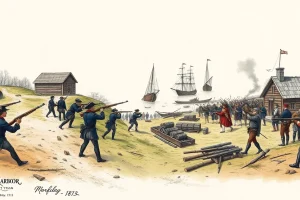
In the autumn of 1813, the United States launched its most ambitious operation of the war: a two-pronged invasion of Lower Canada aimed at capturing Montreal, the military and commercial hub of the province. American strategists believed that seizing Montreal would sever the St. Lawrence River supply line between Lower and Upper Canada, forcing British forces in the west to surrender. Major-General James Wilkinson was to descend the St. Lawrence from Sackets Harbor with about 8,000 men, while Major-General Wade Hampton was to march northward from Lake Champlain along the Châteauguay River with more than 3,000 troops. The two armies were supposed to meet near Montreal and launch a combined assault.
British and Canadian defences in Lower Canada were thin. Governor Sir George Prevost had only a small contingent of British regulars, and he relied heavily on local militia, fencible regiments, and the Canadian Voltigeurs, a light infantry unit raised by de Salaberry from French Canadian volunteers. De Salaberry, a professional soldier who had served in the Napoleonic Wars, understood the terrain and prepared a defensive position that took advantage of the river, a swamp, and thick woods.
What Happened
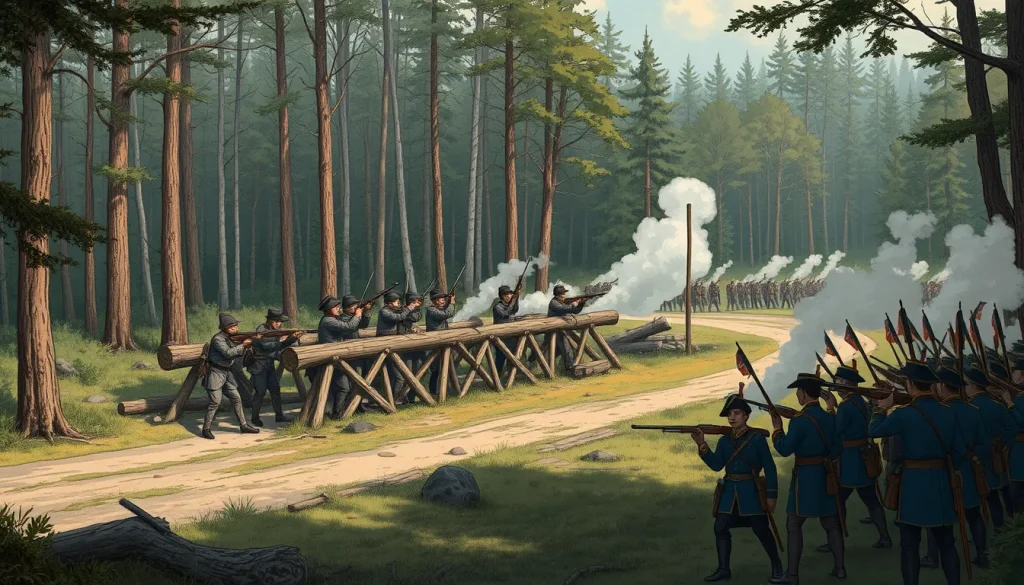
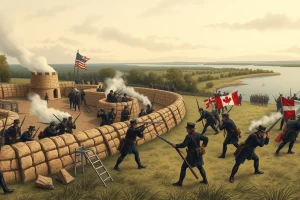
Hampton’s army crossed the border into Canada on 21–23 October 1813 and camped near the present-day town of Ormstown. De Salaberry had already chosen a defensive site near Allan’s Corner, where the road ran between the Châteauguay River on one side and a dense swamp on the other. His men constructed a series of abatis—barriers of felled trees with sharpened branches facing the enemy—and additional defence lines farther back.
On the evening of 25 October, Hampton sent Colonel Robert Purdy with about 1,000 men across the river to outflank the Canadian position. Purdy’s column became lost in the dark woods and failed to reach its objective by dawn. At about 10:00 a.m. on 26 October, Hampton’s leading troops made contact with de Salaberry’s pickets. The Canadians fell back to the abatis and alerted the main force.
For the next several hours, Hampton’s brigades under Brigadier-General George Izard pressed against the abatis, while Purdy’s men struggled to attack from the south bank. De Salaberry had placed only about 300 men in the front line, with the remainder held in reserve. The defenders fired disciplined volleys from cover, while bugles sounded from different parts of the woods and warriors raised war cries, creating the impression of a much larger force. At around 2:30 p.m., Purdy’s troops emerged onto the riverbank and were hit by devastating enfilading fire from the north bank. Disorganized and demoralized, they withdrew into the woods. Hampton, convinced that he faced an overwhelming enemy and that his flanking attempt had failed, ordered a general retreat. The Americans had suffered 23 killed, 33 wounded, and 29 missing; de Salaberry reported 5 killed, 16 wounded, and 4 missing.
Why It Matters
The Battle of Châteauguay ended Hampton’s invasion and, combined with the British victory at Crysler’s Farm on 11 November 1813, forced the abandonment of the American campaign against Montreal. The St. Lawrence supply line remained intact, and Montreal was never seriously threatened again during the war. For the defenders, the battle was a remarkable demonstration that Canadian forces, without British regulars, could defeat a larger American army. It became a source of enormous pride for French Canadians and was later commemorated as a key event in the development of Canadian nationalism. Historians have debated the battle’s strategic importance, but most agree that it thwarted the American plan and preserved British control of the St. Lawrence corridor.
Prelude
In September 1813, de Salaberry raided American positions at Chateaugay Four Corners in New York State and then withdrew, felling trees across roads to slow Hampton’s advance. He selected his defensive ground after inspecting the north bank of the Châteauguay near Allan’s Corner. Between 21 and 23 October, Hampton’s army, including regulars and New York militia, crossed the border and established camp near the Spears farm. De Salaberry’s forces, numbering about 1,500, took position along the north bank. On the night of 25 October, Hampton ordered Purdy to make a flanking march on the south bank, a move that would fail in the difficult terrain.
Forces and Commanders
British/Canadian Forces – Commanded by Lieutenant-Colonel Charles-Michel de Salaberry. Units included the Canadian Voltigeurs (a light infantry regiment), the Select Embodied Militia, companies of sedentary militia from Beauharnois, a detachment of Canadian Fencibles, and allied warriors, including Kahnawake and Abenaki. Total force around 1,500, but only about 300 engaged in the main line.
American Forces – Commanded by Major-General Wade Hampton, with Brigadier-General George Izard as second-in-command. The army comprised regular infantry and militia from the Lake Champlain corridor, numbering approximately 3,000–4,000 men. Colonel Robert Purdy led the flanking detachment.
Battlefield and Map Context
The battlefield lay on the north bank of the Châteauguay River, about 50 km southwest of Montreal, between the present-day towns of Ormstown and Howick. The road ran along a narrow strip of dry ground bordered by the river and a thick swamp. De Salaberry’s main abatis stretched from the river bank to the swamp, effectively blocking the road. A shallow ford (Grant’s Ford) on the south bank provided another potential crossing. The terrain was broken by gullies and thick woods, which made movement difficult for American troops.
Battle Chronology
- 10:00 a.m. – Hampton’s leading troops clash with de Salaberry’s pickets under Lieutenants Guy and Johnson; the Canadians withdraw to the abatis.
- 10:30 a.m. – De Salaberry moves about 300 men, including the light company of the Canadian Fencibles, two Voltigeur companies, and a party of Indigenous warriors, to the abatis.
- 11:00 a.m. – Purdy’s advance guard attacks Captain Brugière’s militia company on the south bank; Brugière is reinforced by companies under Captains Daly and de Tonnancour.
- 12:00 p.m. – Izard’s brigade advances against the abatis; heavy musket fire begins. The Fencibles briefly fall back behind the abatis, giving the impression of a retreat.
- 2:00 p.m. – De Salaberry orders shouting and bugle calls to make the defenders seem far more numerous; Izard’s troops halt and expect a counterattack.
- 2:30 p.m. – Purdy’s men emerge onto the riverbank on the south bank and are caught in enfilading fire from the north bank; they withdraw in confusion.
- 3:00 p.m. – Hampton orders a general retreat, ending the battle.
Casualties and Losses
American losses are generally given as 23 killed, 33 wounded, and 29 missing, though some accounts vary slightly. The British/Canadian force reported 5 killed, 16 wounded, and 4 missing. These figures reflect the one-sided nature of the fighting, which favoured the defenders behind their abatis. The American retreat was described as fearful, with Purdy’s men pursued by warriors through the following night.
Result
The Battle of Châteauguay was a decisive British/Canadian victory. Hampton’s army, though still numerically superior, withdrew to its starting positions and eventually marched back to the United States. The American plan to take Montreal collapsed for good when Wilkinson’s force was defeated at Crysler’s Farm a few weeks later. The defence at Châteauguay became a celebrated example of Canadian military skill and courage.
Strategic Consequences
In the immediate term, the battle secured Montreal against attack and preserved the vital St. Lawrence supply line that connected Upper and Lower Canada. It also prevented the junction of Hampton’s and Wilkinson’s armies, a key American objective. Over the longer term, Châteauguay contributed to the American decision to abandon offensive operations in the St. Lawrence region. For Canadian history, the battle took on legendary importance as a rare instance where colonials, chiefly French Canadians, repelled an invasion without British regulars aiding them. The site is now a National Historic Site of Canada, and the battle is remembered as a source of French Canadian pride.
Primary Accounts
The most important contemporary accounts are the official reports written shortly after the battle. De Salaberry’s report to Governor Prevost, dated 27 October 1813, describes the engagement and his tactical dispositions. Hampton’s report to Secretary of War John Armstrong, dated 29 October 1813, offers an American perspective, acknowledging the strength of the Canadian position and the failure of Purdy’s flanking movement. Additional letters and orderly books from participants survive in archives such as the Library and Archives Canada and the U.S. National Archives. These sources must be read critically, as military reports often exaggerate enemy strength or minimize losses, but they provide the foundational evidence for the battle’s chronology.
Battlefield Today
The Battle of the Châteauguay National Historic Site, operated by Parks Canada, includes 1.56 hectares near the centre of the original battlefield. A stone obelisk, erected in 1895, commemorates the victory. An interpretation centre, opened in 1978, offers panoramic views, exhibits, and a scale model of the battlefield. A 14 km trail between Ormstown and Howick features interpretive panels describing the engagement. Though the landscape has changed considerably, the river and surrounding terrain still give visitors a sense of the obstacles Hampton’s force faced.
Primary Sources
Primary sources for the Battle of Châteauguay include official military correspondence, muster rolls, and contemporary maps. De Salaberry’s dispatches and Hampton’s official report are available in the collections of Library and Archives Canada and the U.S. National Archives. The American side also produced orderly books and soldiers’ letters that offer ground-level views. A notable limitation is that most surviving documents are written by officers; the voices of ordinary militiamen and Indigenous warriors are less well represented. The Parks Canada website provides a chronology derived from primary records.
Further Reading
- Donald R. Hickey, The War of 1812: A Forgotten Conflict (University of Illinois Press).
- Jon Latimer, 1812: War with America (Harvard University Press).
- Andrew Lambert, The Challenge: Britain Against America in the Naval War of 1812 (Faber and Faber).
- Renée Lafferty, “Battle of Châteauguay,” The Canadian Encyclopedia.
- Gail Kudelik and Elaine Young, “Battle of the Châteauguay National Historic Site,” The Canadian Encyclopedia.
- Parks Canada, “A chronology of the events surrounding the battle,” Battle of the Châteauguay National Historic Site.
References
- Renée Lafferty, “Battle of Châteauguay,” The Canadian Encyclopedia, October 23, 2011, last edited March 4, 2015. https://thecanadianencyclopedia.ca/index.php/en/article/battle-of-chateauguay
- Gail Kudelik and Elaine Young, “Battle of the Châteauguay National Historic Site of Canada,” The Canadian Encyclopedia, February 17, 2011, last edited January 14, 2016. https://thecanadianencyclopedia.ca/en/article/battle-of-the-chateauguay-national-historic-site-of-canada
- Parks Canada, “A chronology of the events surrounding the battle,” Battle of the Châteauguay National Historic Site. https://www.parks.canada.ca/lhn-nhs/qc/chateauguay/culture/histoire-history/evenements-events/natcul1c
- “Battle of Chateauguay – War of 1812,” The War of 1812. https://thewarof1812.org/battles/battle-of-chateauguay/
- “The Battle of Chateauguay October 1813,” WarHistory.org. https://warhistory.org/article/the-battle-of-chateauguay-october-1813
FAQ
Why did the Battle of Châteauguay happen?
It was part of the American campaign of autumn 1813 to capture Montreal and cut British supply lines to Upper Canada.
How many troops fought at Châteauguay?
De Salaberry commanded about 1,500 men, but only about 300 engaged in the front line. Hampton's force numbered more than 3,000.
Who commanded the defending forces?
Lieutenant-Colonel Charles-Michel de Salaberry, a French Canadian officer in the British Army, commanded the British/Canadian and Indigenous defenders.
What was the result of the battle?
The Americans were forced to retreat. The battle, combined with the Battle of Crysler's Farm, ended the threat to Montreal.
Why is Châteauguay significant to Canadian history?
It demonstrated that Canadian forces, including French Canadian militiamen, could defeat a large American invasion without British regulars, becoming a source of national pride.
Leave a Reply