
Short Answer
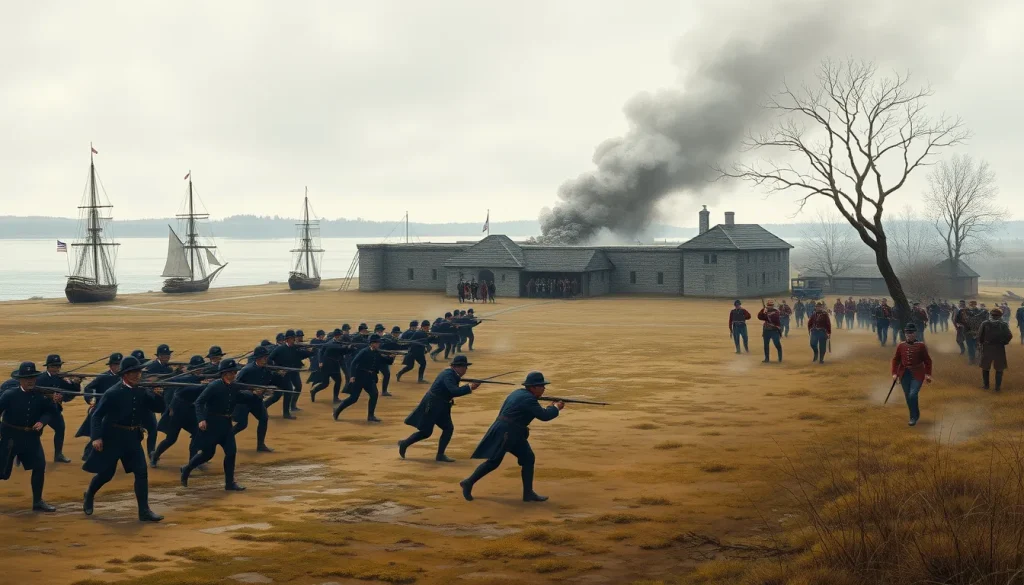
The Battle of York was fought on 27 April 1813, when an American army and naval squadron attacked York, the capital of Upper Canada and the site of the modern city of Toronto. The Americans won, but as the British withdrew the fort’s powder magazine detonated, killing or wounding hundreds of men on both sides and mortally injuring the American land commander, Brigadier General Zebulon Pike. The explosion turned a rapid tactical victory into a destructive occupation and helped set in motion a cycle of retaliation that shaped the rest of the war.
Historical Context
York stood on the north shore of Lake Ontario and had served as the seat of government of Upper Canada since 1793. During the War of 1812 the lake was both the front line between Upper Canada and the United States and the principal British supply route from Quebec to the posts farther west. In 1812 the small British provincial naval force, the Provincial Marine, controlled Lake Ontario, which allowed Major General Isaac Brock to shift his limited troops between threatened points and defeat American attacks in detail. The United States Navy answered by putting Commodore Isaac Chauncey in command at Sackets Harbor, New York, where he armed purchased schooners and laid down purpose-built warships. The British responded by building the sloop Wolfe at Kingston and the Sir Isaac Brock at York’s dockyard.
In January 1813 John Armstrong Jr. became United States Secretary of War. He proposed concentrating about 7,000 regulars at Sackets Harbor and seizing Kingston, the base of the British squadron, before moving against York and Fort George. Major General Henry Dearborn, commanding the Army of the North, and Chauncey had second thoughts: a winter visit by Lieutenant General Sir George Prevost to Upper Canada, together with reports that Kingston held 6,000 or more regulars, convinced them the town was too strong. Later evidence indicated the true garrison was far smaller, but the commanders had already decided to strike the weaker target first. That decision made York, defended by a small garrison and a militia that contemporaries described as unenthusiastic, the opening objective of the 1813 lake campaign.
What Happened
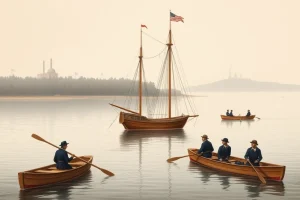
The American force embarked at Sackets Harbor on 22 April and appeared off York at dawn on 27 April. Troops landed west of Fort York, were briefly checked by Ojibwe warriors and militia, and then advanced behind the guns of Chauncey’s squadron. Pike’s two columns carried a western battery and an outwork and were forming for the assault on the main works when the magazine inside the fort exploded, throwing stone and timber through the American ranks. Pike was mortally injured and died aboard ship. Major General Roger Hale Sheaffe, the lieutenant governor and British commander, ordered his regulars to withdraw toward Kingston and left militia officers and civil authorities to negotiate the surrender of the town. During the following days American troops looted and burned public buildings, including the Parliament and Government House, before re-embarking.
Why It Matters
The battle is remembered less for the capture of a provincial capital than for the explosion that followed it. At the time, Americans treated the blast as a treacherous act and used it to justify the destruction of public property in York; British and Canadian accounts described the firing of the magazine as an attempt to deny stores to the enemy and disputed American claims of deliberate cruelty. In the longer term the episode further damaged the reputation of Sheaffe, who was recalled, and it supplied a remembered grievance that Canadians later cited when British forces burned Washington in August 1814, although British commanders of that expedition formally justified it as retaliation for American destruction in Upper Canada, above all the burning of Newark in December 1813. Historians continue to debate how much the loss of stores at York really mattered to the wider war; Robert Malcomson’s detailed study treats the question as one of several claims that require careful testing rather than assumption.
Prelude
The winter of 1812 to 1813 closed Lake Ontario to operations, and both sides used the time to build. Chauncey assembled his squadron at Sackets Harbor while Dearborn’s army, weakened by sickness and exposure after hard marches, fell well short of the 7,000 troops Armstrong had intended. Because the commanders chose York over Kingston, the campaign opened against a town whose defences had been neglected: the fort west of the town mounted a limited number of guns, and the garrison was small. When the ice broke up in mid-April the expedition was ready; David Thompson’s 1815 narrative records that Dearborn selected about 2,000 of the 4,000 men at Sackets Harbor for the venture.
Forces and Commanders
On the American side, Major General Henry Dearborn commanded the Army of the North but remained afloat and in poor health; Brigadier General Zebulon Pike led the landing force; Commodore Isaac Chauncey commanded the naval squadron, variously described as fourteen to sixteen vessels. Estimates of the invading force range from about 1,700 to 2,000 troops, with some accounts giving higher figures.
On the British side, Major General Sir Roger Hale Sheaffe, lieutenant governor of Upper Canada, commanded, assisted by militia and departmental officers including John Robinson, Aeneas Shaw, and James Givins. The garrison is variously given as roughly 600 to 750 regulars and militia, together with somewhere between forty and one hundred Ojibwe warriors and allied Indigenous fighters. The discrepancies reflect the loss and incompleteness of the surviving returns.
Battlefield and Map Context
York lay at approximately 43 degrees 39 minutes north and 79 degrees 22 minutes west on the north shore of Lake Ontario. The town’s commercial and government buildings stood east of the harbour; Fort York guarded the harbour entrance roughly two miles to the west, on rising ground beside the water. The Americans landed on the lakeshore west of the fort, placing themselves between the fort and open country while the fleet controlled the water. Because Toronto’s shoreline was later extended southward by landfill, the 1813 landing area now lies some distance inland from the modern waterfront.
Battle Chronology
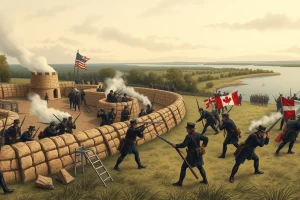
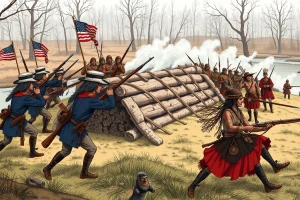
Landing began at dawn on 27 April 1813 west of the fort. Ojibwe warriors and militia contested the shore, and the American advance was briefly disordered before naval gunfire and reinforcements secured the beachhead. Pike then formed two lines, the front under his personal command and the reserve under Colonel Pearce, and advanced against the batteries west of the fort, carrying first a western battery and then an outwork. With the columns halted to dress their lines for the final assault, the main magazine exploded, hurling debris into the American ranks and killing or wounding many men, including Pike.
Sheaffe, judging his outnumbered force unable to hold the town, ordered his regulars to retreat eastward toward Kingston. Before leaving he ordered the destruction of naval stores, of the Sir Isaac Brock then under construction, and of the magazine; the explosion is generally attributed to that order, though contemporary narratives differ over details and some describe more than one blast. Left without a commanding officer, local militia officers and civil authorities negotiated terms. The Americans occupied York, plundering deserted houses and damaging public buildings and the printing press; the question of who ordered the burning of the Parliament buildings has been disputed ever since.
Casualties and Losses
Casualty figures vary by source. The Canadian Encyclopedia reports that the blast killed nearly forty men outright and wounded more than two hundred, many of whom died later, with British losses given as more than 150 killed and wounded and 290 captured. David Thompson’s 1815 narrative gives American losses of 378, of whom thirty-eight were killed and 222 wounded by the explosion. A commonly cited modern summary table lists 55 American killed and 265 wounded, against 82 British killed, 112 wounded, 274 captured, and 7 missing, while the American Battlefield Trust gives combined casualties of about 795. The most detailed published statistics are those compiled by Robert Malcomson from British and American records; where sources disagree, the differences reflect incomplete returns and the confusion caused by the explosion itself.
Result
The battle was an American victory: the fort, town, and dockyard were captured, and large quantities of ordnance and stores were taken or destroyed. The length of the occupation is reported differently, with the Canadian Encyclopedia describing a six-day occupation and Thompson placing the evacuation on 8 May; the fullest chronology is that of Malcomson. What is not disputed is that the Americans withdrew without attempting to hold York or to move on Kingston.
Strategic Consequences
York did not decide control of Lake Ontario. Kingston remained the British naval base, and the American squadron failed to bring the British squadron to action; Chauncey returned to York in July 1813, landing unopposed to burn buildings and carry off supplies. The most consequential material effect of the British destruction, of which the magazine explosion was the most violent part, was the loss of naval and military stores intended for British forces on Lake Erie. Historians have debated how far those losses weakened the British squadron defeated at Put-in-Bay in September 1813; Malcomson treats the claim as one requiring evidence rather than assumption, and the debate remains open.
Politically the victory gave the American administration a success after months of ineffective campaigning, and it was celebrated as the first combined army and navy operation of the war. Its costs, however, were immediate: the death of Pike, heavy casualties from the explosion, and the destruction of public buildings that Canadians remembered as a sack. For the British, the loss of the provincial capital exposed the inadequacy of Upper Canada’s defences and ended Sheaffe’s career in the field. The reprisal question raised by the burning of York was invoked on both sides for the rest of the war, culminating in the British burning of Washington in August 1814, an act whose official justification was retaliation for American destruction at Newark and elsewhere in Upper Canada but which contemporaries and later writers connected to York as well.
Primary Accounts
Contemporary accounts are plentiful but uneven. American official correspondence, including Chauncey’s and Dearborn’s reports to Washington, presents the operation as a success and tends to minimize the destruction of private property. British despatches, including Sheaffe’s reports to Prevost, explain the retreat as a military necessity and the firing of the magazine and stores as a measure to prevent their capture. Civilian testimony from York, including that of the clergyman John Strachan, who helped rally the town’s leadership during the crisis, gives a different perspective on the departure of the regulars and the conduct of the occupiers. Pike’s reported dying words urging his men to avenge their general come down through later accounts rather than a document written at the time, and should be treated as a tradition rather than a verbatim record.
Battlefield Today
Fort York National Historic Site in Toronto preserves the fortifications rebuilt in 1813 to 1815 after the American occupation, together with the surrounding Garrison Common and a visitor centre with exhibits on the battle and the war. Because the fort and its neighbourhood have been absorbed by the modern city, interpretation at the site emphasizes the changed shoreline and the contrast between the small 1813 garrison town and present-day Toronto.
Primary Sources
- Isaac Chauncey’s official report, April 1813. The commodore’s despatches to the Secretary of the Navy describe the landing, the naval bombardment, and the explosion. They are the fullest American naval record of the operation, but they were written to justify the conduct of the campaign and the withdrawal from York. Reproduced in The Naval War of 1812: A Documentary History, edited by William S. Dudley.
- Roger Hale Sheaffe’s despatches to Sir George Prevost, April and May 1813. Sheaffe’s reports explain the decision to retreat and the destruction of the magazine and stores. They are indispensable but defensively written, since his conduct was being questioned in Montreal and London.
- Documents assembled by Ernest Cruikshank. The Documentary History of the Campaign upon the Niagara Frontier, published between 1896 and 1908, reprints many British, Canadian, and American documents and remains a standard finding aid, though its editorial commentary reflects its author’s own judgments.
- David Thompson, History of the Late War between Great Britain and the United States (1815). An early narrative compiled from published reports; useful for how the battle was understood soon afterward, but not a first-hand account.
These sources do not agree in detail, whether on casualty numbers, on the sequence of the explosions, or on who ordered the burning of the Parliament buildings, and none gives a complete picture on its own. Where a verified verbatim transcript of a document is not available here, readers should consult the published documentary editions or the holding archives named above.
Further Reading
- Robert Malcomson, Capital in Flames: The American Attack on York, 1813 (Robin Brass Studio, 2008): the standard modern study, with detailed casualty statistics, participant lists, and hour-by-hour maps.
- Chris Raible, review of Capital in Flames, Ontario History (2008), which summarizes the book’s arguments and its treatment of the battle’s myths.
- Renée Lafferty, The Battle of York, The Canadian Encyclopedia.
- American Battlefield Trust, York Battle Facts and Summary.
- Fort York National Historic Site, City of Toronto: site interpretation and collections relating to the 1813 attack.
- Ernest Cruikshank (editor), The Documentary History of the Campaign upon the Niagara Frontier (1896 to 1908).
References
- American Battlefield Trust, York Battle Facts and Summary, battlefields.org.
- Renée Lafferty, The Battle of York, The Canadian Encyclopedia.
- Chris Raible, review of Robert Malcomson, Capital in Flames: The American Attack on York, 1813, Ontario History (2008), doi:10.7202/1065702ar.
- David Thompson, History of the Late War between Great Britain and the United States (1815), chapter 23.
- Wikipedia, Battle of York, used for the summary order of battle and casualty table and checked against the other sources cited here.
FAQ
Did the powder magazine explosion change the outcome of the Battle of York?
It did not reverse the American victory, which was already effectively decided when Sheaffe withdrew his regulars. The blast did, however, destroy the attacking force's leadership by mortally wounding Brigadier General Pike, accounted for most American casualties, and provoked the looting and burning of public buildings in York.
Who ordered the magazine at Fort York to be set on fire?
Major General Roger Hale Sheaffe ordered the destruction of naval stores, of the warship Sir Isaac Brock under construction, and of the magazine as his regulars retreated toward Kingston. Contemporary narratives differ over some details, and some describe more than one explosion during the fighting.
How many people were killed or wounded in the explosion?
Figures vary. The Canadian Encyclopedia states that the blast killed nearly forty men outright and wounded more than two hundred, most of them Americans. David Thompson's 1815 narrative gives 38 Americans killed and 222 wounded by the explosion, while modern summary tables give wider totals for the whole engagement. Robert Malcomson's study provides the most detailed published statistics.
Leave a Reply