
Short Answer
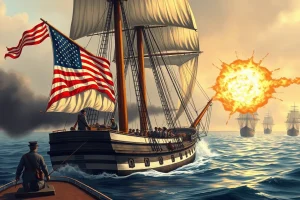
Warships of the War of 1812 included the ocean-going frigates and sloops of the United States Navy and the Royal Navy, as well as the small but strategically vital freshwater squadrons built on the Great Lakes. These vessels determined control of vital supply lines, enabled amphibious operations, and produced some of the war’s most celebrated single-ship actions. The war forced both belligerents to adapt their naval forces to the demands of a conflict that spanned the Atlantic and the inland waters of North America.
Historical Context
When war was declared in June 1812, the Royal Navy was the world’s dominant maritime power, with more than 600 ships in service. The United States Navy was minuscule by comparison, with only sixteen seagoing ships ready for service, including a few powerful frigates. The British also maintained small provincial squadrons on the Great Lakes, while the United States had but a single armed vessel on Lake Ontario. Control of the lakes was essential for supplying armies and moving troops, as roads were poor or nonexistent. On the Atlantic, British naval superiority threatened American trade and coastal cities, while American frigates and privateers sought to disrupt British commerce. The naval war therefore developed along two distinct axes: the blue-water Atlantic and the freshwater inland seas.
What Happened
The naval conflict began with American frigate victories in 1812, including the capture of HMS Guerriere by USS Constitution in August and of HMS Macedonian by USS United States in October. These single-ship duels raised American morale, but the Royal Navy soon imposed a tightening blockade on the American coast. In 1813, the war on the Great Lakes intensified. American Commodore Oliver Hazard Perry’s victory on Lake Erie at the Battle of Put-in-Bay in September secured control of that lake and forced the British to abandon Detroit. On Lake Ontario, rival squadrons under Commodore Isaac Chauncey (American) and Sir James Lucas Yeo (British) engaged in a shipbuilding race, but fought few decisive battles. In the Pacific, Captain David Porter in USS Essex attacked British whalers before being captured. British raids in the Chesapeake Bay in 1813–1814 demonstrated the vulnerability of the American coast. The naval war culminated with American victories on Lake Champlain (September 1814) and at New Orleans (January 1815), though the latter was primarily a land battle. Throughout, warships served as floating batteries, transports, and symbols of national pride.
Why It Matters
The warships of the War of 1812 shaped the conflict’s outcome and its memory. Control of the Great Lakes proved critical to military operations in the Canadian theater, influencing the failure of American invasions and the eventual defense of Upper Canada. On the Atlantic, the Royal Navy’s blockade crippled American trade but also fueled resentment and a sense of defiance. Naval victories, especially those of the frigates, created enduring heroes like Isaac Hull and Oliver Hazard Perry. After the war, the Rush-Bagot Agreement of 1817 demilitarized the Great Lakes, a lasting consequence of the wartime naval race. The war also influenced naval architecture and tactics, particularly the value of heavy frigates and the use of carronades. Historians continue to debate whether the naval war was decisive, but its ships undoubtedly defined the conflict’s character.
Definition
In the context of the War of 1812, warships included all armed vessels built or employed for naval combat. Oceanic types included ships of the line, frigates, sloops, brigs, and schooners, as well as smaller gunboats. On the Great Lakes, vessels ranged from converted merchant schooners to purpose-built brigs, frigates, and even ship of the line HMS St Lawrence. These warships carried a mix of long guns and carronades, the latter being short, heavy cannons effective at close range. Crews varied from a few dozen on gunboats to over 800 on the largest lake warship.
Background
Both the Royal Navy and the United States Navy had established shipbuilding traditions. American frigates such as USS Constitution were designed to be larger and more heavily armed than their British counterparts, a deliberate policy to make them superior in single-ship contests. The Royal Navy relied on a vast fleet of standardized vessels, which emphasized reliability and concentration of force. On the Great Lakes, neither side had significant naval forces at the war’s start, but they quickly established shipyards at Kingston and Sackets Harbor. Shipwrights like Henry Eckford introduced innovative techniques to build large warships rapidly from green timber. The ships built on the lakes had shallower drafts and often used unseasoned wood, sacrificing durability for speed of construction.
How They Worked
Naval tactics in this period followed the line of battle for fleets, but on the ocean, single-ship actions were common. Frigate duels involved maneuvering to rake an opponent while avoiding being raked. Carronades gave a devastating short-range punch, but long guns allowed firing at a distance. On the Great Lakes, squadrons acted as floating artillery and transport for amphibious forces. Commanders like Perry and Macdonough used clever positioning to break an enemy line. The blockading squadrons on the Atlantic employed a close watch on ports, while American privateers used speed and deception to evade them. The control of the lakes required constant construction and maintenance, making shipwrights as important as sailors.
Competing Viewpoints
Historians differ on the importance of the naval war. Some emphasize the psychological and strategic impact of American frigate victories, arguing they offset military failures and boosted national morale. Others stress the overwhelming British naval power, which eventually blockaded the entire American coast, severing trade and weakening the economy. On the Great Lakes, scholars debate whether the British or Americans were more effective. Some argue that the British shipbuilding program, culminating in HMS St Lawrence, achieved dominance on Lake Ontario, while others point to American control of Lakes Erie and Champlain as decisive. Additionally, the role of privateers is contested—whether they were a significant burden to British commerce or a minor nuisance. These interpretations reflect broader views of the war’s outcome and the effectiveness of naval power in an era of limited conflict.
Role in the War of 1812
Warships were essential to every major campaign. On the Great Lakes, control of Lake Erie allowed the Americans to recapture Detroit and invade Upper Canada, while British control of Lake Ontario protected the St. Lawrence supply line. The Battle of Lake Champlain in 1814 prevented an invasion of New York and contributed to peace negotiations. On the Atlantic, the Royal Navy’s blockade strangled American exports and forced the navy to keep its ships in port, but American raiders like USS Essex and hundreds of privateers disrupted British shipping worldwide. Warships also supported combined operations, such as the raids on York and Fort George, where naval gunfire softened defenses. The race to build ever-larger warships on the lakes, including American ships of the line New Orleans and Chippewa, and the British HMS St Lawrence, demonstrated the central importance of naval power to the conflict.
Consequences and Historical Interpretation
The war permanently changed naval policy. The Rush-Bagot Agreement of 1817 limited naval armaments on the Great Lakes, a direct result of the wartime arms race. The U.S. Navy emerged with a reputation for skill and courage, but also with a realization that its traditional reliance on heavy frigates was insufficient against a powerful adversary. The Royal Navy, while victorious in the overall blockade, had to contend with American privateers, influencing future commerce-raiding tactics. The memory of warships and their commanders became central to American national identity, from the immortal Constitution to the battle flags of Perry and Macdonough. Modern historians use shipwrecks and archaeological data to reassess construction and operations, revealing the improvisation and desperation of the freshwater fleets. The ships themselves, though many were scrapped or sunk, remain potent symbols of the conflict.
Primary Sources
Key primary sources include the official correspondence of naval officers, captured in the documentary compilation The Naval War of 1812: A Documentary History, edited by William S. Dudley and others. This multi-volume collection contains letters and reports from American commanders like Isaac Chauncey and Oliver Hazard Perry. British sources include Admiral Sir John Borlase Warren’s dispatches and the logs of Royal Navy vessels. Memoirs, such as the recollections of sailor Ned Myers (published by James Fenimore Cooper), provide first-hand accounts of the Great Lakes campaigns. Perry’s famous dispatch after Lake Erie—“We have met the enemy and they are ours”—is a well-known original document. Naval court-martial transcripts and prize court decisions also survive. These sources must be read critically, as officers often emphasized their own achievements and downplayed setbacks.
Further Reading
- Lardas, Mark. Great Lakes Warships 1812–1815. Osprey Publishing, 2012.
- Malcomson, Robert. Lords of the Lake: The Naval War on Lake Ontario, 1812–1814. Naval Institute Press, 1998.
- Dudley, William S., ed. The Naval War of 1812: A Documentary History. Naval Historical Center, 1985–2002.
- Gibson, Gary M. “The New Orleans Class Ships of the Line.” The Napoleon Series, 2015.
- Canadian Encyclopedia, “HMS St Lawrence (British Warship of the War of 1812).”
References
- Dudley, William S., et al., eds. The Naval War of 1812: A Documentary History, Vol. II. Naval Historical Center, 1992. link
- Lardas, Mark. Great Lakes Warships 1812–1815. Osprey Publishing, 2012. link
- Marsh, James H. “HMS St Lawrence (British Warship of the War of 1812).” The Canadian Encyclopedia, 2011. link
- Gibson, Gary M. “The New Orleans Class Ships of the Line.” The Napoleon Series, 2015. link
- Ford, Ben. “The Sunken Vessels of Chauncey and Yeo in Lake Ontario.” Northeast Historical Archaeology, vol. 44, 2015. link
FAQ
What types of warships were used in the War of 1812?
Both sides used ships of the line, frigates, sloops, brigs, schooners, and gunboats. On the Great Lakes, they also used converted merchant vessels and purpose-built ships with shallower drafts.
Why was control of the Great Lakes important?
The lakes were critical supply and communication routes for armies. Controlling them allowed transport of troops and supplies and prevented enemy invasion, as seen at Lake Erie and Lake Champlain.
What was the largest warship built during the war?
The largest warship built on the Great Lakes was HMS St Lawrence, a British ship of the line with 112 guns, launched in 1814. It never saw action but secured British dominance on Lake Ontario.


Leave a Reply