
Short Answer
The War of 1812, which the United States fought against Great Britain from 1812 to 1815, severely disrupted American commerce but also catalyzed a dramatic expansion of domestic manufacturing. Following the conflict, a combination of protective tariffs, technological innovation, and patriotic sentiment helped transform small workshops into a more industrialized economy, particularly in the northeastern states. This article examines the growth of American manufacturing in the aftermath of the war and its broader implications.
Historical Context
Before the war, the United States was largely an agrarian nation that relied on European imports for manufactured goods. The Embargo Act of 1807 and the Non-Intercourse Act of 1809 had already restricted trade and offered some unintended protection to domestic industry. The outbreak of the War of 1812, with the British naval blockade, further cut off imports and forced the young nation to rely on its own productive capacities. This created a favorable environment for the development of textile mills, iron works, and other manufacturing establishments. After the war, British merchants began dumping surplus goods on the American market, threatening the infant industries. In response, Congress passed the Tariff of 1816, the first protective tariff in U.S. history.
What Happened
During the war, entrepreneurs such as Francis Cabot Lowell in Massachusetts had already begun to build textile mills. The Waltham-Lowell system emerged, integrating spinning and weaving in one factory. After the war, the pace quickened. By the late 1810s and 1820s, manufacturing communities grew along rivers in New England and mid-Atlantic states. The tariff of 1816 provided a protective barrier, and later tariffs in 1824 and 1828 further safeguarded domestic producers. The growth was not uniform: agricultural regions in the South and West remained less industrialized, but the Northeast experienced a significant transformation. The American System, championed by Henry Clay, advocated for internal improvements and a national bank to support and protect manufacturing. This period also saw the spread of the factory system, with hired laborers, including women and children, working in mills.
Why It Matters
The postwar expansion of manufacturing laid the groundwork for the American Industrial Revolution. It reduced the nation’s dependence on European goods and fostered a distinct identity as a producer nation. The period also intensified sectional tensions, as the South’s reliance on slave-based agriculture clashed with the North’s industrial growth. The tariff debates of the 1820s became a central political issue, leading to the Nullification Crisis in 1832. Historians view this era as a decisive transition from an agrarian to an industrial economy.
Definition
“American Manufacturing After the War” refers to the growth of the domestic manufacturing sector in the United States between the end of the War of 1812 (1815) and roughly the start of the American Civil War. It encompasses the expansion of textile mills, iron forges, and other industrial enterprises, aided by protective tariffs and governmental policies.
Background
The roots of this transformation lay in the early republic. Merchants in New England had accumulated capital from shipping and trade. The interruption of trade during the war redirected that capital into domestic production. Technological innovations, such as the power loom and the cotton gin (though the latter predates the war), also played a role. The postwar surge of British imports, which were sold at low prices to crush competition, prompted Congress to respond with tariffs designed to protect “infant industries.”
How It Worked
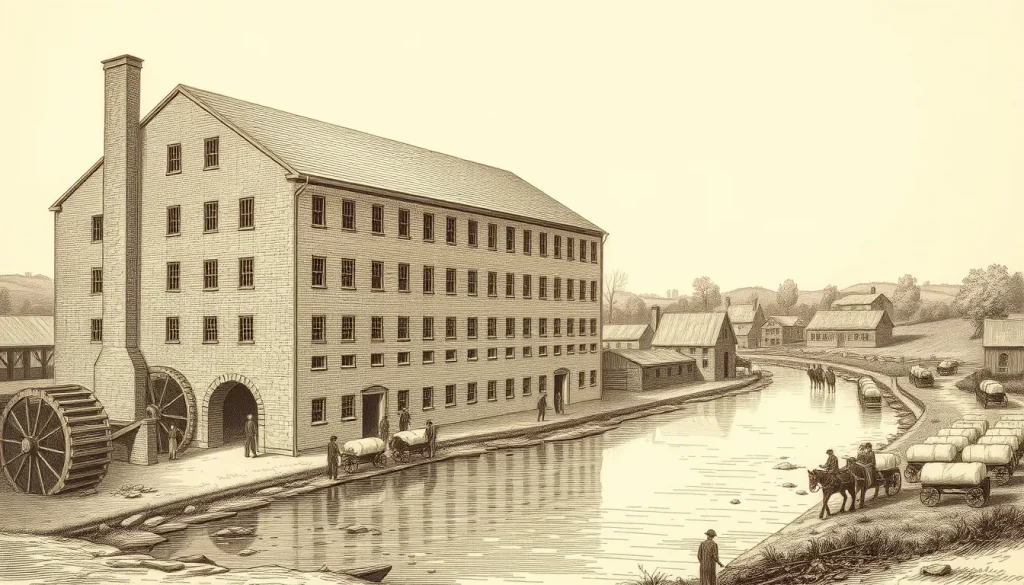
The manufacturing economy operated through a combination of factors: protective tariffs raised the cost of imported goods, giving American producers a price advantage. State chartered banks provided credit. Many factories were located near rivers for water power. The system of “putting out” (where raw materials were distributed to households) gradually gave way to centralized factory production, particularly in textiles. Skilled mechanics and unskilled laborers, including women and children, were employed in mills. The Waltham-Lowell system pioneered the complete production process under one roof.
Competing Viewpoints
Historians and contemporaries differed on the value of postwar manufacturing. Some, like Henry Clay, argued that manufacturing would strengthen national independence and provide a home market for agricultural surplus. Others, particularly southern agriculturalists, saw tariffs as a burden that raised prices for consumers and threatened the export economy. Historian Douglas C. North and others have debated the extent to which manufacturing contributed to economic growth before 1840, with some emphasizing the role of trade and others focusing on domestic innovation.
Role in the War of 1812
The war directly stimulated manufacturing by cutting off imports. The British blockade created shortages of goods such as cloth and metalware, encouraging domestic production. After the war, the Tariff of 1816 was explicitly justified as a means to protect the industries that had emerged during the conflict. Thus, the War of 1812 acted both as a catalyst and a rallying cry for manufacturing development.
Consequences and Historical Interpretation
Long-term consequences include the rise of the factory system, urbanization, and the sectional divide. The protective tariffs remained controversial and were a factor leading to the Nullification Crisis. Later historians have reinterpreted this period as the beginning of the American Industrial Revolution, emphasizing that the foundation for later industrial might was laid in the decades after the War of 1812.
Primary Sources
A key primary source is the Tariff of 1816 itself, which illustrates the legislative response to postwar manufacturing. Also important are the speeches of Henry Clay in Congress, particularly his 1824 “American System” address. Contemporary newspapers such as Niles’ Weekly Register documented the growth of factories. Accounts from mill workers, like those from Lowell, Massachusetts, provide insight into labor conditions. These sources must be read with awareness of their political and business bias.
Further Reading
- Stuart Bruchey, The Roots of American Economic Growth, 1607-1861 (1968).
- Robert F. Dalzell Jr., Enterprising Elite: The Boston Associates and the World They Made (1987).
- Charles Sellers, The Market Revolution: Jacksonian America, 1815-1846 (1991).
- Douglass C. North, The Economic Growth of the United States 1790-1860 (1961).
References
- Bruchey, Stuart. The Roots of American Economic Growth, 1607-1861. Harvard University Press, 1968.
- North, Douglass C. The Economic Growth of the United States 1790-1860. Prentice-Hall, 1961.
- Sellers, Charles. The Market Revolution: Jacksonian America, 1815-1846. Oxford University Press, 1991.
- Taylor, George Rogers. The Transportation Revolution, 1815-1860. Rinehart & Company, 1951.
FAQ
How did the War of 1812 affect American manufacturing?
The war cut off British imports, creating shortages that forced the United States to develop domestic production. This stimulus continued after the war through protective tariffs.
What was the Tariff of 1816?
The Tariff of 1816 was the first protective tariff in U.S. history, passed to shield American industries that had grown during the war from British competition.
What is the significance of the American System?
The American System, championed by Henry Clay, promoted protective tariffs, internal improvements, and a national bank to support manufacturing and unify the national economy.



Leave a Reply