
Short Answer
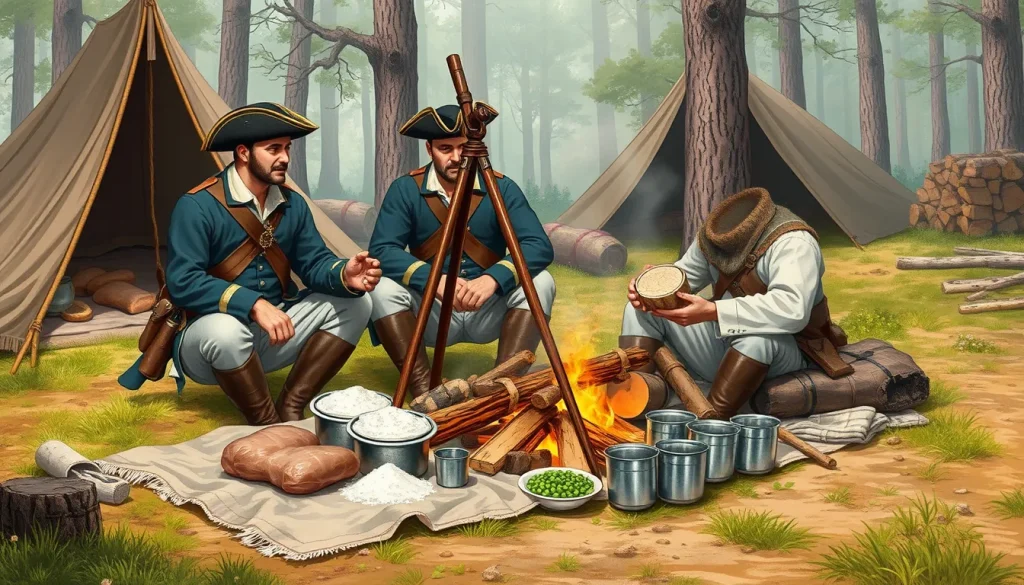
During the War of 1812 (1812–1815), soldiers on both sides survived on a monotonous diet of preserved foods designed to travel and keep under field conditions. The standard ration varied by nation and location, but typically included salted meat, flour or hardtack, peas, and a spirit ration, supplemented with whatever fresh food could be obtained from the surrounding country. Understanding what soldiers ate reveals the logistical challenges of the conflict and the daily hardships faced by regulars, militia, and Indigenous allies.
Historical Context
At the start of the nineteenth century, food preservation was limited to salting, drying, and smoking. Without refrigeration, armies depended on durable stores: salt pork or beef, ship’s biscuit (hardtack), dried peas, and flour. During the War of 1812, the United States and Britain both faced the challenge of supplying troops across vast, often sparsely populated territories. British forces in Upper Canada (modern Ontario) relied heavily on local farmers for fresh beef and flour, while American armies struggled to move supplies through wilderness and along poor roads. The availability of food often determined the pace and success of campaigns, especially in the Niagara Peninsula, the American Northwest, and along the St. Lawrence River.
What Happened
American soldiers received a daily ration that, by regulation, included approximately 20 ounces of beef (or 12 ounces of pork), 18 ounces of flour or bread, and a gill (5 fluid ounces) of rum, plus salt, vinegar, soap, and candles. In practice, when on campaign, these components were often simplified. Salt pork and hardtack biscuits were common substitutes for fresh meat and bread. British soldiers in North America were issued a ration that could include 1 pound of flour, 1 pound of fresh beef or 9 ounces of pork, a small amount of butter, 3/7 pint of pease, and 1 ounce of rice. Fresh beef was frequently supplied from local Canadian farms when contracts functioned properly.
Cooking methods were rudimentary. Bread, when flour was available, was sometimes kneaded in a trough, coiled around a pole, and baked over an open fire. On the march, soldiers often carried raw dough that they cooked on flat stones or in pans. Hardtack, a hard biscuit made from flour and water, was a staple for both armies, especially for naval crews and detached units. The Kentucky militiamen marching to the River Raisin in 1813, for instance, ran out of flour and resorted to pounding corn from abandoned fields, which they baked into cornmeal bread. They called their camp “Fort Starvation” because of the lack of food, according to private Elias Darnell’s journal.
When in garrison, soldiers might have access to more varied fare. At Fort George in Upper Canada, fresh beef was delivered in quarters from local suppliers, and soldiers were known to purchase cheese or pork privately. Cooked meals were prepared by regimental messes or by female camp followers, who often accompanied the army. Officers generally ate better, using their pay to augment rations with local produce and liquor. After the American capture of Frenchtown (now Monroe, Michigan) on January 18, 1813, soldiers seized 30 barrels of flour and 2,000 pounds of beef from the British, and Darnell described the village as a “culinary paradise” with apples, cider, butter, sugar, and whiskey.
Why It Matters
The quality and quantity of soldiers’ food had direct consequences for health, morale, and military effectiveness. Malnutrition and the diseases that followed poor diet often killed more soldiers than combat. Scurvy, dysentery, and other deficiency and sanitation-related illnesses plagued both armies. Food shortages could cause desertion, looting, and even mutiny. The American campaign of 1812 along the Niagara frontier was hampered by supply failures; in contrast, the British ability to feed their troops from Canadian resources was a strategic advantage. Historians have long debated whether the war’s outcome was influenced as much by logistics as by combat, with food supply being a central feature of that logistics. The experience of soldiers on the ground, recorded in journals like Darnell’s, provides a vivid record of the centrality of food to daily life in the conflict.
Definition
In the War of 1812, a “soldier’s ration” referred to the daily allowance of food and drink issued to military personnel by their government. The ration was intended to provide basic subsistence, but its components were selected for durability and portability rather than taste or nutrition. In both American and British armies, the ration typically included a source of protein (salted or fresh meat), a carbohydrate staple (bread, flour, or hardtack), a legume (peas or beans), and a beverage (often rum or beer).
Background
European and North American armies of the early nineteenth century inherited a system of field rations that had evolved during the eighteenth century. Salted meat (beef or pork) preserved in barrels, ship’s biscuit (hardtack) that could last for months, and dried peas were the cornerstones. These items were measured by weight and volume, and regulations defined exactly how much each soldier was entitled to. The British Army’s regulations were influenced by the experience of the Napoleonic Wars, while the United States Army based its system on colonial and Revolutionary War precedents. In Upper Canada, the British also relied on a system of contracts with local farmers for fresh beef and flour, which could be more economical than shipping salted provisions across the Atlantic.
How It Worked
Rations were distributed by the commissary department, which purchased, stored, and issued food. In garrison, soldiers often cooked together in mess groups, with rations pooled to create meals. On campaign, soldiers were given a few days’ worth of rations to carry, typically hardtack and salt pork, since these were easiest to transport and did not require immediate cooking. Foraging and purchase from local civilians were common supplements, though often illegal or discouraged by officers. Cooking was done over open campfires, with each soldier or mess having a tin kettle, frying pan, and utensils. Bread was baked when flour was available; otherwise, hardtack was soaked or toasted to make it edible. The rum ration was a significant part of the daily issue, providing calories and a morale boost, but also leading to discipline problems.
Competing Viewpoints
Contemporary observers and historians have offered differing assessments of the soldiers’ diet. Some British officers praised the quality of fresh beef supplied by Canadian farmers, while American soldiers often complained of “stinking” salt pork and weevil-infested hardtack. Modern historians debate the nutritional adequacy of the rations; while the calorie count was probably sufficient for ordinary activity, it lacked vitamins (especially vitamin C) and fiber, leading to scurvy on long campaigns. Others interpret the widespread foraging and private purchase as evidence that the official ration was neither sufficient nor palatable. Indigenous allies, who fought alongside both sides, had their own dietary practices and often depended on the armies they accompanied for food, which could strain relationships if supplies ran short.
Role in the War of 1812
Food supply directly shaped major operations. The American invasion of Canada in 1812 was delayed and ultimately failed partly because of supply shortages. At Frenchtown, the capture of British provisions was a key objective. During the siege of Fort Meigs in 1813, American defenders subsisted on dwindling stores until relieved. On the Atlantic coast and Great Lakes, naval crews relied on hardtack and salted meat; the ability to provision ships was a limiting factor for both the United States Navy and the Royal Navy. The British blockade of the American coast aimed to cut off American food imports, but also forced American armies to rely more heavily on internal resources.
Consequences and Historical Interpretation
The wartime experience with food had long-term consequences. The inadequacies of the American commissary system prompted reforms in army logistics in the following decades. British reliance on Canadian farmers strengthened the economic ties between the colony and the imperial military. For soldiers, the memory of hunger was a defining part of the war; Darnell’s journal and other memoirs underscore that food was a constant preoccupation. Historians now view subsistence as a critical factor in troop health and morale, and note that the war was as much a struggle over resources as over territory.
Primary Sources
The most direct evidence comes from soldier journals and official records. Private Elias Darnell, a Kentucky militiaman, recorded his company’s food experiences on the march to the River Raisin, describing the lack of flour and the use of corn and hogs. Darnell’s journal is a key source for the Frenchtown campaign. The British side is documented in the letters and reports of commissary officers and military officials, such as the 1802 decision from London to purchase fresh beef locally in Canada. Regimental mess records and the published ration tables, like those reproduced in Robert Henderson’s study “Diet and Food Preparation for the British Army during the War of 1812,” provide the official framework. A valuable limitation of these sources is they often reflect the experience of officers and regulars, not always the militia or camp followers. Modern educational materials, such as the Jefferson Patterson Park & Museum’s guide, also use historic recipes and equipment to interpret the soldiers’ diet.
Further Reading
- Robert Henderson, “Diet and Food Preparation for the British Army during the War of 1812” (article on warof1812.ca).
- Jefferson Patterson Park & Museum, “Preparing and Tasting Food” (educational document).
- Marie Zorniak, interview on “Food in the War of 1812” (Canada’s History video, 2014).
- River Raisin Battlefield, “Soldier’s Fare” (web article).
- Donald R. Hickey, The War of 1812: A Forgotten Conflict (University of Illinois Press, 1989).
- Pierre Berton, Flames Across the Border: The Canadian-American Tragedy, 1813-1814 (McClelland & Stewart, 1981).
References
- River Raisin Battlefield. “Soldier’s Fare.” Accessed 2025. https://riverraisinbattlefield.org/soldiersfare.htm.
- Henderson, Robert. “Diet and Food Preparation for the British Army during the War of 1812.” Warof1812.ca. Accessed 2025. https://www.warof1812.ca/food.htm.
- Jefferson Patterson Park & Museum. “Preparing and Tasting Food.” Accessed 2025. https://jefpat.maryland.gov/Documents/education/traveling-trunks/War%20of%201812/07-Preparing%20and%20Tasting%20Food.pdf.
- Canada’s History. “Food in the War of 1812.” Video and transcript. Accessed 2025. https://www.canadashistory.ca/explore/military-war/food-in-the-war-of-1812.
FAQ
Did soldiers in the War of 1812 get enough food?
In theory, rations were sufficient in calories but often lacking in nutrition and variety. In practice, shortages, poor logistics, and the need to carry supplies meant soldiers often went hungry, especially during campaigns. Foraging and private purchase were common supplements.
What was the most common meal for soldiers?
A typical meal would be hardtack soaked in water or toased, accompanied by salted pork or beef, and possibly boiled peas. When fresh bread and meat were available, soldiers preferred them, but hardtack and salt meat were the staples on campaign.
Did officers eat better than enlisted men?
Yes. Officers could use their higher pay to purchase additional food, including fresh meat, vegetables, and liquor, from local civilians or sutlers. They often dined in messes with better prepared meals.

Leave a Reply