
Short Answer
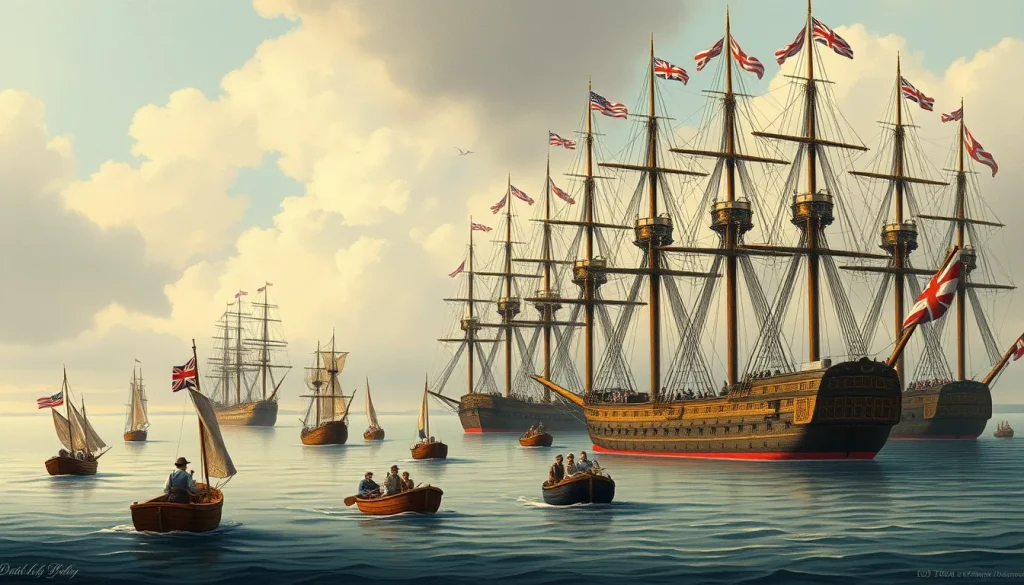
The Royal Navy’s strategy during the War of 1812 was a dynamic combination of naval blockade, convoy protection, amphibious operations, and force augmentation. Initially caught unprepared while Britain was engaged in the Napoleonic Wars, the Royal Navy rapidly reinforced its North American station and adopted methods that would eventually confine the U.S. Navy to port, disrupt American commerce, and support British military campaigns along the Atlantic coast. This strategy was central to the conflict’s maritime dimension and contributed significantly to the war’s outcome.
Historical Context
When the United States declared war on Great Britain in June 1812, the Royal Navy was the world’s largest and most experienced naval force, but its resources were heavily committed against Napoleonic France. The North American station initially possessed only one ship-of-the-line and five frigates, a force too small to effectively blockade the American coastline or protect British trade. The U.S. Navy, by contrast, fielded sixteen warships, including several powerful 44-gun frigates like USS Constitution, and had a large pool of experienced merchant seamen. American privateers also posed a serious threat to British commerce. Moreover, Britain’s strategic priorities centered on defeating France, and war with the United States was an unwelcome diversion. The British government and Admiralty had to decide how to respond to American naval challenges while maintaining vital operations in Europe and the West Indies.
What Happened
In the first months of the war, the under-strength Royal Navy squadron in American waters suffered a series of humiliating frigate defeats: USS Constitution captured HMS Guerrière on 19 August 1812 and HMS Java on 29 December 1812, while USS United States captured HMS Macedonian on 25 October 1812. These losses prompted the Admiralty to reinforce the North American station. By mid-1813, the British had built up a force of ten ships-of-the-line, sixteen frigates, and other vessels, and by late 1814 the total reached twelve ships-of-the-line, two razees, and twenty-nine frigates. This massive concentration of force allowed Admiral Sir John Borlase Warren and his successor, Vice-Admiral Sir Alexander Cochrane, to implement a comprehensive strategy.
The core of British strategy was the blockade. In February 1813, a squadron under Rear Admiral George Cockburn established a close blockade of the Chesapeake Bay, and the blockade gradually extended to cover the entire Atlantic coast from New England to the Gulf of Mexico. The blockade prevented American warships from leaving port, intercepted American merchantmen, and cut off supplies to the United States. The British also organized convoy systems to protect their own merchant shipping from American privateers and warships. In addition, the Royal Navy conducted amphibious raids, particularly in the Chesapeake Bay region, to divert American troops from the Canadian frontier and to destroy military supplies and public buildings. The most notable operations included the attack on Craney Island in June 1813, the burning of Hampton, and the 1814 campaign that resulted in the burning of Washington.
To minimize losses against the powerful American frigates, the Admiralty issued orders in July 1813 instructing British frigate commanders to avoid single-ship combat with the largest American vessels unless they had a clear advantage. This tactical directive reflected the reality that British frigates were generally smaller than the American ‘super-frigates.’ The strategy also included hunting American privateers, which were a major threat to British trade; British warships and specially appointed vessels pursued them relentlessly.
By 1814, the Royal Navy had effectively gained command of the sea along the American coast. The U.S. Navy’s major units were blockaded, and only individual cruisers like USS Constitution and USS President occasionally broke out. The blockade imposed severe economic hardship on the United States, causing a decline in customs revenue and inflation. Meanwhile, British amphibious forces were able to strike virtually at will, culminating in the capture and burning of Washington in August 1814.
Why It Matters
The Royal Navy’s strategy was instrumental in shaping the outcome of the War of 1812. It neutralized the U.S. Navy as a fighting force, suppressed American privateering, and crippled American foreign trade. The blockade and raids also placed immense pressure on the American government, affecting elections and public morale. Moreover, the Royal Navy’s ability to project power along the American coast allowed Britain to support its Canadian provinces and to conduct offensive operations that forced the United States to divert troops and resources to coastal defense. The strategy also influenced American strategic thinking, encouraging a shift toward commerce raiding in distant waters. Ultimately, the dominance of the Royal Navy was a key factor in the peace negotiations, as Britain’s military and naval advantages strengthened its negotiating position.
Definition
Royal Navy strategy during the War of 1812 refers to the overall operational approach adopted by the British Admiralty and commanders in North American waters. It combined close blockade of American ports, convoy protection for British merchantmen, amphibious raids against the American coast, and tactical regulations designed to avoid loss of warships. The strategy aimed to control the sea lines of communication, destroy American maritime trade, and support British land operations in Canada and the United States.
Background
The strategy evolved from Britain’s naval doctrine developed during the French Revolutionary and Napoleonic Wars, which emphasized blockade, convoy, and the concentration of force. When war with the United States began, the Royal Navy was already operating blockades against France, and the Admiralty had to balance these commitments with the new American challenge. The initial weakness of the North American station stemmed from the demands of the European war, but the Admiralty quickly recognized the need for a substantial force to deal with American naval activity. The strategy was also shaped by the geography of the American coast, which offered many harbors and inlets that required constant patrolling, and by the presence of numerous American privateers that threatened British trade.
How It Worked
The strategy operated through several interrelated components. First, the Admiralty dramatically increased the number of ships on the North American station, creating a fleet large enough to blockade the entire American seaboard. Second, it established close blockading squadrons off major ports and rivermouths to prevent the exit of American warships and the entry of supplies. Third, it organized convoys for British merchant vessels, especially in the Atlantic and West Indies, to protect against American cruisers. Fourth, it deployed light vessels to hunt down American privateers. Fifth, it launched amphibious operations, using Royal Marines and army detachments, to destroy coastal fortifications, public stores, and economic resources. Finally, it issued command orders that instructed frigate captains to avoid action against the largest American frigates unless they had overwhelming superiority. These measures were coordinated by the station commanders, first Warren and later Cochrane, who reported to the Admiralty and the Secretary of State for War and the Colonies.
Competing Viewpoints
Historians have debated the wisdom and effectiveness of different elements of Royal Navy strategy. Some contemporaries, including Admiral Cockburn, advocated aggressive, destructive raids along the American coast to break civilian morale and force the U.S. government to concentrate on defense. Others, such as Admiral Warren, preferred a more limited approach focused on blockade and the protection of British trade. The Admiralty itself alternated between these priorities, reflecting wider debates about the use of naval power in a limited conflict. Some scholars argue that the blockade was too porous and allowed many American privateers to slip through, while others contend that the threat of blockade itself had a devastating impact on the American economy. The legality and ethics of the blockade, and especially of the attacks on coastal towns, were fiercely criticized by Americans and remain a subject of historical discussion.
Role in the War of 1812
The Royal Navy’s strategy was the dominant factor in the naval war. It determined the fate of American commerce, restricted the movements of U.S. warships, and enabled British amphibious offensives. The blockade forced the American government to rely on revenue from internal taxation and led to fiscal strain. It also prevented the U.S. Navy from breaking out in force, aside from occasional sorties. The strategy supported British military operations in Canada by threatening the American coast and compelling the United States to withhold troops and resources from the Canadian front. At the same time, British naval pressure contributed to the war weariness in the United States and influenced the peace negotiations that culminated in the Treaty of Ghent.
Consequences and Historical Interpretation
The immediate consequence of the Royal Navy’s strategy was the establishment of British naval supremacy along the American coast, which was a key factor in military campaigns such as the burning of Washington. In the longer term, the strategy had significant economic and political repercussions for the United States, but also demonstrated the limits of sea power against a determined land defense. Historians have interpreted the strategy as a successful application of traditional British naval doctrine, adapted to a limited war across the Atlantic. Some emphasize its role in preserving Canada and in helping Britain negotiate a favorable peace. Others point out that the blockade did not break American resistance completely and that the Treaty of Ghent essentially restored the status quo ante bellum. The debate hinges on whether the Royal Navy’s material and psychological pressure was decisive in ending the war, or whether the British strategic focus on Napoleon mattered more.
Primary Sources
The most important primary sources for understanding Royal Navy strategy are the official correspondence and orders contained in the British Admiralty Papers at The National Archives in Kew, United Kingdom. These include letters from Admirals Warren and Cochrane, as well as Admiralty instructions regarding blockades, convoys, and tactical engagements. A valuable published collection is The Naval War of 1812: A Documentary History, edited by William S. Dudley and others, which reproduces many of these British documents with annotations. Also relevant are Captain William James’s Naval Occurrences of the War of 1812, which provides a contemporary British perspective, and Jeremy Black’s article ‘A British View of the Naval War of 1812’ in Naval History, which offers modern analysis. Researchers should note that these sources reflect the authors’ national and personal biases, and that British official reports often sought to justify decisions to the Admiralty.
Further Reading
- Dudley, William S., ed. The Naval War of 1812: A Documentary History. Vol. 2. Washington: Naval Historical Center, 1992.
- Black, Jeremy. ‘A British View of the Naval War of 1812.’ Naval History 22, no. 4 (2008).
- McCranie, Kevin D. ‘Waging Protracted Naval War: The Strategic Leadership of Secretary of the U.S. Navy William Jones in the War of 1812.’ The Northern Mariner/le marin du nord 21, no. 2 (2011): 143-157.
- Arthur, Brian. ‘The Royal Navy and Economic Warfare in North America, 1812-1815.’ PhD diss., University of Greenwich, 2009.
- James, William. Naval Occurrences of the War of 1812. London, 1817.
References
- Black, Jeremy. ‘A British View of the Naval War of 1812.’ Naval History 22, no. 4 (2008). Accessed at https://www.usni.org/magazines/naval-history-magazine/2008/august/british-view-naval-war-1812.
- Dudley, William S., ed. The Naval War of 1812: A Documentary History. Vol. 2. Washington: Naval Historical Center, 1992. Accessed at https://www.history.navy.mil/content/dam/nhhc/research/publications/Publication-PDF/THE%20NAVAL%20WAR%20OF%201812,%20Vol.%202_reduced.pdf.
- McCranie, Kevin D. ‘Waging Protracted Naval War: The Strategic Leadership of Secretary of the U.S. Navy William Jones in the War of 1812.’ The Northern Mariner/le marin du nord 21, no. 2 (2011): 143-157. Accessed at https://www.cnrs-scrn.org/northern_mariner/vol21/tnm_21_143-157.pdf.
- Arthur, Brian. ‘The Royal Navy and Economic Warfare in North America, 1812-1815.’ PhD diss., University of Greenwich, 2009. Accessed at https://gala.gre.ac.uk/id/eprint/5708/8/Brian%20Arthur%20Vol.1%202009%20-%20Redacted.pdf.
FAQ
What was the main goal of Royal Navy strategy during the War of 1812?
The main goal was to control the sea lines of communication along the American coast through blockade and convoy protection, while also using amphibious raids to divert American resources and pressure the U.S. government.
How did the Royal Navy enforce the blockade?
The Royal Navy deployed a large force of ships-of-the-line, frigates, and smaller vessels to station off major American ports and rivers. These ships intercepted neutrals and enemy shipping, prevented the exit of American warships, and often boarded and captured merchantmen.
Why did British commanders avoid single-ship duels later in the war?
After initial defeats against the larger American frigates, the Admiralty ordered British frigate captains in July 1813 to avoid combat with the heaviest American frigates unless they had a clear advantage in force. This was a tactical measure to preserve British ships for the blockade and other operations.


Leave a Reply