Short Answer
The Red Sticks were a militant, traditionalist faction of the Muscogee (Creek) Nation that emerged in the Upper Creek towns of present-day Alabama and Georgia during the early 1810s. They opposed the growing influence of Euro-American culture, land cessions, and U.S. government policies, and they sought to preserve communal land and Creek spirituality. Their resistance helped ignite the Creek War (1813–1814), which became an integral front in the broader War of 1812, ultimately leading to a devastating defeat and the loss of millions of acres of Creek territory.
Historical Context
By the early nineteenth century, the Creek Nation, with a population of roughly 20,000 people, occupied a vast territory along the Chattahoochee, Tallapoosa, and Coosa Rivers. American expansion after the Revolution placed enormous pressure on Creek lands. The 1805 treaty allowed construction of the Federal Road, which cut through the heart of Creek country and brought thousands of settlers, slaves, and travelers. The U.S. Indian agent Benjamin Hawkins promoted programs of acculturation, encouraging Creek men to abandon hunting for farming and to adopt European gender roles. Meanwhile, illegal squatters crossed the Ocmulgee River boundary, and the Creek National Council, dominated by Lower Creek chiefs, made land cessions to the United States.
In 1811, the Shawnee leader Tecumseh visited the Southeast, urging tribes to form a pan-Indian confederacy to stop American expansion. His message resonated with many Upper Creeks, who felt the erosion of their traditions and the loss of hunting grounds. A split developed between the Lower Creeks, many of whom had intermarried with whites and favored accommodation, and the Upper Creeks, who embraced traditional ways. The Red Sticks emerged from this Upper Creek resistance, influenced by Tecumseh’s prophetic teachings and the spiritual revival led by Creek prophets.
What Happened
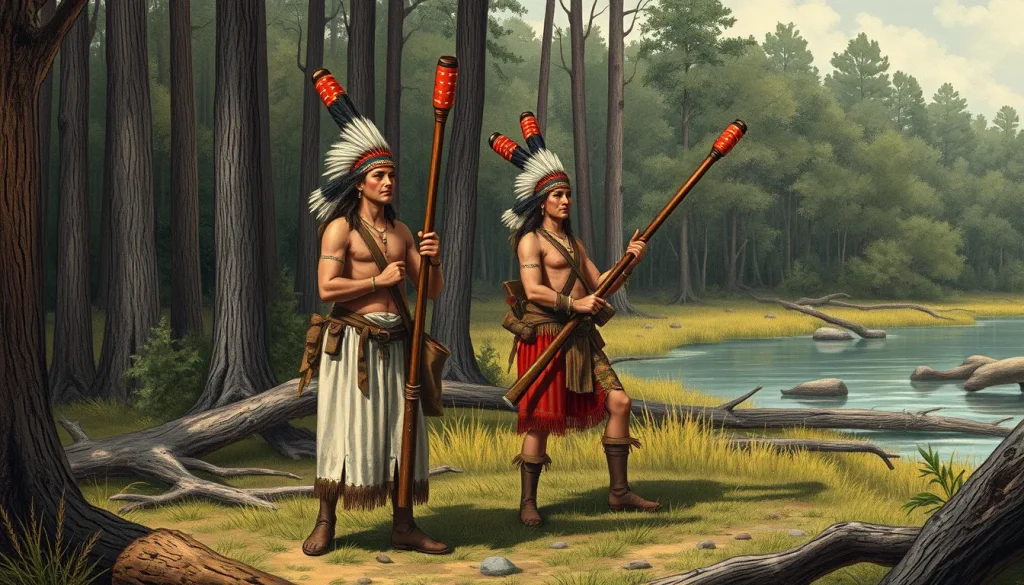
The Red Sticks, named for their distinctive red-painted war clubs (atássa), began active resistance in 1812. In May 1812, a Red Stick war party killed settlers on Tennessee’s Duck River, and in February 1813 they again attacked along the Ohio River. In retaliation, the Creek National Council, under pressure from the United States, executed several Red Stick warriors, intensifying the internal conflict. The Red Sticks also attacked Lower Creek towns and sought arms from Spanish and British agents in Pensacola.
The conflict escalated in July 1813 when Mississippi Territory militia intercepted a Red Stick party returning from Pensacola at Burnt Corn Creek. Though initially surprised, the Red Sticks rallied and drove off the Americans. This skirmish was followed by the Red Sticks’ attack on Fort Mims on August 30, 1813, where they overwhelmed a makeshift stockade and killed an estimated 250 settlers and friendly Creeks. The “Fort Mims massacre” shocked the American frontier and prompted a military response.
Andrew Jackson, then a major general of the Tennessee militia, led a campaign into Creek country. In November 1813, his forces destroyed the Red Stick towns of Tallushatchee and Talladega. After a brief withdrawal, Jackson rebuilt his army and, with Cherokee and Lower Creek allies, marched against the Red Stick stronghold at Tohopeka (Horseshoe Bend). On March 27, 1814, Jackson’s force of about 3,300 defeated the 1,000 Red Stick warriors, killing nearly all of them. The subsequent Treaty of Fort Jackson (August 9, 1814) forced the Creek Nation to cede over 23 million acres of land, most of it from the pro-American Lower Creeks, as the United States sought to cut off British and Spanish influence and open the region for settlement.
Why It Matters
The Red Stick rebellion had immediate and long-term consequences. Its suppression ended Creek armed resistance in the Southeast and broke the power of the traditionalist faction. The land cession at Fort Jackson removed a vast tract from Creek hands, paving the way for Alabama’s statehood and the rapid expansion of cotton agriculture. For Andrew Jackson, the Creek War made his national reputation and propelled him toward the presidency, where he later engineered Indian removal in the 1830s. For the Red Sticks themselves, the war was catastrophic: survivors fled to Florida, where they joined the Seminoles, while others were forced into new towns. The conflict also demonstrated how the War of 1812 intertwined with Indian-U.S. land struggles, as both British and Spanish agents armed the Red Sticks, and American expansion proceeded while the nation fought Britain.
Definition
The Red Sticks were a faction of the Creek Nation that emerged around 1812, composed primarily of warriors from the Upper Towns of the Tallapoosa, Coosa, and Alabama River valleys. They opposed the federal policies of assimilation and land cession promoted by U.S. Indian agent Benjamin Hawkins and the Lower Creek chiefs. The name derived from the red-painted wooden war clubs they carried, known as atássa, which were fitted with iron or bone points. Their ideology blended Creek traditionalism, communal landholding, and a prophetic spiritual revival.
Background
The Creek Confederacy was a loose alliance of towns, each with its own council, but with a shared matrilineal clan system and Green Corn Ceremony (póskita). By the 1800s, economic and social pressures had widened a divide between the Lower Towns (east of the rivers) and the Upper Towns. Lower Creek towns, closer to white settlements, had more intermarriage, trade contacts, and had made multiple land cessions. Upper Creeks retained more of their traditional economy, but also felt the incursions of the Federal Road and squatters. Tecumseh’s visit in 1811 and his call for a return to ancestral ways galvanized Upper Creek resistance. When the National Council executed Red Stick warriors for attacks on white settlements, the movement turned into a civil war.
How It Worked
The Red Sticks organized around prophetic leaders such as Hillis Hadjo and Menawa, who claimed to possess spiritual powers and sacred talismans that would protect them from bullets. They performed the “dance of the Indians of the lakes,” a Shawnee-derived ritual, and women played a key role in gathering food and supporting the fighters. The movement was not a centralized army but a coalition of town-based warriors who united in ad hoc bands. Their tactics included hit-and-run raids on frontier settlements, attacks on supply lines, and the defense of fortified positions, as at Horseshoe Bend. They also sought arms from British and Spanish agents in Florida, which tied their conflict to the wider Anglo-American war.
Competing Viewpoints
American officials and many later historians viewed the Red Sticks as agents of British and Spanish intrigue, acting to destabilize the American frontier during the War of 1812. Others, including modern historians, emphasize the internal Creek roots of the conflict, portraying the Red Sticks as defenders of sovereignty and cultural identity against an encroaching settler state. The Lower Creeks, who allied with the United States, saw the Red Sticks as a threat to their own survival and negotiated separate peace. The U.S. government, and indeed many Americans, depicted the war as a defensive struggle against “savages,” while the Red Sticks themselves saw it as a last stand for their way of life. These contrasting interpretations reflect the complexity of a war that was at once a civil conflict, a frontier land grab, and a theater of the larger British-American war.
Role in the War of 1812
The Red Stick uprising occurred concurrently with the War of 1812 and drew in American forces that were also needed for the northern fronts. The British, through their agents at Pensacola and along the Gulf Coast, supplied arms and encouraged attacks on American settlements, hoping to divert U.S. resources. Vice Admiral Alexander Cochrane attempted to exploit the Red Sticks’ resistance by sending a small British force to the Apalachicola River in 1814 to train warriors, a move that contributed to the Gulf Coast campaign and eventually to the Battle of New Orleans. For the United States, victory over the Red Sticks at Horseshoe Bend eliminated a major British ally in the South and secured the region for American expansion, a key strategic objective even as the war with Britain continued.
Consequences and Historical Interpretation
The defeat of the Red Sticks had profound consequences: it opened Alabama to American settlement, weakened the Creek Confederacy, and set the stage for the forced removal of the Creek people in the 1830s. Historians have interpreted the Red Stick movement as an early example of Indigenous resistance to American expansion, highlighting the prophetic and revivalist elements that gave it spiritual power. Some scholars emphasize the agency of the Red Sticks in shaping their own destiny, while others frame them as victims of a larger geopolitical struggle. The romanticized figure of William Weatherford, “Red Eagle,” who survived and adapted to postwar conditions, has often overshadowed the broader context of the movement. Modern scholarship stresses the diversity within the Creek Nation and the complexity of the civil war, noting that the Red Sticks’ defeat did not end Creek resistance, as many fled to Florida and continued fighting under the banner of the Seminoles.
Primary Sources
Contemporary accounts include the letters and reports of Benjamin Hawkins, the U.S. Indian agent, who documented the Creek divisions and the Red Stick uprising. Andrew Jackson’s official reports of the Creek campaign, especially his account of the Battle of Horseshoe Bend, provide the American military perspective. A firsthand participant’s memoir is that of Davy Crockett, who served as a Tennessee volunteer and vividly described the brutality of the conflict in his autobiography. The British side is represented by the correspondence of Vice Admiral Cochrane and Captain Hugh Pigot, who reported on the possibilities of cooperating with the Red Sticks. Each source carries biases—Hawkins advocated assimilation, Jackson sought to justify his actions, and Crockett wrote for popular audiences—so they must be read critically. Direct quotations from these sources should be drawn from published editions only.
Further Reading
- Halbert, H.S., and T.H. Ball. The Creek War of 1813 and 1814. 1895.
- Waselkov, Gregory A. A Conquering Spirit: Fort Mims and the Redstick War of 1813–1814. University of Alabama Press, 2006.
- Ethridge, Robbie Franklyn. Creek Country. University of North Carolina Press, 2003.
- Sugden, John. Tecumseh: A Life. Holt, 1997.
- National Park Service. “Creeks organize to resist white expansion.” nps.gov.
References
- U.S. National Park Service. “Creeks organize to resist white expansion.” Last updated August 14, 2017. https://www.nps.gov/articles/creek-organize-to-resist-white-expansion.htm.
- Wikipedia. “Red Sticks.” Accessed October 2023. https://en.wikipedia.org/wiki/Red_Sticks.
- Encyclopedia.com. “Creek War.” https://encyclopedia.com/history/encyclopedias-almanacs-transcripts-and-maps/creek-war.
- National Park Service. “William Weatherford.” Last updated September 14, 2017. https://www.nps.gov/people/william-weatherford.htm.
- Hutton, Paul Andrew. “Crockett and the Creek War: ‘We Now Shot Them Like Dogs’.” HistoryNet, September 26, 2019. https://historynet.com/crockett-and-the-creek-war-we-now-shot-them-like-dogs/.
FAQ
Why were they called Red Sticks?
They were named for the red-painted wooden war clubs (atássa) they carried, which were a traditional weapon and symbol of resistance.
What was the Creek War?
The Creek War (1813–1814) was both a civil conflict between Red Stick Upper Creeks and pro-American Lower Creeks, and a military campaign by the United States against the Red Sticks, ending at the Battle of Horseshoe Bend.
How did the Red Sticks affect the War of 1812?
The Red Stick uprising diverted American troops and resources to the South, and the British supplied them with arms, making it a peripheral but important front that influenced the Gulf Coast campaign.
Leave a Reply