
Short Answer
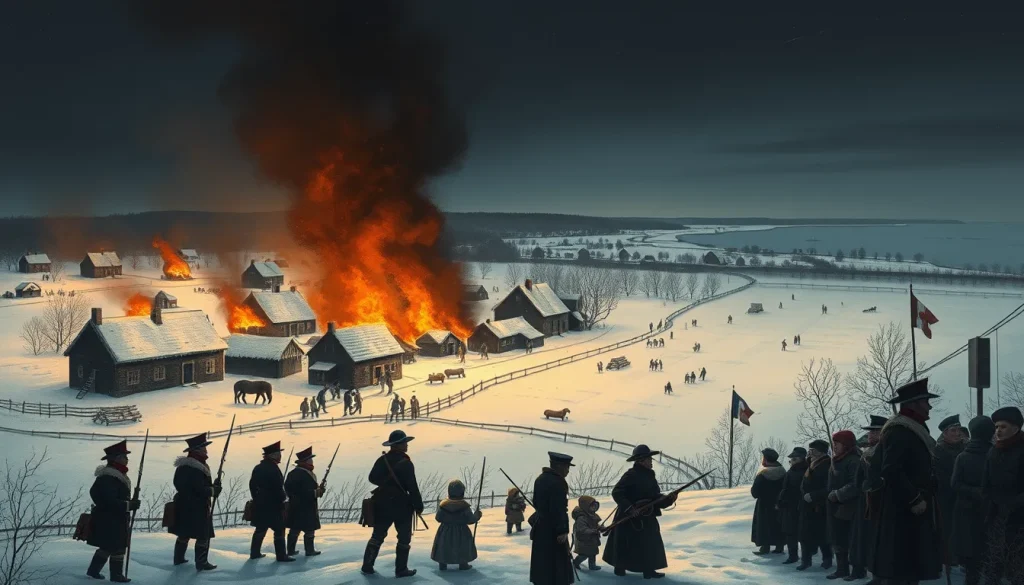
The Burning of Newark occurred on the night of 10 December 1813, when retreating American forces under Brigadier General George McClure set fire to the village of Newark (modern Niagara-on-the-Lake, Ontario) in Upper Canada, beside Fort George. The destruction left hundreds of civilians, largely women and children, without shelter in the dead of winter. It became one of the most notorious episodes of the War of 1812 and a central case study of civilian suffering, military necessity claims, and the cycle of retaliatory burnings that followed on the Niagara Frontier and beyond.
Historical Context
By late 1813, the War of 1812 had settled into a grinding conflict along the Niagara River. The United States had invaded Upper Canada in May 1813 and captured Fort George, occupying the nearby town of Newark. American forces, however, never secured a decisive hold on the peninsula. British regulars, Canadian militia, and Indigenous allies remained active, and the American position at Fort George depended on fragile supply lines, short-term militia enlistments, and a population whose loyalties were divided.
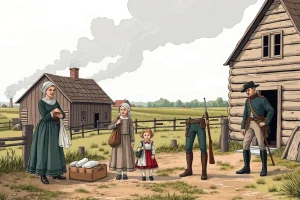
Newark—also called Niagara—was a small but significant settlement at the mouth of the Niagara River, directly across from Fort Niagara on the American side. It contained government buildings, commercial stores, and homes, and it had already endured military occupation, foraging, and looting. Earlier in 1813, American forces had burned public buildings at York (modern Toronto), an act the British would later cite in justifying retaliation. As winter approached, American commanders in the Niagara region faced dwindling numbers and feared a British counteroffensive. The stage was set for a retreat that would turn a military decision into a civilian catastrophe.
What Happened
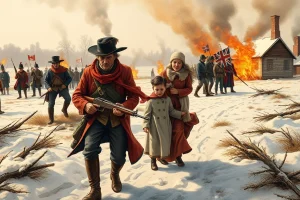
In early December 1813, Brigadier General George McClure, commanding the American force at Fort George, concluded that he could not hold his position against an expected British attack. Rather than wait to be besieged, he ordered a withdrawal across the Niagara River. On the night of 10 December, American soldiers and members of the Canadian Volunteers—an Upper Canadian corps fighting with the United States—set fire to Newark. According to contemporary and later accounts, more than eighty houses, barns, and stables were destroyed. The town’s civilians fled into severe frost and snow. Elizabeth Campbell and Charlotte Dickson, who had merged households during the occupation, were left with seven children and “nowhere to place their heads,” as one digital exhibit summarizes their plight; a compensation claim described them as exposed for three days and nights with only the sky for cover.
The American retreat was marked by contradictions that fueled outrage. Although McClure claimed the burning was necessary to prevent the British from using the town for shelter, his troops abandoned Fort George without dismantling its defenses, threw at least seven cannons into a ditch, and left tents standing. The powder magazine was blown up, but the fort itself remained largely intact. British Lieutenant-Colonel John Harvey soon wrote to McClure demanding to know whether the “atrocious act” had been authorized by the American government or was the unauthorized act of an individual. American Brigadier General Timothy Hopkins complained to New York Governor Daniel D. Tompkins that McClure’s decisions had disgusted many of his own men. Federalist newspapers, especially those opposed to the war, denounced the burning, while some Americans defended McClure as acting from military necessity.
British retaliation followed swiftly. On 19 December 1813, British forces under Colonel John Murray captured Fort Niagara in a surprise attack, and British and Indigenous raiders then burned Lewiston, Black Rock, and Buffalo on the American side of the Niagara. The cycle of destruction continued into 1814. British leaders later cited York and Newark among the reasons for their Chesapeake raids and for the burning of Washington’s public buildings in August 1814.
Why It Matters
The Burning of Newark mattered immediately because it turned hundreds of civilians into refugees in winter, destroyed homes and livelihoods, and deepened suffering in a region already strained by occupation, foraging, and fear. It also mattered militarily: the American withdrawal failed to deny the British the fort, and the burning handed British commanders a powerful propaganda and moral justification for retaliation. On the Niagara Frontier, the episode inaugurated a series of vengeful conflagrations that devastated towns and farms on both sides of the river.
In the longer term, Newark became a focal point for debates over responsibility and the limits of military necessity. Some historians emphasize McClure’s decision and the lack of discipline among his forces, arguing that the burning of a civilian town was neither necessary nor effective. Others place it within a broader pattern of escalating civilian targeting in the War of 1812, noting that both sides burned settlements and that earlier acts such as the burning of York contributed to the cycle. Scholars of gender and society have also used Newark to examine women’s experiences, showing that women were not merely passive victims: they managed households, sought compensation, rebuilt lives, and navigated military occupation. The episode remains central to Canadian memory of the war and to American debates about the conflict’s darker chapters.
Prelude
The burning of Newark followed months of American occupation. After the Battle of Fort George in May 1813, U.S. forces controlled the fort and nearby Newark, but their hold was never secure. By December, McClure’s command had been reduced by expired enlistments and desertions, and British reinforcements under Major General Sir Gordon Drummond were gathering. McClure feared being trapped. He also faced pressure from Washington to avoid losing his force and stores. His decision to evacuate Fort George was militarily defensible; his decision to burn Newark was not uniformly accepted, even within his own army.
Forces and Commanders
The American force at Fort George was commanded by Brigadier General George McClure of the New York militia. It included regulars, New York militia, and the Canadian Volunteers, a corps of Upper Canadians who had sided with the United States and were led by Colonel Joseph Willcocks. British and Canadian forces in the region included regulars under Lieutenant-Colonel John Harvey and, soon, Major General Sir Gordon Drummond; Colonel John Murray led the attack on Fort Niagara. Indigenous allies, including warriors under John Norton, participated in the retaliatory raids on the American side of the Niagara. The burning itself was carried out by American troops and Canadian Volunteers; British forces were not present in Newark at the time.
Battlefield and Map Context
Newark lay on the west bank of the Niagara River at its mouth, immediately south of Fort George and directly across from Fort Niagara in New York. The Niagara River connects Lake Erie and Lake Ontario, and the surrounding Niagara Peninsula was a principal theater of the war. A surviving 1810 map shows Fort George, Fort Niagara, and Newark’s main buildings, including the location of Elizabeth Campbell’s home. The town’s proximity to the fort made it strategically exposed: it could shelter troops, store supplies, and serve as a base for either army. Modern Niagara-on-the-Lake, Ontario, occupies the site, and Fort George National Historic Site preserves part of the military landscape.
Battle Chronology
Early December 1813: McClure decides to abandon Fort George rather than face a British attack. 10 December 1813: American forces evacuate, set fire to Newark, and blow up the powder magazine; more than eighty buildings are destroyed, and civilians flee into the snow. 11–12 December: British forces reoccupy the ruined town and Fort George; Lieutenant-Colonel John Harvey demands an explanation from McClure. 19 December 1813: British forces capture Fort Niagara; retaliatory raids burn Lewiston, Black Rock, and Buffalo. Winter–spring 1814: burning and raiding continue along the Niagara Frontier, contributing to the wider escalation that culminates in the British burning of Washington in August 1814.
Casualties and Losses
The burning of Newark produced few immediate battle casualties, but its civilian losses were severe. More than eighty houses, barns, and stables were destroyed, along with household goods, tools, livestock, and winter stores. Hundreds of people, mostly women and children, were left without shelter. Some died from exposure or hardship in the months that followed, though precise mortality figures are not reliably documented. Compensation claims filed by displaced inhabitants provide detailed evidence of property loss, but they are incomplete and reflect the perspectives of those who sought redress. Military casualties at Fort George during the retreat were minimal; the more deadly fighting came with the British capture of Fort Niagara and the subsequent raids.
Result
The immediate result was the destruction of Newark and the British reoccupation of Fort George. The American attempt to deny the British winter quarters failed because the fort was left largely intact. The burning outraged many Americans and British observers, and it gave British commanders a justification for retaliation. McClure’s reputation suffered; some of his own officers and numerous newspapers condemned the act. The British retaliated by burning Lewiston, Black Rock, and Buffalo, turning the Niagara Frontier into a desolate landscape of burned farms and abandoned villages.
Strategic Consequences
Newark changed the character of the war on the Niagara Frontier by normalizing attacks on civilian settlements. British retaliation devastated American border towns, and American forces responded in kind into 1814. The cycle of destruction weakened morale, displaced thousands, and made the war more costly for civilians on both sides. British leaders later used York and Newark to justify the burning of Washington’s public buildings, arguing that the Americans had set the precedent. The episode also contributed to a lasting memory in Canada of American invasion and civilian suffering, while in the United States it became a source of embarrassment and debate over military conduct.
Primary Accounts
Contemporary accounts of Newark come from military correspondence, civilian compensation claims, and newspapers. Elizabeth Campbell’s claim describes the loss of her home and the exposure of her family in the snow. Lieutenant-Colonel John Harvey’s letter to McClure demands to know whether the burning was authorized. Brigadier General Timothy Hopkins’s letter to Governor Tompkins criticizes McClure’s leadership. A letter from Lewiston reprinted in the New York Evening Post under the title “Newark Burnt!” condemns the destruction. McClure’s own correspondence with Secretary of War John Armstrong offers his military justification. Each source has limitations: official letters are shaped by honor, politics, and self-justification; compensation claims are prepared to prove loss; newspapers reflect partisan editors. Together, however, they provide a substantial record of the event and its human cost.
Battlefield Today
There was no conventional battlefield at Newark; the site is the historic town of Niagara-on-the-Lake, Ontario. Fort George National Historic Site preserves the fort and interprets the War of 1812, including the American occupation and retreat. The Niagara Historical Society Museum and local heritage organizations maintain documents, artifacts, and exhibits related to the burning and to civilian experience. The town’s surviving street plan and historic buildings evoke the early nineteenth-century settlement, though much of Newark was destroyed in 1813. Visitors can walk the area between Fort George and the Niagara River, where the town once stood.
Primary Sources
The most important contemporary sources for the Burning of Newark include:
- Elizabeth Campbell’s compensation claim and accompanying agent’s letter. Created by or on behalf of a displaced civilian, it describes the loss of a home and belongings and the family’s exposure in the snow. It is valuable for civilian experience but was written to support a claim for financial compensation.
- Lieutenant-Colonel John Harvey to Brigadier General George McClure, December 1813. A British military demand for explanation. It reflects British outrage and the political use of the event, and it does not provide a neutral account.
- Brigadier General Timothy Hopkins to Governor Daniel D. Tompkins. An American officer’s criticism of McClure. It shows division within the U.S. command but is shaped by personal and political friction.
- New York Evening Post, “Newark Burnt!” A reprinted anonymous letter from Lewiston. It captures American newspaper condemnation, especially from Federalist opponents of the war, and may exaggerate for effect.
- George McClure’s correspondence with Secretary of War John Armstrong. McClure’s military justification and the question of authorization. It is essential for understanding his reasoning but is self-interested.
- War loss claims from the Niagara District. A broad set of petitions and schedules documenting property loss. They offer social and economic detail but cover only those who filed claims and can be difficult to generalize.
Further Reading
- David S. Heidler and Jeanne T. Heidler, The Ravages of War: Targeting Civilians in the Anglo-American Conflict, U.S. National Park Service.
- Fortitude and Resolution: Women and the War of 1812 in the Niagara District, digital exhibit, Brock University.
- Donald R. Hickey, The War of 1812: A Forgotten Conflict (University of Illinois Press).
- Alan Taylor, The Civil War of 1812: American Citizens, British Subjects, Irish Rebels, and Indian Allies (Knopf).
- George Sheppard, Plunder, Profit, and Paroles: A Social History of the War of 1812 in Upper Canada (McGill-Queen’s University Press).
- Andrew Lambert, The Challenge: Britain Against America in the Naval War of 1812 (Faber and Faber).
References
- David S. Heidler and Jeanne T. Heidler, “The Ravages of War: Targeting Civilians in the Anglo-American Conflict,” U.S. National Park Service, https://www.nps.gov/articles/ravages-of-war.htm.
- “Reduced to ashes,” Fortitude and Resolution, Brock University, https://swroberts.ca/far/exhibits/show/introduction/intro-opening.
- “Nowhere to place their heads,” Fortitude and Resolution, Brock University, https://swroberts.ca/far/exhibits/show/module2-niagara-at-war/opening.
- Amanda Balyk, “Defying Notions of Nineteenth Century Masculine Honour in the War of 1812: The Case of the American Burning of Newark, December 1813,” General Brock University Undergraduate Journal of History, https://doi.org/10.26522/gbuujh.v2i0.1491.
- “Burning of Lewiston – War of 1812,” https://thewarof1812.org/battles/burning-of-lewiston/.
- Donald R. Hickey, The War of 1812: A Forgotten Conflict (Urbana: University of Illinois Press, 1989; rev. ed. 2012).
- Alan Taylor, The Civil War of 1812: American Citizens, British Subjects, Irish Rebels, and Indian Allies (New York: Knopf, 2010).
- George Sheppard, Plunder, Profit, and Paroles: A Social History of the War of 1812 in Upper Canada (Montreal: McGill-Queen’s University Press, 1994).
- Andrew Lambert, The Challenge: Britain Against America in the Naval War of 1812 (London: Faber and Faber, 2012).
FAQ
What was the Burning of Newark?
It was the destruction of the Upper Canadian village of Newark (now Niagara-on-the-Lake, Ontario) by retreating American forces on 10 December 1813. The burning left hundreds of civilians homeless in winter and became a notorious episode of the War of 1812.
Why did American forces burn Newark?
Brigadier General George McClure claimed military necessity, arguing that the town could shelter British troops during a winter counteroffensive. Critics noted that his forces left Fort George largely intact and that the burning was not clearly authorized, making the justification controversial.
How did the burning of Newark affect the War of 1812?
It helped trigger a cycle of retaliatory burnings on the Niagara Frontier, including British attacks that burned Lewiston, Black Rock, and Buffalo. British leaders later cited Newark, along with the burning of York, as part of their justification for burning Washington in 1814.
Leave a Reply