
Short Answer
The British invasion of Louisiana was the last major campaign of the War of 1812, launched in late 1814 to capture New Orleans and seize control of the Mississippi River. The campaign culminated in the Battle of New Orleans on January 8, 1815, in which American forces under Major General Andrew Jackson won a spectacular victory over a British army that had recently defeated Napoleon. The invasion failed to achieve its objectives, but it shaped American national identity and propelled Jackson to the presidency.
Historical Context
After the abdication of Napoleon in April 1814, Great Britain was free to concentrate its considerable military resources on the war with the United States. The British government and Admiralty developed a strategy to strike at vital American coastal and riverine targets, with the capture of New Orleans as a primary objective. New Orleans was the gateway to the Mississippi River and the interior United States; it handled a third of American exports and held millions of dollars in cotton and sugar. Control of the city would sever the western states from the Atlantic, provide a bargaining chip in peace negotiations at Ghent, and potentially allow Britain to establish a base in the Gulf of Mexico. British Vice Admiral Sir Alexander Cochrane proposed the expedition in June 1814, and the War Ministry approved it in July. A combined naval and military force was assembled in Jamaica, while a diversionary attack on Washington, D.C., in August 1814 drew attention away from the Gulf.
What Happened
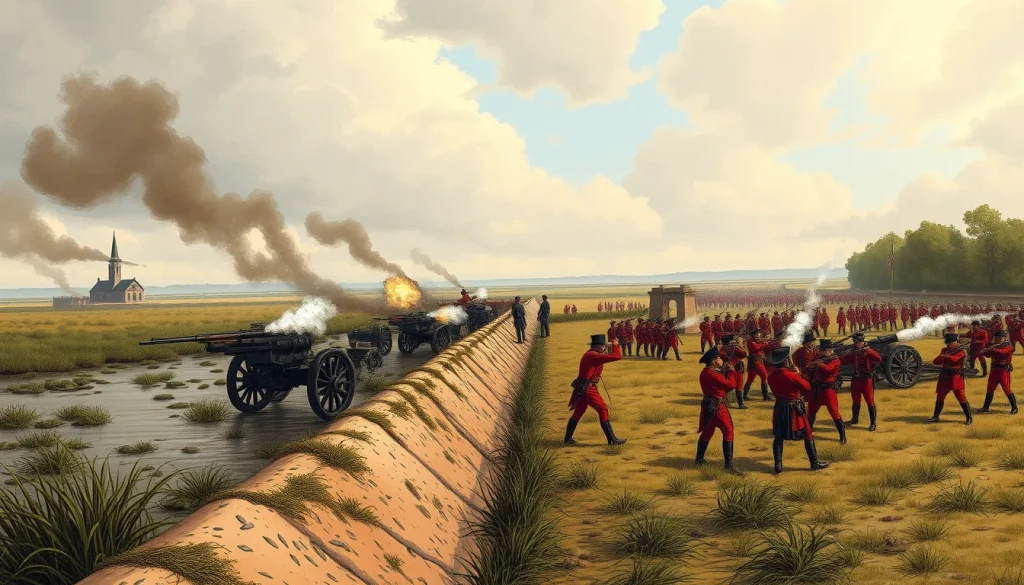
The British expeditionary force, commanded by Major General Robert Ross until his death at Baltimore, was placed under Major General Sir Edward Pakenham, brother-in-law of the Duke of Wellington. Rear Admiral Cochrane commanded the naval squadron. After a rendezvous in Jamaica, the fleet sailed toward the Gulf Coast, arriving off Ship Island, Mississippi, on December 8, 1814. A British gunboat flotilla defeated an American naval force on Lake Borgne on December 14, eliminating the Americans’ ability to monitor British movements. Using local pilots, the British moved troops through the bayous and landed on the east bank of the Mississippi River at the Villere Plantation on December 23. Alerted to the landing, Andrew Jackson, commander of the U.S. Seventh Military District, launched a surprise night attack that slowed the British advance but did not stop it. Jackson then withdrew to a defensive line along the Rodriguez Canal at Chalmette Plantation, and his men constructed an earthwork that stretched from the river to an impassable cypress swamp. On Christmas Day, Pakenham arrived and assumed command, but his attempts to break the line on December 27 and New Year’s Day were repulsed. Pakenham then planned a full-scale frontal assault for January 8, 1815.
At dawn on January 8, the British launched a coordinated attack against the American left and right. A column under Colonel William Thornton crossed the Mississippi River and captured the American guns on the west bank, but the main assault on the east bank failed catastrophically. The British infantry advanced in dense columns into concentrated artillery and rifle fire from behind the earthworks. Pakenham and his senior officers were killed or wounded, and the assault collapsed within thirty minutes. The British suffered over 2,000 casualties, while American losses were only 71. The remaining British forces withdrew to the fleet on January 18, and the campaign ended. A subsequent British attack on Fort Bowyer in February succeeded, but the news of the Treaty of Ghent, signed December 24, 1814, ended all hostilities.
Why It Matters
The American victory at New Orleans was the most lopsided major battle of the War of 1812 and gave the United States a much-needed psychological boost after years of defeats. It made Andrew Jackson a national hero and helped create a narrative of American military strength and democratic triumph over European aristocracy. The battle also secured American control of the Mississippi River and the port of New Orleans, which was vital for the expanding western territories. Although the Treaty of Ghent had already been signed, the news of the victory reached Washington before the treaty, intensifying American pride and influencing the ratification debate. For the next half century, January 8 was celebrated as a national holiday, and Jackson’s fame propelled him to the White House in 1828. Historically, the invasion demonstrated the strategic importance of the Gulf Coast and contributed to the eventual annexation of Florida and westward expansion.
Prelude
After Napoleon’s defeat, Britain prepared a major expedition against the Gulf Coast. Admiral Cochrane’s fleet arrived at Ship Island in early December and moved through Lake Borgne after destroying the American flotilla. The British landed below New Orleans on December 23, but Andrew Jackson’s night attack on December 23–24 forced them to pause. Jackson then established a powerful defensive position behind the Rodriguez Canal at Chalmette Plantation, and both sides prepared for a decisive engagement.
Forces and Commanders
American forces under Major General Andrew Jackson numbered approximately 4,500–5,700 men, including U.S. Army regulars, Tennessee and Kentucky militia, Louisiana militia, free men of color, Choctaw warriors, Baratarian privateers under Jean Lafitte, and crews from naval vessels. British forces, commanded by Major General Sir Edward Pakenham and Vice Admiral Sir Alexander Cochrane, numbered about 8,000 troops, many veterans of the Peninsular War. The British army included the 4th, 7th, 21st, 43rd, 44th, 85th, 93rd, and 95th Regiments of Foot, along with artillery and marines.
Battlefield and Map Context
The battlefield lay on the east bank of the Mississippi River at Chalmette Plantation, about five miles south of New Orleans. Jackson’s line extended three-quarters of a mile from the riverbank to a cypress swamp, anchored on the right by a redoubt near the river. The west bank was also defended with artillery batteries. The terrain was flat, open farmland, with the Rodriguez Canal serving as a natural trench in front of the American earthworks. The British advance on January 8 crossed about 400–500 yards of open ground, exposed to American artillery and musketry.
Battle Chronology
At approximately 6:15 a.m. on January 8, the British artillery opened fire, and the infantry moved forward. On the east bank, the main assault columns under Major Generals Samuel Gibbs and John Keane advanced toward the American left and center. They were met with a devastating crossfire of artillery and rifle fire. The 44th Regiment, tasked with carrying fascines and ladders, failed to bring them, leaving the attacking columns unable to cross the canal or scale the earthworks. Pakenham, attempting to rally his troops, was hit by grapeshot and killed. The assault stalled and then retreated. On the west bank, Colonel William Thornton’s force landed and captured the American gun battery after a brief fight, but by then the main assault had failed. Major General John Lambert, succeeding Pakenham, ordered the west bank force to withdraw. The battle lasted less than an hour.
Casualties and Losses
British casualties were 291 killed, 1,262 wounded, and 484 captured or missing, totaling approximately 2,034. American casualties were 13 killed, 39 wounded, and 19 missing, a total of 71. The overwhelming disparity reflected the strength of Jackson’s defensive position and the failure of the British to coordinate their attack.
Result
The Battle of New Orleans was a decisive American victory. The British army retreated to its fleet and abandoned the invasion. The victory secured the city and the Mississippi River for the United States and ended the last major British offensive of the War of 1812.
Strategic Consequences
The American victory prevented the capture of New Orleans and control of the Mississippi, preserving the economic and territorial integrity of the American West. It strengthened the U.S. position at the Treaty of Ghent negotiations, though the treaty had already been signed. The victory also demonstrated the vulnerability of Britain’s extended amphibious operations and contributed to the decision to conclude peace. For the United States, the battle enhanced national prestige and opened the way for the acquisition of Florida and expansion into the Gulf region.
Primary Accounts
Contemporary accounts include Andrew Jackson’s official report to Secretary of War James Monroe, dated January 9, 1815, describing the engagement. British officers’ letters and court-martial records, especially concerning the failure of the 44th Regiment, provide insight. American soldier John Overton wrote a vivid description of the battlefield after the battle. These sources must be read critically for patriotic bias and the fog of war. Jackson’s own account emphasizes unity and discipline, while British accounts often focus on the lack of fascines and the delayed west bank crossing.
Battlefield Today
The Chalmette battlefield is preserved as Chalmette Battlefield and National Cemetery, part of Jean Lafitte National Historical Park and Preserve. It features the reconstructed earthworks, a monument to the American victory, and interpretive markers. The site is open to visitors and serves as a memorial to the soldiers of both sides.
Primary Sources
Key primary sources include Andrew Jackson’s report to the Secretary of War (9 January 1815), British Vice Admiral Cochrane’s dispatches to the Admiralty, the official journal of the USS Carolina, and letters from British officers such as Major General John Lambert. The Treaty of Ghent, signed 24 December 1814, marks the official end of the war and is crucial for understanding the timing of the battle. The National Archives in the United States and the National Archives of the United Kingdom hold many of these documents. The American Battlefield Trust provides digital access to some, but users should consult archival databases for transcriptions.
Further Reading
- Remini, Robert V. The Battle of New Orleans. New York: Viking, 1999.
- Hickey, Donald R. The War of 1812: A Forgotten Conflict. Urbana: University of Illinois Press, 1989.
- Latimer, Jon. 1812: War with America. Cambridge, MA: Harvard University Press, 2007.
- Borneman, Walter R. 1812: The War That Forged a Nation. New York: HarperCollins, 2004.
- Ridler, Jason. “Battle of New Orleans.” The Canadian Encyclopedia, 2023.
References
- “New Orleans Battle Facts and Summary.” American Battlefield Trust, Accessed 2024. https://www.battlefields.org/learn/war-1812/battles/new-orleans.
- “Battle of New Orleans: The Last Battle of the War of 1812.” American Battlefield Trust, 2024. https://www.battlefields.org/learn/articles/battle-new-orleans-last-battle-war-1812.
- “Battle of New Orleans.” The War of 1812, Accessed 2024. https://thewarof1812.org/battles/battle-of-new-orleans/.
- Kimball, Jeffrey, and Richard Adler. “Battle of New Orleans.” EBSCO Research Starters, 2023. https://www.ebsco.com/research-starters/military-history-and-science/battle-new-orleans/.
- Ridler, Jason. “Battle of New Orleans.” The Canadian Encyclopedia, 2023. https://thecanadianencyclopedia.ca/en/article/battle-of-new-orleans.
FAQ
Why did the British invade Louisiana in 1814?
The British sought to capture New Orleans and control the Mississippi River, which would cripple American trade and westward expansion, provide leverage in peace negotiations, and possibly re-establish British influence in the Gulf region.
What was the outcome of the Battle of New Orleans?
The battle was a decisive American victory. British casualties were over 2,000, while American losses were only 71. The British withdrew and the invasion failed.
Did the Battle of New Orleans affect the War of 1812's outcome?
The treaty ending the war had already been signed before the battle, so it did not affect the treaty's terms. However, it boosted American morale and provided a powerful symbol of American independence.


Leave a Reply