
Short Answer
The Russian mediation of 1813 was a diplomatic initiative by Tsar Alexander I to broker peace between the United States and Great Britain during the War of 1812. Though the offer was accepted by the United States, Britain declined it, and the mission ultimately contributed to the direct negotiations that produced the Treaty of Ghent in 1814. This episode underscores the interplay between the Napoleonic Wars in Europe and the conflict in North America.
Historical Context
The War of 1812 arose from long-standing American grievances against British maritime practices, especially impressment of American sailors and the Orders in Council that restricted neutral trade. Britain, deeply engaged in a life-and-death struggle with Napoleonic France, viewed the American declaration of war in June 1812 as an unwanted distraction. Russia, meanwhile, was an ally of Britain in the coalition against Napoleon, but also maintained friendly relations with the United States. By 1812, Napoleon’s invasion of Russia had made the tsar eager to concentrate British resources on the European theater, prompting him to see a quick end to the Anglo-American conflict as strategically advantageous.
What Happened
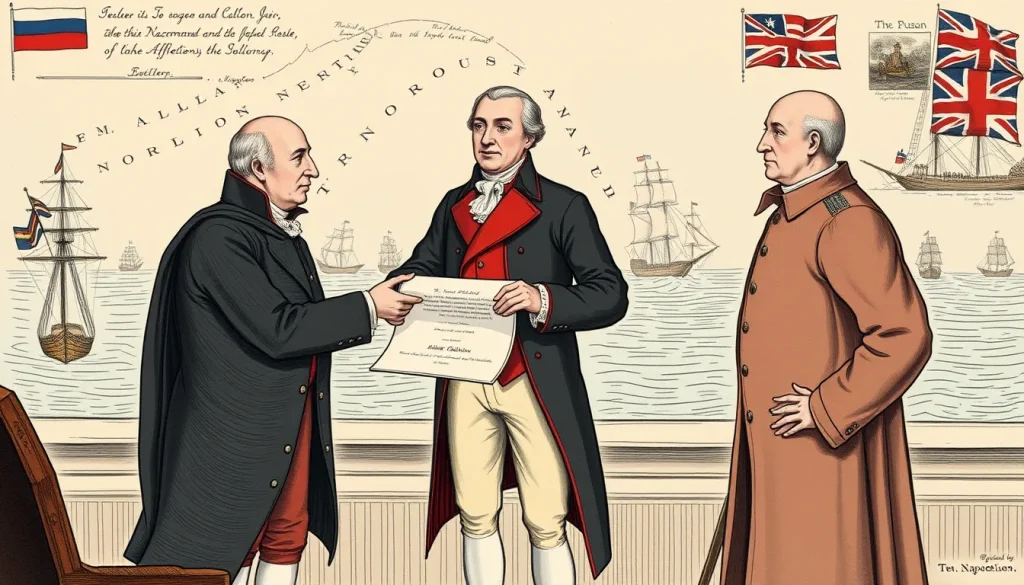
In early 1813, Tsar Alexander I formally offered his mediation to the United States and Great Britain. The offer was conveyed to President James Madison, who readily accepted, viewing it as an opportunity to achieve peace without further bloodshed. Madison selected Treasury Secretary Albert Gallatin and Senator James Bayard to join U.S. Minister to Russia John Quincy Adams as peace commissioners in St. Petersburg. The three men were to negotiate a treaty of peace with British representatives.
Gallatin and Bayard departed for Russia in May 1813, but by the time they arrived in St. Petersburg in July, the British government had already rejected Russia’s mediation. London preferred to avoid any third-party involvement, suspecting that Russian mediation might favor American interests or complicate its own war aims. The American commissioners remained in Europe through the summer and into the fall, awaiting instructions from Washington and hoping for a change in British attitude. Meanwhile, the British offered to open direct peace negotiations with the United States, an overture that eventually led to formal talks at Ghent.
Why It Matters
Though the Russian mediation offer itself failed, it marked a significant diplomatic moment. It demonstrated the willingness of the United States to seek a negotiated settlement and highlighted the wider international dimensions of the war. The American mission to St. Petersburg, led by Gallatin and Bayard, laid the groundwork for the later peace negotiations at Ghent by keeping channels open and familiarizing American diplomats with European diplomacy. Historians often view the mediation offer as an early illustration of Russia’s growing international influence, as well as a reflection of the interconnected nature of the Napoleonic Wars and the War of 1812.
Definition: The Russian Mediation Offer
The Russian mediation offer was a proposal by Tsar Alexander I to act as an intermediary between the United States and Great Britain to end the War of 1812. It was a formal diplomatic overture communicated to both belligerents in early 1813, though earlier informal feelers were made as early as September 1812. The tsar’s motivation was strategic: ending the war would allow Britain to focus its military efforts against Napoleon.
Background: Russia and the Napoleonic Wars
Russia was a key member of the anti-French coalition and had been fighting Napoleon since 1805. After Napoleon’s invasion of Russia in June 1812, the tsar sought to strengthen the alliance with Britain. A prolonged Anglo-American war threatened to divert British naval and military resources away from Europe, so Alexander saw mediation as a way to accelerate a settlement that would free Britain’s capacity for the continental struggle. Russia also maintained formal neutrality in the war, which made its offer plausible.
How the Offer Was Made and Received
The mediation offer was formally communicated to President Madison in early 1813, likely through the Russian ambassador in Washington. Madison accepted it promptly, as he had been seeking ways to end the war since its beginning. In his special session message to Congress on May 25, 1813, Madison recounted the offer and his decision to send envoys. He stated that the tsar’s ‘high character’ was a pledge of sincerity. The British, however, were skeptical. They believed that a third-party mediation would complicate their negotiating position and potentially favor American claims, especially on impressment. The British foreign secretary, Lord Castlereagh, preferred to negotiate directly with the United States, which he believed would be more advantageous.
Competing Viewpoints: American Optimism and British Caution
American leaders, including Madison, were optimistic that Russian mediation would lead to peace. They saw it as a face-saving way to end the war without yielding on core issues like impressment. Some Federalists opposed the mission, arguing that it would inevitably fail and waste resources. The British viewed the offer with distrust, seeing it as an attempt by Russia to curry favor with the United States at Britain’s expense. They also worried that mediation might produce pressure to make concessions on maritime rights, which they considered vital to their wartime strategy. These conflicting perspectives shaped the ultimately unsuccessful outcome.
The Mission to St. Petersburg
In response to the offer, President Madison appointed Albert Gallatin, James Bayard, and John Quincy Adams as peace commissioners. Gallatin, then Secretary of the Treasury, was a skilled negotiator; Bayard, a Federalist senator, gave the delegation political balance; and Adams was already in St. Petersburg. They were authorized to conclude a treaty of peace and also to negotiate a commercial treaty with Russia. The trio assembled in St. Petersburg in July 1813, only to learn that Britain had spurned the mediation. They remained in Europe, waiting for instructions, until they were eventually recalled to join the direct negotiations at Ghent. The mission, while fruitless in its immediate aim, helped maintain a framework for diplomatic engagement.
Consequences and Historical Interpretation
The failure of the Russian mediation offer did not end the diplomatic efforts. Britain’s counterproposal for direct talks led to the Ghent negotiations, which concluded with the Treaty of Ghent on December 24, 1814, ending the war. Some historians argue that the failed mediation actually hastened the peace process by forcing the British to formally propose negotiations, while others see it as a missed opportunity to avoid further bloodshed. Many emphasize that Russia’s role, though unsuccessful, demonstrated the importance of a neutral power with interests in both belligerent camps. The episode is often seen as a sign of Russia’s emergence as a player in international diplomacy, a role that would grow throughout the nineteenth century.
Primary Sources
The most important primary source from the American side is President James Madison’s message to Congress of May 25, 1813, in which he formally recounted the Russian offer, his acceptance, and the dispatch of envoys. This message, available through the American Presidency Project and the Founders Online edition, provides the official American narrative. Another useful source is the satirical print Bruin become Mediator or Negociation for Peace (1813) by William Charles, which uses the Russian bear to depict the mediation effort. That print is held in the Lilly Library at Indiana University and illustrates contemporary political satire. A limitation of the president’s message is that it is a public statement, shaped to justify the administration’s actions; the print is a cartoon that simplifies the diplomatic complexity.
Further Reading
- Golder, F. A. “The Russian Offer of Mediation in the War of 1812.” Political Science Quarterly 31, no. 3 (1916): 380-391.
- National Park Service. “Republicans hope to win concessions with minimal bloodshed.” Last updated May 24, 2016. https://nps.gov/articles/winning-the-peace.htm.
- Lilly Library, Indiana University. “Politics & Diplomacy.” The War of 1812 in the Collections of the Lilly Library. https://collections.libraries.indiana.edu/warof1812/exhibits/show/warof1812/the-war-1813/politics—diplomacy.
- Hickey, Donald R. The War of 1812: A Forgotten Conflict. Champaign: University of Illinois Press, 1989.
References
- Golder, F. A. “The Russian Offer of Mediation in the War of 1812.” Political Science Quarterly 31, no. 3 (1916): 380-391. doi:10.2307/2141651.
- James Madison, “Special Session Message to Congress,” May 25, 1813, The American Presidency Project, https://www.presidency.ucsb.edu/documents/special-session-message-1.
- National Park Service, “Republicans hope to win concessions with minimal bloodshed,” accessed 2023, https://nps.gov/articles/winning-the-peace.htm.
- Lilly Library, Indiana University, “Politics & Diplomacy,” The War of 1812 in the Collections of the Lilly Library, https://collections.libraries.indiana.edu/warof1812/exhibits/show/warof1812/the-war-1813/politics—diplomacy.
FAQ
Why did Russia offer to mediate in the War of 1812?
Tsar Alexander I wanted to free British military resources to fight against Napoleon's invasion of Russia, and he hoped to end the Anglo-American conflict quickly to help the coalition.
Did the Russian mediation lead to peace?
No. Britain rejected the Russian offer, but it prompted Britain to propose direct negotiations, which ultimately resulted in the Treaty of Ghent.
Who were the American commissioners sent to Russia?
Albert Gallatin, James Bayard, and the existing U.S. minister to Russia, John Quincy Adams.



Leave a Reply