
Short Answer
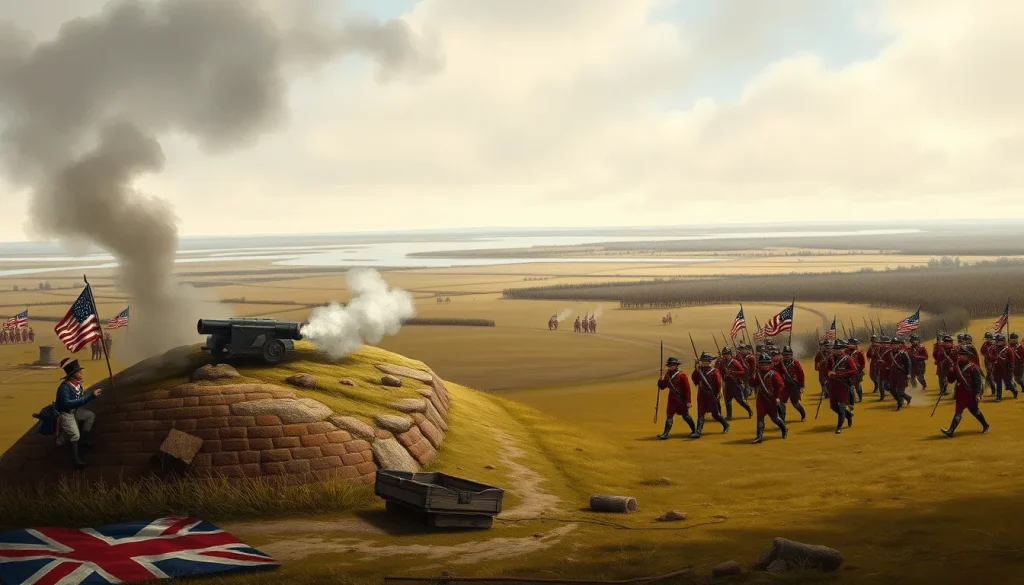
The New Orleans Battlefield, commonly known as Chalmette Battlefield, is the historic site of the Battle of New Orleans, fought on January 8, 1815, during the War of 1812. Located about six miles downriver from New Orleans in Chalmette, Louisiana, the battlefield marks the last major battle of the war, where Major General Andrew Jackson’s outnumbered American forces repelled a British invasion. The site is preserved as part of Jean Lafitte National Historical Park and Preserve and includes the Chalmette Monument, a national cemetery, and interpretive exhibits.
Historical Context
By late 1814, the War of 1812 had reached a stalemate, with peace negotiations underway at Ghent, Belgium. The British, freed from their war with France after Napoleon’s defeat, turned full attention to North America. New Orleans, the largest port on the Gulf of Mexico and the gateway to the Mississippi River Valley, was a prime target. Control of the city would give Britain command of the Mississippi, choke American westward trade, and provide leverage in the peace talks. Nearly one-third of American produce passed through New Orleans, and millions of dollars in cotton sat on its docks due to the British blockade. British Admiral Sir Alexander Cochrane proposed a campaign to seize the city, and after an unsuccessful attempt to land at Mobile, he redirected his forces toward the Gulf coast below New Orleans.
What Happened
Andrew Jackson, already a major general in the U.S. Army, arrived in New Orleans on December 1, 1814, after a forced march from Mobile. He improvised a defense that included U.S. regulars, Tennessee and Kentucky militia, Louisiana volunteers, Choctaw warriors, free men of color, and Jean Lafitte’s Baratarian pirates. On December 14, British ships destroyed the American gunboats on Lake Borgne, giving the British control of that waterway. British troops under Lieutenant General Sir Edward Pakenham then landed at the Villere Plantation on the east bank of the Mississippi on December 23. Jackson launched a surprise night attack that checked the British advance but did not drive them off. He then withdrew to a defensive position along the Rodriguez Canal on the Chalmette Plantation, about five miles from the city, and built a strong earthwork known as Line Jackson.
After a failed artillery exchange on January 1, 1815, Pakenham ordered a frontal assault on the American line. Early on January 8, 1815, the British launched a two-pronged attack: a main effort against Line Jackson and a secondary crossing of the river on the west bank. The American artillery and rifle fire devastated the advancing British columns. Pakenham was mortally wounded, and British casualties mounted to over 2,000 (including about 700 killed), while American losses were remarkably light—roughly 71 total, including 13 killed. The attack on the west bank succeeded temporarily, but it was not enough to change the outcome. The British withdrew on January 18, re-embarked for the fleet, and departed the region.
Why It Matters
The Battle of New Orleans was the final major engagement of the War of 1812, and the American victory had enormous symbolic and psychological importance. Although peace had been signed at Ghent on December 24, 1814, news had not reached the armies; thus, the battle had no bearing on the treaty’s terms. Still, the victory gave Americans a triumphant close to an often-uncertain war, fostering a new sense of national unity and pride. January 8 became a national holiday for decades, celebrated alongside the Fourth of July. Andrew Jackson’s fame from New Orleans helped carry him to the presidency in 1828. The battlefield also holds later historical layers, including the establishment of Chalmette National Cemetery during the Civil War and the African American community of Fazendeville, which existed until the 1960s. Today, the site is a major public history destination.
Historical Map Context
Contemporary and later maps show the battlefield’s position on a relatively flat, open floodplain along the east bank of the Mississippi River. The Battle of New Orleans occurred at the Chalmette Plantation, bordered by the river to the southwest, a cypress swamp to the northeast, and the Rodriguez Canal that served as the American line. The British line lay approximately 400 yards to the south. Maps from the era depict the earthwork, artillery positions, and troop formations. The U.S. National Park Service preserves and interprets these historic maps at the visitor center, showing the setting as a sugarcane field in 1815.
Modern Location
The New Orleans Battlefield is located in Chalmette, Louisiana, at 1 St. Bernard Highway, about six miles downriver from New Orleans. It is a unit of Jean Lafitte National Historical Park and Preserve. The site includes a visitor center, the Chalmette Monument, a walking trail around the old battlefield, and the adjacent Chalmette National Cemetery. Accessible by car from the city, it is a popular heritage destination. The coordinates are approximately 29.940° N, 89.990° W.
Events at the Site
The primary event at the site was the Battle of New Orleans on January 8, 1815, where American forces repelled the British attack. The site also hosted the earlier night battle of December 23, 1814, when Jackson struck the British camp at Villere Plantation, and the artillery duel of January 1, 1815. After the battle, the field remained agricultural land. In 1864, during the Civil War, Chalmette National Cemetery was established to inter Union soldiers, and it later became a national cemetery for veterans of many conflicts. From 1867 to the 1960s, the village of Fazendeville, founded by formerly enslaved African Americans, existed on part of the property; the National Park Service purchased the land for expansion in the 1960s, and the village was razed. The site now also includes the Malus-Beauregard House, built in 1832–33, which is being restored.
Associated People
Andrew Jackson commanded the American forces during the battle and emerged as the hero of the campaign. British commander Lieutenant General Sir Edward Pakenham was killed in action on January 8. Other notable figures include Jean Lafitte, whose pirates provided artillery and ammunition; Major General William Carroll, who led Tennessee militia; and British Admiral Sir Alexander Cochrane, who planned the invasion. Later, the site is associated with the residents of Fazendeville and the veterans interred in the national cemetery.
Surviving Monuments and Site
The most prominent monument is the Chalmette Monument, a 100-foot-tall obelisk completed in 1856 and dedicated to the American victory. The adjacent Chalmette National Cemetery has grave markers of veterans from the War of 1812, the Civil War, the Spanish-American War, World Wars I and II, Korea, and Vietnam. The Malus-Beauregard House is a Greek Revival structure also on the property. The National Park Service maintains interpretive trails, cannon emplacements, and a reconstructed section of the earthworks, allowing visitors to visualize the battlefield. The visitor center exhibits artifacts and provides orientations.
Primary Sources
Important contemporary accounts include Andrew Jackson’s official dispatch to Secretary of War James Monroe, dated January 13, 1815, in which he described the American defensive position and the British assault. British accounts, such as the report from Major General John Lambert after Pakenham’s death, offer the other side, including the decision to retreat. A number of enlisted men’s letters and diaries also survive, though they are often fragmentary. These sources are available in archives such as the National Archives and the Louisiana State Museum. Each source reflects its author’s perspective; Jackson’s report emphasizes American discipline, while British accounts stress poor visibility and the strength of the American fortifications. Direct quotations from these documents appear in scholarly works, but for a verified transcript, researchers should consult the original collections.
Further Reading
- Robert V. Remini, The Battle of New Orleans (1999).
- Benton C. McAdams, The Battle of New Orleans: A Chronicle (2001).
- National Park Service, Chalmette Battlefield visitor guide.
- American Battlefield Trust, Chalmette Battlefield page.
- Donald R. Hickey, The War of 1812: A Short History (2012).
References
- National Park Service, “Chalmette Battlefield,” accessed October 2025, https://www.nps.gov/places/chalmette-battlefield.htm.
- American Battlefield Trust, “Visit Chalmette,” accessed October 2025, https://www.battlefields.org/visit/battlefields/chalmette.
- American Battlefield Trust, “Chalmette National Historical Park (Battle of New Orleans),” accessed October 2025, https://www.battlefields.org/learn/articles/chalmette-national-historical-park-battle-new-orleans.
- American Battlefield Trust, “Battle of New Orleans: The Last Battle of the War of 1812,” accessed October 2025, https://www.battlefields.org/learn/articles/battle-new-orleans-last-battle-war-1812.
- New Orleans Historical, “Battle of New Orleans: Introduction,” accessed October 2025, https://neworleanshistorical.org/items/show/508.
FAQ
What is the New Orleans Battlefield?
The New Orleans Battlefield, also known as Chalmette Battlefield, is the historic site of the Battle of New Orleans (January 8, 1815), where American forces under Andrew Jackson defeated a British invasion. It is preserved as part of Jean Lafitte National Historical Park and Preserve in Chalmette, Louisiana.
Why was the Battle of New Orleans fought after the Treaty of Ghent was signed?
The Treaty of Ghent, which ended the War of 1812, was signed on December 24, 1814, but news had not reached the combatants by January 8, 1815. Thus, the battle occurred without knowledge of the peace agreement.
What can visitors see at the New Orleans Battlefield today?
Visitors can see the Chalmette Monument, the Chalmette National Cemetery, the Malus-Beauregard House, a walking trail with interpretive markers, and the remnants of the American earthworks. The visitor center provides orientation and exhibits.


Leave a Reply