
Short Answer
Indigenous nations joined the War of 1812 for a complex set of strategic reasons, chiefly to resist American westward expansion, protect their territories and sovereignty, and preserve their cultures. Many allied with Great Britain, which offered military support and promises of an independent Indigenous state; others, such as the Lower Creek, sided with the United States. The war became a pivotal moment for Indigenous peoples as they sought to unite against a common threat.
Historical Context
After the American Revolution, the newly independent United States expanded aggressively into lands west of the Appalachian Mountains, despite the fact that these territories were already occupied by numerous Indigenous nations. The Treaty of Paris (1783) transferred sovereignty over the region between the Appalachian Mountains and the Mississippi River to the United States without Indigenous consent, setting the stage for decades of conflict. The United States government signed treaties that ceded Indigenous lands for minimal compensation and encouraged settlement, leading to continual violence and displacement.
Britain, for its part, had cultivated alliances with Indigenous nations since the 17th century through trade, military cooperation, and formal agreements such as the Covenant Chain and the Royal Proclamation of 1763. After the Revolution, British officials in Canada maintained these relationships, providing arms and supplies to communities in the Ohio country and Great Lakes region. The British feared American expansion would threaten Canadian colonies, and they saw Indigenous allies as a buffer against American invasion. By the early 1800s, tensions between Britain and the United States over trade restrictions, impressment, and British support for Indigenous resistance had created an explosive situation.
What Happened
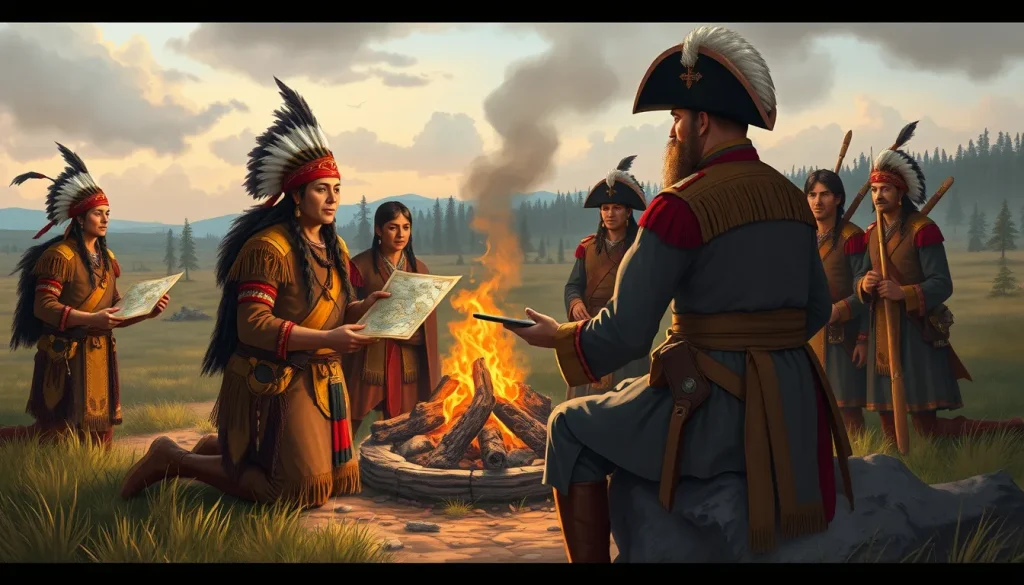
The War of 1812 began in June 1812, and Indigenous nations were immediately drawn into the conflict. Tecumseh, a Shawnee leader, and his brother Tenskwatawa, known as the Prophet, had been building a pan-Indian confederacy to unify tribes against American expansion. In July 1812, Tecumseh allied with the British, encouraged by promises of an independent Indigenous state and the restoration of lands. The British, lacking sufficient troops to defend Canada, relied heavily on Indigenous warriors.
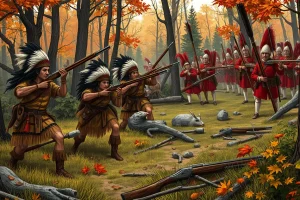
In July 1812, a combined British and Indigenous force captured Fort Michilimackinac. In August, Tecumseh and his warriors played a critical role in the surrender of Detroit, where British Major General Isaac Brock and Tecumseh’s forces faced an American army under General William Hull. The fall of Detroit and other posts brought many additional Indigenous nations to the British cause. Indigenous warriors also fought at the Battle of Queenston Heights in October 1812, where Brock was killed.
In the south, the Creek War erupted as a civil war between the Red Sticks, who opposed American encroachment, and the Lower Creek, who supported the United States. After the Red Sticks attacked Fort Mims in August 1813, American forces under Andrew Jackson retaliated. The Battle of Horseshoe Bend in March 1814 broke Red Stick resistance, leading to the Treaty of Fort Jackson, which forced the Creek to cede over 20 million acres.
The war in the north continued with battles at Frenchtown, Fort Meigs, and the Thames River. On October 5, 1813, at the Battle of the Thames, Tecumseh was killed, and the confederacy he had led disintegrated. The war ended with the Treaty of Ghent in December 1814, which restored the status quo ante bellum but did not address Indigenous lands or sovereignty.
Why It Matters
The war had devastating consequences for Indigenous nations. Despite the Treaty of Ghent’s stipulation that Indigenous peoples were entitled to the lands they had held in 1811, neither Britain nor the United States enforced this provision. Britain abandoned its support for an Indigenous buffer state, and the United States continued its policy of expansion. Within three decades, most Indigenous nations east of the Mississippi were forcibly removed to lands west of the river under the Indian Removal Act of 1830. The war marked the last time Indigenous peoples could mount a broad, united military challenge to American expansion.
Scholars interpret the war as a turning point in Indigenous history, emphasizing the strategic choices made by Indigenous leaders and the long-term betrayal by European powers. Tecumseh’s legacy as a resistance leader remains powerful, but the war is also a reminder of the tragic loss of Indigenous homelands and political autonomy.
Definition
The question “Why did Indigenous nations join the War of 1812?” refers to the motivations and rationales that led various Indigenous groups to align with either the British or the American forces during the conflict. These decisions were shaped by a combination of immediate threats, alliances of convenience, and long-standing geopolitical strategies aimed at preserving Indigenous lands, sovereignty, and trade relationships.
Background
Indigenous-European relations had been defined by centuries of alliance and conflict. The British Crown had established formal alliances with many Indigenous peoples through treaties and commercial ties, particularly after the Royal Proclamation of 1763, which recognized Indigenous land rights and created a policy of separating settlers from Indigenous lands. In contrast, the United States quickly moved to acquire Indigenous territories through conquest, purchase, and coercive treaties. The Louisiana Purchase and the expansion of settlement into the Old Northwest heightened fears among Indigenous communities.
After the Battle of Fallen Timbers in 1794 and the Treaty of Greenville in 1795, many Ohio and Great Lakes nations were forced to cede large tracts of land. The pan-Indian movement led by Tecumseh and Tenskwatawa sought to resist further losses by uniting tribes in a collective front. Tenskwatawa’s religious revival, which emphasized a return to traditional ways and rejection of American goods and culture, gained many followers. Tecumseh built a political network that aimed to create a collective Indigenous sovereignty over all ancestral lands, and he argued that no single tribe could cede land without the consent of all.
How It Worked
The alliances formed during the War of 1812 operated on mutual needs. The British, short on troops due to the Napoleonic Wars, saw Indigenous warriors as essential to defending Canada. They supplied arms, ammunition, and supplies, and they promised to support an independent Indigenous state as a buffer against American expansion. Indigenous nations, for their part, brought military skill, intimate knowledge of the terrain, and the ability to mobilize significant numbers of warriors. The relationship was not one of simple subordination; Indigenous leaders often chose when and where to fight based on their own strategic interests.
Tecumseh’s role was pivotal. He commanded respect and often coordinated with British officers, although he was not always satisfied with British support. The partnership between Tecumseh and Isaac Brock proved highly effective, as seen at the capture of Detroit. However, after Brock’s death and Tecumseh’s loss at the Thames, the alliance frayed. In the south, the Creek War involved internal divisions and alliances with the United States, further demonstrating the complexity of Indigenous choices.
Competing Viewpoints
Historians disagree over the motivations and agency of Indigenous nations in the war. Some argue that Indigenous peoples were manipulated by the British and used as pawns in the imperial conflict. Others emphasize Indigenous agency, noting that leaders like Tecumseh made calculated decisions to ally with Britain because it was the best available option for protecting their lands. Carl Benn, a prominent historian, argues that American claims that British agents incited Indigenous violence were exaggerated and served as a pretext for war. He points out that the British actually tried to restrain Indigenous attacks before 1812 because they feared a premature conflict with the United States. Another viewpoint focuses on the internal divisions among Indigenous peoples, such as the split between the Upper Creek and Lower Creek, which were not simply pro-British or pro-American but were shaped by local circumstances.
Role in the War of 1812
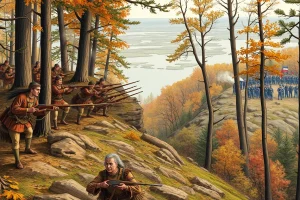
Indigenous nations played a critical role in the war’s military operations. At Fort Michilimackinac, a force of about 400 Indigenous warriors and British troops captured the post without a fight. At Detroit, Tecumseh’s warriors surrounded the fort and effectively cut off Hull’s supply line, contributing to his surrender. Indigenous warriors also fought at the Battle of Queenston Heights, where they provided key assistance. In the Old Northwest, Tecumseh and his allies forced American armies to face significant opposition, delaying U.S. advances into Canada. In the south, the Red Sticks’ attack on Fort Mims triggered a brutal counteroffensive that ultimately destroyed their strength. The Treaty of Ghent, signed in 1814, did not include any provisions to protect Indigenous lands, and the promises made to Tecumseh were never fulfilled.
Consequences and Historical Interpretation
The war’s outcome was a disaster for Indigenous nations. The British withdrew their support after the war, leaving Indigenous peoples with no foreign ally to resist American expansion. The U.S. government quickly moved to negotiate a series of treaties that ceded additional lands, and by the 1830s, the Indian Removal Act forced the relocation of thousands of Indigenous people to the west of the Mississippi. Historians view the War of 1812 as a pivotal moment when the Indigenous nations lost their last chance to maintain a significant land base east of the river. The tragedy was compounded by the fact that the Treaty of Ghent, which promised to restore pre-war lands, was completely ignored. The legacy of Tecumseh and the confederacy remains a powerful symbol of Indigenous resistance, but the war is also memorialized as a turning point toward eventual removal and loss.
Primary Sources
Several primary sources provide insight into Indigenous motives and the nature of alliances. Tecumseh’s speeches, though recorded by European witnesses, offer a sense of his ideas about land ownership and unity. British military dispatches and correspondence, such as those from Isaac Brock, describe the essential role of Indigenous warriors. The autobiographical narratives of Black Hawk, a British-allied Sauk leader, and William Apess, a Pequot who served in the American forces, are invaluable first-hand accounts. Also important are the treaty texts of the war, such as the Treaty of Ghent and the Treaty of Fort Jackson, which delineate the outcome for Indigenous lands. The British Library and Library and Archives Canada hold many of these documents.
Further Reading
- Benn, Carl. Native Memoirs from the War of 1812: Black Hawk and William Apess. Johns Hopkins University Press, 2014.
- Hall, Anthony J. “Indigenous Title and the War of 1812.” The Canadian Encyclopedia.
- National Park Service. “Indigenous Peoples – War of 1812.”
- American Battlefield Trust. “Native American Involvement in the War of 1812.”
References
- National Park Service. “Indigenous Peoples – War of 1812.” https://www.nps.gov/subjects/warof1812/indigenous-peoples.htm
- Anthony J. Hall, “Indigenous Title and the War of 1812,” The Canadian Encyclopedia, updated by Gretchen Albers, 2022. https://thecanadianencyclopedia.ca/en/article/aboriginal-title-and-the-war-of-1812
- Michael Eamon and Tabitha Marshall, “First Nations and Métis Peoples in the War of 1812,” The Canadian Encyclopedia. https://thecanadianencyclopedia.ca/en/article/first-nations-in-the-war-of-1812
- Carl Benn, “British agents curry favor with Native Nations,” National Park Service. https://www.nps.gov/articles/causes-of-war-in-the-old-northwest.htm
- American Battlefield Trust, “Native American Involvement in the War of 1812.” https://www.battlefields.org/learn/articles/native-american-involvement-war-1812
FAQ
Why did Tecumseh ally with the British?
Tecumseh allied with the British because they promised to support an independent Indigenous state and protect their lands, and he saw the British as the lesser threat compared to American expansion.
What was the Indigenous buffer state?
A British plan to create an independent Indigenous territory between the United States and Canada, which was never realized.
How did the War of 1812 affect Indigenous nations?
It led to loss of land, British abandonment, and eventually forced removal to west of the Mississippi.

Leave a Reply