
Short Answer
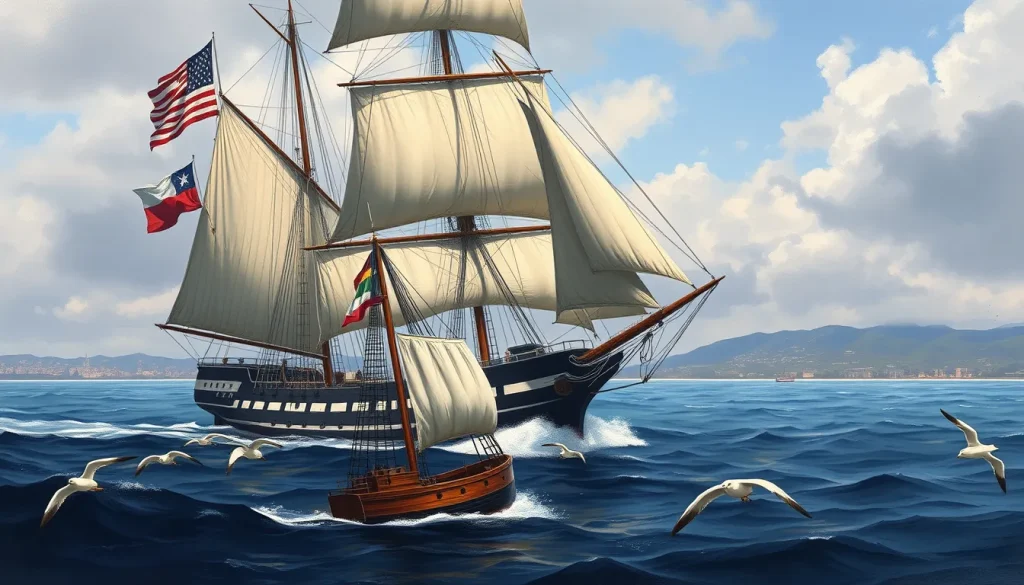
The USS Essex, a 46-gun sailing frigate of the United States Navy, became the first American warship to round Cape Horn and enter the Pacific Ocean during the War of 1812. Commanded by Captain David Porter, Essex disrupted British whaling operations across the South Pacific between 1813 and 1814, capturing or destroying more than a dozen vessels. Her campaign ended on 28 March 1814 at the Battle of Valparaíso, where a superior British force of the frigates HMS Phoebe and HMS Cherub forced her surrender after a prolonged engagement.
Historical Context
The War of 1812 pitted the United States against the United Kingdom, primarily over maritime rights, impressment, and territorial expansion. On the high seas, the Royal Navy dominated, but early American frigate victories—such as USS Constitution’s defeat of HMS Guerriere—emboldened American commerce raiding. The Pacific was a vital economic region for Britain because of its lucrative whaling industry, which supplied oil for lighting and lubrication. The United States, with a small navy, sought to damage British commerce wherever possible. Captain David Porter, already a celebrated officer for his role in the Quasi-War and Barbary Wars, proposed a raiding cruise against British whalers in the Pacific as a strategic way to strike at British interests with a single ship.
What Happened
USS Essex sailed from the Delaware River in October 1812, initially intending to join Commodore William Bainbridge’s squadron in the South Atlantic. When that rendezvous failed, Porter decided to proceed on his own, passing Cape Horn in February 1813 and entering the Pacific. He arrived off the coast of Chile in March 1813 and immediately began targeting British whaling ships. Over the next year, Essex captured or destroyed 16 British whaling vessels, including the heavily armed whaler Sir Andrew Hammond, which Porter added to his squadron as an escort. Porter also made use of neutral ports such as Valparaíso in neutral Chile to provision and refit.
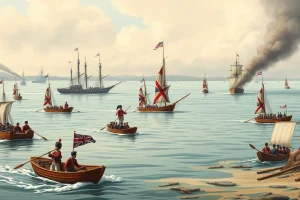
The climax occurred on 28 March 1814 while Essex was at anchor in neutral Valparaíso. The British frigate HMS Phoebe (36 guns) and sloop-of-war HMS Cherub (18 guns), commanded by Captain James Hillyar, arrived and blockaded the port. On 28 March, as Essex attempted to escape, a squall forced her to sail to windward, and the British fired on her in international waters. Porter fought a desperate running battle for two hours, hoping to board the enemy or use his carronades effectively, but the British longer-range guns inflicted heavy damage. With his ship badly battered and many killed, Porter surrendered. Essex lost 58 men killed and 66 wounded; the British suffered modest casualties.
Why It Matters
The Essex’s Pacific campaign significantly disrupted British whaling in the South Pacific, causing economic losses to British merchants and helping to justify the Royal Navy’s later commitment of additional warships to that region. Although the ship was lost, Porter and his crew were hailed as heroes in the United States. The campaign demonstrated that American commerce raiding could reach far beyond the Atlantic, and it contributed to the British decision to tighten naval protection of its valuable colonial and commercial routes. Historians have interpreted the campaign as an early example of naval irregular warfare and as a symbol of American naval ambition, even in the face of overwhelming British naval power. The defeat at Valparaíso also reinforced the dangers of operating in neutral waters and the tactical disadvantages of a frigate armed mainly with carronades against long-gun opponents.
Type and Construction
USS Essex was a 46-gun sailing frigate of the standard American design, built at Salem, Massachusetts, and launched in 1799. She was constructed of live oak and cedar, measuring 164 feet in length and displacing about 860 tons. Her hull was designed for speed and maneuverability, though her armament was later modified to include heavier carronades, which had shorter range but devastating close-range firepower.
Nation
United States of America. Essex served in the U.S. Navy, initially during the Quasi-War with France and the Barbary Wars, and most famously during the War of 1812.
Armament
At the time of her Pacific cruise, Essex carried a main battery of 32 carronades (32-pounders) and six long 12-pounder guns on her forecastle and quarterdeck. This arrangement gave her immense broadside weight at short range but left her vulnerable to enemies with longer-range guns, a factor that proved decisive at the Battle of Valparaíso. Additionally, she carried swivel guns and small arms for boarding actions.
Crew
The ship’s crew numbered approximately 300 officers and men, including several midshipmen who later rose to prominence, such as David Farragut, then a boy of 12 who served as a midshipman on Essex. The crew was a mix of experienced sailors, volunteers, and impressed seamen, a common composition on American warships of the period.
Commander
Captain David Porter (1780–1843) commanded USS Essex throughout the Pacific campaign. Porter was a career naval officer, known for his aggressive leadership and strategic acumen. He had previously served in the Quasi-War and Barbary Wars, and after the loss of Essex, he became a vocal advocate for naval expansion. Later he commanded the Mexico Squadron and served as a naval diplomat.
Engagements
Essex’s Pacific campaign included the capture of numerous British whalers, including ship-to-ship actions against armed whalers. The most significant engagement was the Battle of Valparaíso on 28 March 1814, fought against HMS Phoebe and HMS Cherub. Essex also engaged and captured the armed whaler Sir Andrew Hammond, which she subsequently used as a store ship and prize crew.
Fate
After the Battle of Valparaíso, USS Essex was surrendered to the British. She was taken as a prize and later repaired and commissioned into the Royal Navy as HMS Essex. She served briefly under the British flag but was never recommissioned for active service; she was eventually sold for breaking up in 1825.
Primary Sources
Several contemporary accounts survive. Captain David Porter published a detailed memoir, Journal of a Cruise Made to the Pacific Ocean (1815), which provides a first-hand account of the Pacific campaign and the final battle. Official letters between Porter and Secretary of the Navy William Jones, kept in the National Archives, provide administrative details. The British side is recorded in the official logs and letters of Captain James Hillyar and his officers, available in the Admiralty records at The National Archives (UK). These sources offer complementary but sometimes conflicting perspectives on the events, particularly regarding the legality of the attack in neutral waters. The American accounts emphasize British aggression, while British accounts argue that Essex was attempting an escape and was lawfully attacked.
Further Reading
- David Porter, Journal of a Cruise Made to the Pacific Ocean (1815; reprint, Naval Institute Press, 1986).
- William Henry W. Murray, The Naval History of the United States (1890) – section on the Essex.
- Donald R. Hickey, The War of 1812: A Forgotten Conflict (University of Illinois Press, 1989).
- Ronald W. Neufeld and Patricia H. Marks, The Fatal Cruise of USS Essex: A Documentary Account (Naval Historical Center, 1990).
References
- Porter, David. Journal of a Cruise Made to the Pacific Ocean. 1815.
- Hickey, Donald R. The War of 1812: A Forgotten Conflict. University of Illinois Press, 1989.
- Neufeld, Ronald W., and Patricia H. Marks. The Fatal Cruise of USS Essex: A Documentary Account. Naval Historical Center, 1990.
- National Archives and Records Administration, Records of the Office of Naval Records and Library, Letters from Captain David Porter to the Secretary of the Navy, 1812-1814.
FAQ
How many British ships did USS Essex capture in the Pacific?
Essex captured or destroyed about 16 British whaling vessels during her Pacific cruise in 1813–1814.
Why was USS Essex armed with carronades rather than long guns?
Porter favored carronades because they had a devastating short-range broadside and allowed a larger number of guns on a given deck. This design suited his raiding strategy but proved a disadvantage against long-gun opponents like the Phoebe.
Where did the final battle take place, and was it legal?
The final battle occurred off Valparaíso, Chile, a neutral port. The U.S. claimed the British attack violated neutrality, while the British argued that Essex was attempting to escape and thus lost the protection of the neutral harbor.
Leave a Reply