
Short Answer
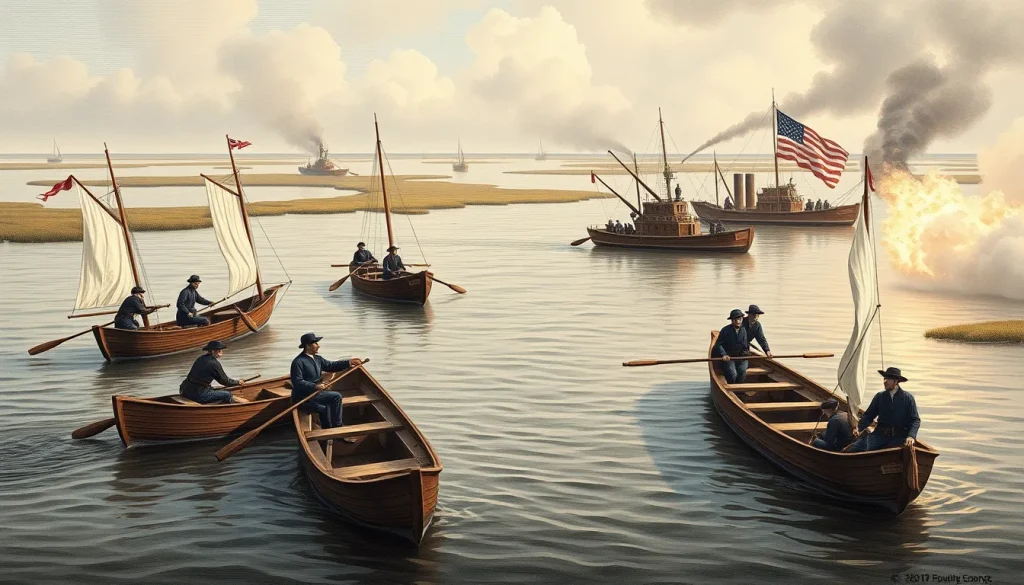
The Battle of Lake Borgne, fought on December 14, 1814, was a coastal engagement between British Royal Navy forces and a small American naval squadron on the shallow waters of Lake Borgne, Louisiana. Part of the Gulf campaign of the War of 1812, the battle resulted in a British victory that cleared the way for the landing of troops for the assault on New Orleans. Although the American flotilla was captured, the fight delayed the British expedition long enough for Major General Andrew Jackson to strengthen the city’s defenses before the decisive Battle of New Orleans.
Historical Context
By late 1814, the British sought to capture New Orleans as part of a strategy to control the mouth of the Mississippi River and weaken American trade and morale. After a failed attempt against Fort Bowyer in September 1814, the British expedition, commanded by Vice Admiral Sir Alexander Cochrane and Major General Sir Edward Pakenham, shifted its focus to the coast of Louisiana. The fleet anchored near Ship Island and Cat Island, preparing to move troops through the shallow lakes east of the city. Lake Borgne, a shallow lagoon (though often called a lake) connected to the Gulf of Mexico, lay directly in the path to New Orleans. The only American naval force in the area was a small flotilla of five gunboats and two tenders under Lieutenant Thomas ap Catesby Jones, stationed to observe the British and to deny them unrestricted passage. Because the lake was too shallow for the British frigates and ships of the line, Cochrane decided to use the fleet’s rowboats and barges to attack and eliminate the American gunboats.
What Happened
Warned of the approaching British fleet, Commodore Daniel Patterson, the American naval commander at New Orleans, dispatched Lieutenant Jones with five Jeffersonian gunboats, the schooner USS Sea Horse, the sloop USS Alligator, and the small sloop USS Tickler to patrol Lake Borgne and the Rigolets. On December 8, the British frigates HMS Seahorse, Armide, and Sophie passed Cat Island and exchanged long-range fire with two of the gunboats. The British realized that the gunboats could obstruct their planned landing and decided to destroy them. On December 12, Cochrane placed all the fleet’s boats under Commander Nicholas Lockyer of Sophie and dispatched them to seek out the American squadron. The British force consisted of about forty-two to forty-five launches, barges, and gigs, each armed with a carronade or long gun, carrying around 1,200 sailors and Royal Marines. The American gunboats, each mounting five guns (except one with three) and crewed by roughly 31 to 41 men, had a combined force of about 182 to 225 men.
Despite being ordered to observe and avoid battle, Jones attempted to withdraw westward toward the protection of the fort at Petit Coquilles on the Rigolets. Strong currents and contrary winds prevented the slow gunboats from escaping, and on the night of December 13–14 they anchored near Malheureux Island in Lake Borgne. The British rowboats approached during the night and at dawn on December 14 attacked the American line. After a two-hour contest that included cannon fire, boarding actions, and hand-to-hand fighting, all five gunboats were captured. The Alligator was taken early, the Sea Horse was burned by her own crew to prevent capture, and the Tickler was scuttled and burned. Both Jones and Lockyer were seriously wounded during the fighting.
Why It Matters
The immediate effect of the Battle of Lake Borgne was the removal of the only American naval force that could contest the British crossing of the lake. Afterward, the British were able to disembark their troops at Bayou Bienvenue on December 23, 1814, giving them access to the road to New Orleans. However, the time lost in assembling the boat forces and rowing across the lake allowed Jackson more days to strengthen the city’s defenses and to assemble a combined force of regulars, militia, free men of color, and Baratarian privateers. Scholars often note that the battle’s strategic consequence was double-edged: while the British won, they suffered significant casualties and the delay contributed to their ultimate defeat at New Orleans on January 8, 1815. The battle also highlighted the importance of small-boat warfare and the challenges of amphibious operations in shallow coastal waters.
Prelude
The British decision to attack New Orleans came after earlier operations along the Gulf Coast. The failed attempt against Fort Bowyer in September 1814, which was meant as a preliminary step toward an overland advance from Mobile, forced the British to seek a different route. Admiral Cochrane planned to bring the main fleet into Lake Borgne, pass through the Rigolets or the Chef Menteur Pass, and move troops into Lake Pontchartrain, from which they could approach New Orleans via Bayou St. John or other waterways. The American naval authorities, warned by an anonymous letter from Pensacola dated December 5, 1814, dispatched Jones’s flotilla to patrol the lake. The gunboats were relatively new, purpose-built for harbor defense, but their shallow draft allowed them to operate in water too shallow for the British frigates. British reconnaissance by the frigates on December 8 confirmed the presence of the gunboats, and Cochrane concluded that they had to be eliminated before the troop transports could safely land.
Forces and Commanders
The American force under Lieutenant Thomas ap Catesby Jones comprised three types of vessels:
- Five Jeffersonian gunboats (No. 156, No. 163, No. 5, No. 23, No. 162), each mounting a long 24-pounder or 12-pounder cannon, 12-pounder carronades, and swivel guns, with crews of 36 to 41 men.
- USS Sea Horse, a schooner commanded by Sailing-Master Johnson, used as a dispatch and store vessel.
- USS Alligator, a small sloop, and USS Tickler, a 50-ton sloop, serving as tenders.
The British assault force was composed of approximately 42–45 launches, barges, and gigs drawn from the warships of the fleet, including HMS Tonnant, Norge, Bedford, Royal Oak, Ramillies, Armide, Cydnus, Seahorse, Trave, Sophie, Belle Poule, Gorgon, Manly, and Meteor. Each boat carried one 12-, 18-, or 24-pounder carronade, with the exception of three gigs that mounted long brass 12-pounders. The total force numbered about 1,200 sailors and Royal Marines, under the command of Commander Nicholas Lockyer.
Battlefield and Map Context
Lake Borgne is a shallow, triangular lagoon situated between the Mississippi Sound to the east and Lake Pontchartrain to the west, from which it is separated by the Rigolets and Chef Menteur Pass. In 1814, the lake was open to the Gulf of Mexico through the Chandeleur Islands and the Mississippi Sound, making it a deep enough passage for shallow-draft vessels but not for larger warships. The battle took place near the western end of the lake, where the channel between Malheureux Island and the mainland (near present-day Shell Beach) forms the approach to the Rigolets. Pea Island lies at the mouth of the Pearl River to the north, and St. Malo to the south. The American gunboats anchored in open water near Malheureux Island after being unable to reach the fort at Petit Coquilles. Modern maps show that coastal erosion and land subsidence have significantly altered the shoreline; the area is now part of the Louisiana coastal wetlands and is within the boundaries of the Jean Lafitte National Historical Park and Preserve.
Battle Chronology
On December 8, the British frigates HMS Seahorse, Armide, and Sophie left Pensacola and anchored off Ship Island. On the same day, they observed two American gunboats and later spied three more. On December 12, Cochrane ordered Lockyer to take all available boats and attack the American squadron.
December 12–13: The British boat expedition, rowing from the fleet anchorage near Ship Island, entered Lake Borgne via the Mississippi Sound and the passes between the Chandeleur Islands. The Americans, after attempting to find a safe position near the Rigolets, anchored near Malheureux Island due to contrary winds and currents.
At about 10 a.m. on December 14, the British boats sighted the American squadron anchored across the channel. Lockyer divided his force into three divisions and gave his men breakfast before attacking. The American gunboats opened fire at long range, but the British continued to row closer. The British closed rapidly, despite heavy fire that sank two barges and damaged others. At about noon, the first boarding parties reached the American line. Hand-to-hand combat with cutlasses, pikes, bayonets, and muskets followed. Lockyer boarded Jones’s flagship, Gunboat No. 156, and captured her after a severe struggle. The British then turned the captured gunboat’s guns on the remaining American vessels, capturing all five gunboats in quick succession. The entire engagement lasted roughly two hours, with the final boarding action completed in about five minutes.
Casualties and Losses
British casualties were reported as 17 killed and 77 wounded. American losses were 6 killed and 35 wounded according to the National Park Service source, though other accounts, such as those from Donald Hickey, give figures of 10 killed and 35 wounded. All five American gunboats were captured, along with the sloop Alligator. The Sea Horse was burned to avoid capture, and the Tickler was scuttled and burned. The American prisoners numbered around 182 men, including Jones, who was wounded in the shoulder. The differences in casualty figures reflect contemporary discrepancies in official reports; both sides suffered heavily for a small-boat action.
Result
The Battle of Lake Borgne was a clear British tactical victory. The British captured or destroyed the entire American naval force on the lake, securing uncontested use of the waterway for the army’s landing. The victory allowed the British to disembark about 8,000 troops at Bayou Bienvenue on December 23, 1814, without further naval interference. However, the necessity of rowing over 30 miles and the delay incurred in organizing the boat attack gave Jackson time to prepare the city’s defenses. In that sense, the British won the battle but contributed to the conditions of their later defeat.
Strategic Consequences
The immediate strategic consequence was the opening of the water route to New Orleans. The British immediately began moving troops and supplies toward the city. However, the delay of more than a week between the initial arrival of the fleet and the landing allowed Jackson to summon militia reinforcements, strengthen earthworks, and coordinate with Jean Lafitte’s Baratarian gunners. The subsequent British advance and attack on January 8, 1815, ended in a disastrous assault against American lines. Historians such as Howard Jones and J.C.A. Stagg have emphasized that the Lake Borgne battle’s outcome was a tactical necessity but strategically problematic for the British, because the loss of time was fatal to their plans. The battle also demonstrated the effectiveness of the American gunboat program in forcing a costly boat assault, even though the boats were eventually captured.
Primary Accounts
Important primary sources include the official reports of the American commanders, Lieutenant Thomas ap Catesby Jones and Commodore Daniel Patterson, both of which are collected in the naval documents of the War of 1812. Jones’s report, written from captivity, describes the action and his wounds; Patterson’s report to Secretary of the Navy Benjamin W. Crowninshield provides the American perspective and details of the flotilla’s composition. On the British side, Commander Nicholas Lockyer’s official dispatch to Vice Admiral Cochrane, published in the London Gazette, gives a detailed account of the boat attack and the boarding actions. The anonymous letter from Pensacola, dated December 5, 1814, which warned of the British arrival, is also preserved in the United States National Archives. These documents are essential contemporary evidence, though they naturally reflect the viewpoints and interests of their authors.
Battlefield Today
The site of the Battle of Lake Borgne lies within the boundaries of Louisiana’s coastal wetlands, which have been heavily altered by erosion, subsidence, and storm damage. The specific waters where the gunboats anchored are now part of the open lake or marsh. The Jean Lafitte National Historical Park and Preserve, which covers parts of the Barataria basin and other historic sites, does not have a specific memorial to this battle. However, the nearby Fort Pike and the Rigolets area are historical landmarks that visitors can explore. The American vessels were captured and later either destroyed or used by the British; their wreck sites have not been formally identified. The battle is remembered primarily through historical accounts and interpretive panels in regional museums, such as the Louisiana State Museum and the Maritime Museum Louisiana.
Primary Sources
The most useful primary sources are the naval dispatches and letters of the participants. These include:
- Official Report of Lieutenant Thomas ap Catesby Jones to Commodore Daniel Patterson, December 15, 1814 (from captivity). This report details the American fleet’s movements, the engagement, and the capture.
- Official Report of Commander Nicholas Lockyer to Vice Admiral Alexander Cochrane, published in the London Gazette, January 1815. Lockyer gives the British view of the attack, including the order of battle and casualty counts.
- Anonymous letter from Pensacola to Commodore Daniel Patterson, dated December 5, 1814, warning of British presence. This document is preserved in the National Archives and is crucial for understanding American intelligence.
Each of these sources must be read with awareness of its official nature and the combatants’ desire to present their actions in the best light. The casualty figures, for example, vary between the American and British reports.
Further Reading
- Hickey, Donald R. The War of 1812: A Forgotten Conflict. University of Illinois Press, 1989.
- Lambert, Andrew. The Challenge: Britain Against America in the Naval War of 1812. Faber and Faber, 2012.
- Latimer, Jon. 1812: War with America. Harvard University Press, 2007.
- Stagg, J.C.A. The War of 1812: Conflict for a Continent. Cambridge University Press, 2012.
- Roosevelt, Theodore. The Naval War of 1812. G.P. Putnam’s Sons, 1882 (modern reprints available).
- National Park Service. Jean Lafitte National Historical Park and Preserve – interpretive resources.
References
- “Battle of Lake Borgne.” Wikipedia. Accessed October 2023. https://en.wikipedia.org/wiki/Battle_of_Lake_Borgne.
- “Battle of Lake Borgne – War of 1812.” TheWarof1812.org. Accessed October 2023. https://thewarof1812.org/battles/battle-of-lake-borgne/.
- Maritime Museum Louisiana. “Battle of Lake Borgne.” Accessed October 2023. https://maritimemuseumlouisiana.org/maritimeblog/battle-of-lake-borgne.
- “The Battle of Lake Borgne 1814.” WarHistory.org. Accessed October 2023. https://warhistory.org/article/the-battle-of-lake-borgne-1814.
- National Park Service. “Chalmette National Historical Park, Handbook: The Battle of Lake Borgne.” Accessed October 2023. https://npshistory.com/handbooks/historical/29/hh29g.htm.
- Hickey, Donald R. The War of 1812: A Forgotten Conflict. University of Illinois Press, 1989.
- Latimer, Jon. 1812: War with America. Harvard University Press, 2007.
- Lambert, Andrew. The Challenge: Britain Against America in the Naval War of 1812. Faber and Faber, 2012.
FAQ
Why did the British attack the American gunboats on Lake Borgne?
The British needed to secure control of Lake Borgne to safely land troops for their advance on New Orleans. The American gunboats, with their shallow draft and guns, posed a threat to the invasion force in waters where large British ships could not operate.
What was the outcome of the Battle of Lake Borgne?
The British captured all five American gunboats and forced the surrender of the flotilla, winning a tactical victory. However, the battle's delay gave Andrew Jackson time to prepare New Orleans's defenses, which contributed to the American victory at the Battle of New Orleans.
What are the most reliable sources on the Battle of Lake Borgne?
The official reports from Lieutenant Jones and Commander Lockyer, as well as Commodore Patterson's correspondence, are primary sources. Modern scholars like Donald Hickey and Andrew Lambert provide balanced analysis. The National Park Service also has interpretive materials.


Leave a Reply