
Short Answer
Indigenous Resistance in the Old Northwest encompasses the political, diplomatic, and military efforts of Native American nations to oppose United States expansion into the territory north of the Ohio River during the late eighteenth and early nineteenth centuries. This resistance reached its zenith in the years immediately before and during the War of 1812, when Indigenous leaders such as the Shawnee brothers Tecumseh and Tenskwatawa forged alliances with British forces to halt American encroachment. The conflict reshaped the region’s power dynamics and had enduring consequences for Indigenous sovereignty and land rights.
Historical Context
After the American Revolution, the United States claimed the Old Northwest under the Treaty of Paris (1783), but the region remained contested as British garrisons remained at Detroit and other posts, and Indigenous nations, who had been allies of the British, refused to accept American sovereignty. The Northwest Ordinance of 1787 set a framework for eventual statehood and encouraged white settlement, intensifying pressure on Indigenous lands. American military campaigns in the 1790s, including defeats of Generals Josiah Harmar and Arthur St. Clair and the eventual victory at Fallen Timbers in 1794, led to the Treaty of Greenville (1795), which ceded substantial portions of Ohio but acknowledged that other lands remained under Indigenous control. However, continued American settlement and the growth of the Indiana Territory under Governor William Henry Harrison created new tensions. Meanwhile, the British, through their Indian Department, maintained diplomatic and trading relationships with Indigenous nations, often encouraging resistance to American expansion as a buffer for Canada. This volatile context set the stage for a broad pan-Indian revival.
What Happened
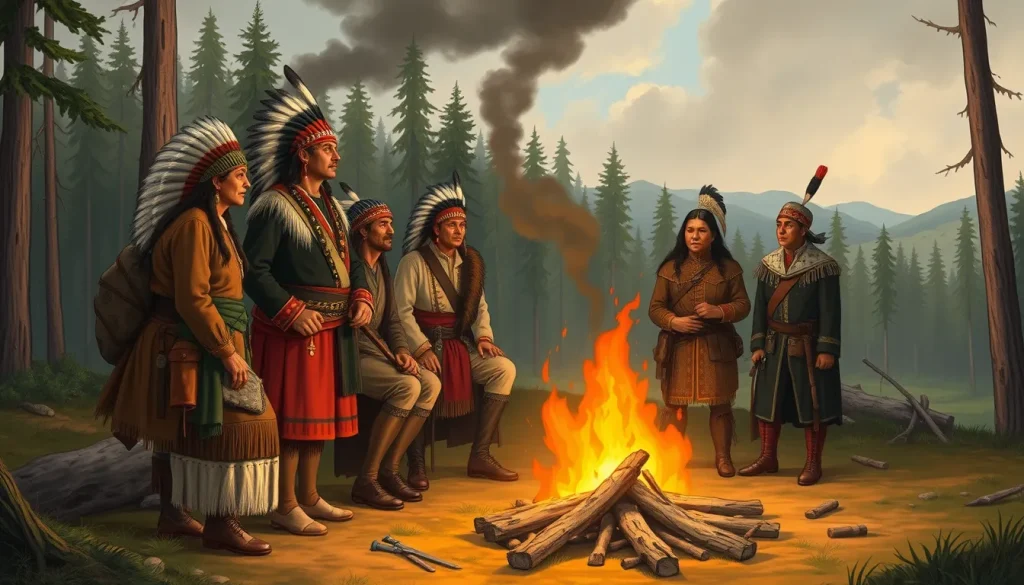
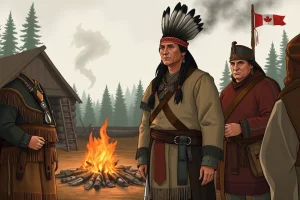
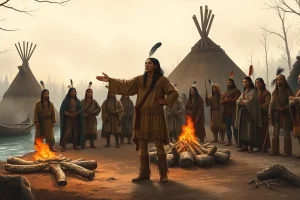
The most significant expression of Indigenous resistance in the Old Northwest was the emergence of a pan-Indian confederacy rooted in the spiritual teachings of Tenskwatawa (the Prophet) and the political leadership of his brother Tecumseh. In 1808, they established Prophetstown on the Wabash River near modern Lafayette, Indiana, which became a center for resistance. Tenskwatawa urged rejection of American goods and customs, while Tecumseh traveled widely to recruit allies from the Great Lakes to the Gulf of Mexico. The movement sought to halt further land cessions and create a unified Indigenous front. Governor Harrison, alarmed by the growing league, negotiated a series of treaties from 1809 that alienated millions of acres, further inflaming resistance. In November 1811, Harrison led a force to attack Prophetstown while Tecumseh was away, resulting in the Battle of Tippecanoe. Though Harrison claimed victory and the town was burned, the battle galvanized Indigenous resistance and pushed many nations into an alliance with Britain, which was already on the brink of conflict with the United States.
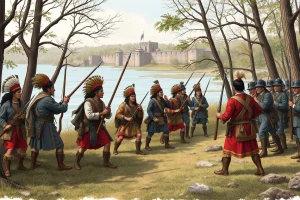
When the War of 1812 began in June 1812, Tecumseh sought to align his confederacy with the British. British officials, especially at Fort Malden in Upper Canada, promised support for a separate Indigenous state in exchange for military assistance. Indigenous forces played key roles in the early British victories, including the capture of Fort Detroit in August 1812, where Tecumseh’s warriors helped intimidate General William Hull into surrender. However, American counteroffensives in 1813, including the Battles of the Thames and Perry’s naval victory on Lake Erie, reversed the momentum. At the Battle of the Thames on October 5, 1813, Tecumseh was killed, and his coalition fragmented. The British withdrew support for an Indigenous buffer state, and after the war, American leaders negotiated a series of treaties that forced massive land cessions, leading to the eventual removal of most Indigenous peoples from the Old Northwest.
Why It Matters
Indigenous resistance in the Old Northwest shaped the course of the War of 1812 by forcing the United States to divert significant military resources to the western frontier and by contributing to early British successes. The loss of Tecumseh and the collapse of his confederacy were pivotal in the war’s outcome, as they removed a major threat to American expansion. In the postwar period, the United States, now supreme in the region, imposed treaties that extinguished Indigenous land claims and accelerated removal policies. The conflict also transformed the memory and identity of Indigenous nations, who preserved narratives of resistance and sovereignty. Historians have interpreted these events as a critical chapter in settler colonialism, highlighting how Indigenous peoples actively shaped their own destinies despite overwhelming odds. The factionalism and internal dynamics of the confederacy, as well as the diversity of local interests, have also been emphasized, challenging simplistic narratives of a monolithic resistance.
Definition
Indigenous Resistance in the Old Northwest refers to the collective and individual actions of Native American peoples—including the Shawnee, Miami, Potawatomi, Delaware, Kickapoo, and others—to resist the encroachment of American settlers and the authority of the United States into the region bounded by the Ohio River, the Great Lakes, and the Mississippi River. This resistance took the form of diplomatic negotiations, military alliances, spiritual revivals, and everyday acts of defiance, and it was closely intertwined with the larger geopolitics of the War of 1812.
Background
The background to this resistance lies in the aftermath of the American Revolution, when the United States sought to assert dominion over lands that Indigenous peoples had occupied for millennia. The British, who retained posts in the region until the 1790s, continued to trade and ally with Indigenous nations. The Treaty of Greenville (1795) and subsequent treaties represented a pattern of American expansion that threatened the very existence of Indigenous lifeways. In response, leaders such as Little Turtle of the Miami and Blue Jacket of the Shawnee sought to forge alliances, but it was the religious awakening led by Tenskwatawa in the early 1800s that provided a unifying ideology. Tenskwatawa’s message of spiritual renewal and resistance to American influences, combined with Tecumseh’s political strategizing, created the most significant pan-Indian confederacy to that point.
How It Worked
The resistance operated through a decentralized network of Indigenous nations and communities. Tecumseh and his adherents traveled widely, often using British-supplied goods as gifts to win support. The confederacy was not a single state but a coalition of autonomous groups that coordinated action when necessary. Tecumseh’s diplomacy sought to secure a general peace among Indigenous nations and to present a united front against American land cessions. The British Indian Department, under officers like Matthew Elliott, provided arms, supplies, and military support, viewing the confederacy as a useful ally in the event of war. On the ground, resistance manifested in raids on American settlements, refusal to attend treaty councils, and the establishment of Prophetstown as a symbolic and practical center. After Tippecanoe, the resistance merged with the British war effort, and Indigenous warriors fought alongside British regulars in many engagements.
Competing Viewpoints
Historians have disagreed over the nature and motivations of Indigenous resistance. Early narratives often portrayed Indigenous peoples as obstacles to progress or as pawns of Britain. More recent scholarship, exemplified by the works of Richard White, Patrick Bottiger, and others, emphasizes Indigenous agency and the diversity of interests within and among nations. Bottiger’s The Borderland of Fear argues that violence stemmed from factionalism among Indigenous groups and between rival Euro-American factions, rather than a simple conflict of nations or races. The thesis by Justin Power highlights the inner workings of the Ohio Confederacy, showing that its dissolution came from internal regional splits rather than military defeat. Another viewpoint stresses the long-term continuity of resistance, as seen in Patrick Jung’s study of anonymous resistance after 1815, and the adaptability of nations like the Miami, who used legal and cultural strategies to delay removal. These interpretations collectively reject a monolithic narrative and underscore the complexity of the historical moment.
Role in the War of 1812
Indigenous resistance was a direct cause and significant participant in the War of 1812. American concerns about British support for Indigenous attacks were a stated factor in the declaration of war. During the war, Indigenous forces were crucial to British operations in the Northwest: they helped capture Detroit, defended British positions, and launched raids on American territories. Tecumseh’s death at the Battle of the Thames was a turning point that eliminated a unifying figure and demoralized many allies. After the war, the British abandoned their promise of an independent Indigenous state in the Treaty of Ghent, leaving Indigenous peoples to face American retribution. The war thus marked the end of large-scale armed resistance in the Old Northwest, but it also forged a legacy of resistance that continued through removal-era conflicts like the Black Hawk War.
Consequences and Historical Interpretation
The immediate consequences were devastating for Indigenous peoples of the Old Northwest. Postwar treaties, such as the Treaty of Greenville (1814) and the Treaty of St. Mary’s (1818), extinguished vast amounts of land. The loss of Tecumseh and the fragmentation of the confederacy led to increased vulnerability. Over the following decades, most Indigenous nations were forcibly removed west of the Mississippi. However, as Peyton’s study of the Miami shows, some nations employed creative resistance strategies that allowed them to remain longer. Historically, the resistance has been interpreted as a heroic but ultimately failed struggle against an expansionist republic. Newer scholarship emphasizes the resilience and adaptation of Indigenous communities, and the importance of the Old Northwest as a crucible of American Indian policy. Commemoration often focuses on Tecumseh as a symbol of pan-Indian unity and on the Battle of Tippecanoe as a key event, while Indigenous perspectives are increasingly incorporated into public history.
Primary Sources
Relevant primary sources include the dispatches of Governor William Henry Harrison to the War Department, which describe his dealings with Tecumseh and the events leading to Tippecanoe. Harrison’s letters, along with Tecumseh’s speeches as recorded by his aide, are preserved at the National Archives and the Indiana State Library. British Indian Department records, including the correspondence of Matthew Elliott and others, provide Indigenous viewpoints through colonial lenses. The memoir of John Norton, a Mohawk leader, and the journals of traders and captives also offer insights. Each source is biased—American officials sought to justify their actions, while British officials had their own agendas. The voices of Indigenous participants are often filtered through these records, requiring careful reading.
Further Reading
- Patrick Bottiger, The Borderland of Fear: Vincennes, Prophetstown, and the Invasion of the Miami Homeland (Lincoln: University of Nebraska Press, 2016).
- Justin M. Power, “With this belt [we] bind your hearts and minds with ours”: Diplomacy and Conflict in the Ohio River Valley, 1783–1793 (MA thesis, University of Toledo, 2013).
- Patrick Jung, “American Indian Resistance to Settler Colonialism in the Western Great Lakes and Upper Mississippi Valley, 1815–1832,” Annals of Iowa 81 (2022).
- J. Peyton, “The Land We Have We Wish to Keep: Miami Autonomy and Resistance to Removal in Indiana, 1812–1826,” Indiana Magazine of History 119, no. 2 (2023): 139–176.
- Andrew Sturtevant, “Indigenous Politics in Pontiac’s War,” Oxford Research Encyclopedia of American History (2018).
References
- Power, Justin M. “With this belt [we] bind your hearts and minds with ours”: Diplomacy and Conflict in the Ohio River Valley, 1783–1793. MA thesis, University of Toledo, 2013. https://etd.ohiolink.edu/acprod/odb_etd/etd/r/1501/10?clear=10&p10_accession_num=toledo1364900187.
- Bottiger, Patrick. The Borderland of Fear: Vincennes, Prophetstown, and the Invasion of the Miami Homeland. Lincoln: University of Nebraska Press, 2016.
- Sturtevant, Andrew. “Indigenous Politics in Pontiac’s War.” Oxford Research Encyclopedia of American History, 2018. https://oxfordre.com/americanhistory/display/10.1093/acrefore/9780199329175.001.0001/acrefore-9780199329175-e-502.
- Jung, Patrick. “American Indian Resistance to Settler Colonialism in the Western Great Lakes and Upper Mississippi Valley, 1815–1832.” Annals of Iowa 81 (2022). https://doi.org/10.17077/0003-4827.31923.
- Peyton, J. “The Land We Have We Wish to Keep: Miami Autonomy and Resistance to Removal in Indiana, 1812–1826.” Indiana Magazine of History 119, no. 2 (2023): 139–176. https://scholarworks.iu.edu/journals/index.php/imh/article/view/40401.
FAQ
What was the main goal of Indigenous resistance in the Old Northwest?
The main goal was to stop American settlement and land cessions, and to preserve Indigenous sovereignty and homeland.
How did the War of 1812 affect Indigenous peoples in the Old Northwest?
The war brought both hope and devastation. Some allied with Britain and initially gained victories, but the death of Tecumseh and British abandonment led to massive land losses and eventual removal.
Why is the Battle of Tippecanoe significant?
The battle, fought in 1811 before the official declaration of war, galvanized Indigenous resistance and intensified tensions between the United States and Britain, contributing to the outbreak of the War of 1812.
Leave a Reply