Short Answer
British strategy on the Gulf Coast during the War of 1812 centered on a late-war offensive to capture New Orleans, seize control of the Mississippi River, and disrupt American commerce and territorial expansion. The campaign, which unfolded in 1814–1815, included the occupation of Pensacola, attacks on Fort Bowyer, and the climactic Battle of New Orleans. Although the battle became a celebrated American victory, it occurred after the Treaty of Ghent had been negotiated, and the British ultimately achieved a tactical success at the war’s final engagement, the Second Battle of Fort Bowyer.
Historical Context
The Mississippi River was the lifeblood of American westward expansion, and New Orleans, at its mouth, dominated the trade route. Throughout the early 19th century, the United States had sought to secure the port through diplomacy and annexation, as seen in the Louisiana Purchase and the seizure of West Florida. By 1814, the War of 1812 had reached a stalemate in the north, and British naval commanders, particularly Vice-Admiral Alexander Cochrane, sought to strike a decisive blow in the South. The Gulf Coast offered a vulnerable flank, with sparse American defenses, a large enslaved population potentially open to British appeals, and a network of Indigenous nations, including the Creeks and Seminoles, who had been fighting the United States in the Creek War. British planners hoped to recruit these groups, seize New Orleans, and thereby strangle American commerce on the Mississippi, potentially altering the peace negotiations.
What Happened
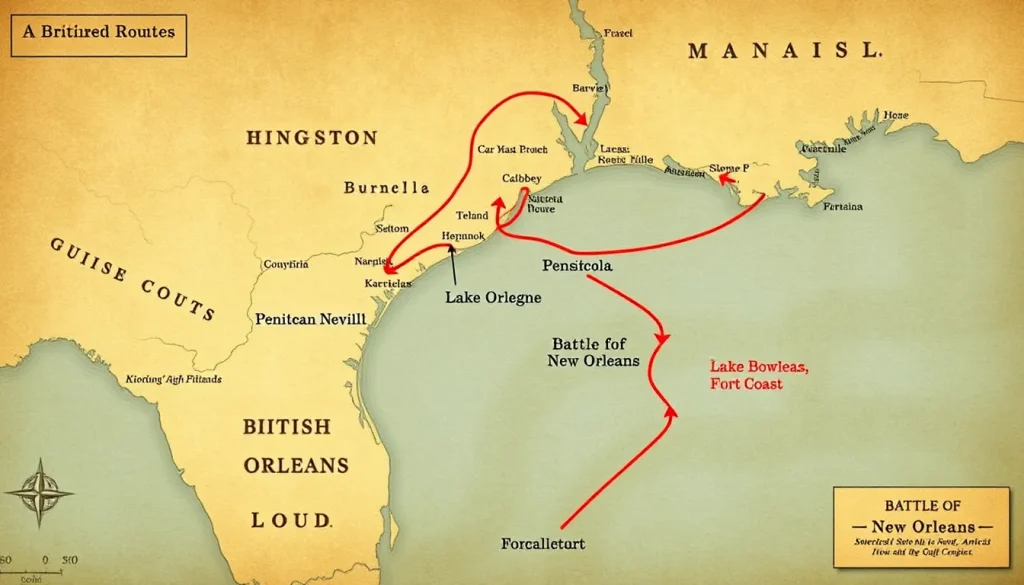
In summer 1814, the British formalized a strategy for the Gulf Coast. They occupied Pensacola in Spanish West Florida as a staging base and established contact with the Red Stick Creeks and other Indigenous forces. Colonel Edward Nicolls and George Woodbine were sent to raise troops among the enslaved and Indigenous populations, and a fort was constructed on the Apalachicola River. In September 1814, a British naval squadron attacked Fort Bowyer, which guarded Mobile Bay, but was repulsed with the loss of HMS Hermes. This setback redirected the British plan. Instead of advancing overland from Mobile, they decided on a direct naval assault on New Orleans via Lake Borgne and the bayous south of the city. On 14 December 1814, British gunboats defeated American naval forces on Lake Borgne, opening the way. Major General Sir Edward Pakenham assumed command, and the British landed troops near the city. Andrew Jackson, commanding the American defenses, had prepared a fortified line along the Rodriguez Canal. On 8 January 1815, the British launched a frontal assault, which was repulsed with heavy losses—over 2,000 British casualties against about 70 American. Pakenham was killed. The British withdrew. The war had actually ended with the Treaty of Ghent on 24 December 1814, but news had not reached the Gulf. In February 1815, a larger British force under Major General John Lambert besieged Fort Bowyer and captured it on 12 February, gaining control of Mobile Bay. The next day, word of the peace treaty arrived, and hostilities ceased.
Why It Matters
The Gulf Coast campaign had limited strategic effect on the war’s outcome because the Treaty of Ghent had already been signed, but it shaped the war’s memory. The Battle of New Orleans became the most famous American victory of the conflict, boosting national pride and elevating Andrew Jackson to hero status. Historians debate its significance: some argue it was a meaningless tactical victory with no bearing on the peace, while others contend that it influenced American bargaining power and perceptions of the war. The campaign also had profound consequences for Indigenous peoples, as British promises of support contributed to the Creek War and later conflicts, and for African Americans, many of whom escaped to British lines. The British failure to capture New Orleans and the subsequent peace meant that the Mississippi remained in American hands, solidifying U.S. territorial claims in the Southeast.
Definition
British strategy on the Gulf Coast refers to the series of military plans and operations conducted by Great Britain in 1814–1815 to establish naval and territorial control over the Gulf of Mexico littoral, particularly the lower Mississippi River Valley. The strategy aimed to seize New Orleans, disrupt American trade, and potentially create a buffer zone or separate region under British influence, using a combination of naval power, regular troops, and alliances with Indigenous and enslaved populations.
Background
The strategy emerged from Britain’s broader war aims in 1814. With the end of the Napoleonic Wars, Britain could devote more resources to the American conflict. Admiral Alexander Cochrane, commander of the North American Squadron, championed a southern campaign. He believed that seizing New Orleans would cripple American commerce and distract U.S. forces from Canada. The area’s complex geopolitical landscape—Spanish Florida, the Creek War, and the presence of numerous enslaved people—offered opportunities for unconventional warfare. British agents like Nicolls and Woodbine had been active in the Southeast since 1814, courting the Red Sticks and promising freedom to enslaved men who joined their ranks. The formal decision to launch the Gulf Coast campaign was made in London in late 1814, with troops redirected from the Chesapeake to the Gulf.
How It Worked
The British plan called for a coordinated naval and land assault. The Royal Navy would secure the Gulf Coast and transport troops, while land forces would approach New Orleans from multiple directions. Initially, the plan was to capture Fort Bowyer and Mobile, then advance overland to New Orleans. However, the failure at Fort Bowyer in September 1814 forced a revision. Cochrane opted for a direct amphibious landing on the south shore of Lake Borgne, followed by a march through the marshes to the Mississippi River above New Orleans. The landing succeeded, but the overland approach through the bayous was slow and difficult. The final attack on 8 January 1815 was poorly coordinated—missing ladders and fascines, delayed flanking movements, and a frontal assault against a heavily fortified position led to catastrophe. The British also employed Indigenous and escaped enslaved soldiers in raiding parties, but these did not play a major role in the main assault. After the defeat, the British regrouped and captured Fort Bowyer in February, though the peace treaty made this operation a postscript.
Competing Viewpoints
Historians have debated the wisdom and execution of the British Gulf Coast strategy. Some, like Donald Hickey, argue that the campaign was a diversionary effort with limited strategic value, launched late in the war when peace was imminent. Others, such as Jon Latimer, contend that it was a sound plan that could have succeeded had it been executed properly—the failure at New Orleans was due to tactical errors and overconfidence, not the overall strategy. The decision to assault New Orleans directly rather than via Mobile is also criticized. Additionally, the British reliance on Indigenous and slave recruitment raised ethical questions and may have hardened American resistance. The impact of the campaign on the peace negotiations is another point of disagreement: while some claim that the American victory strengthened its diplomats, others note that the treaty was already signed and the fighting had no official bearing on its terms.
Role in the War of 1812
The Gulf Coast campaign was the final major British offensive of the war. It diverted American forces from the Canadian frontier and forced the United States to defend a new theater. The campaign also highlighted the intersection of the war with ongoing conflicts with Indigenous peoples, as the British exploited the Creek War and offered support to the Red Sticks. The battle of New Orleans, fought after the treaty, did not alter the formal peace but influenced American national memory. In the broader narrative of the war, the Gulf Coast was a secondary theater that became prominent only in the final months, and its results—a British defeat at New Orleans and a British victory at Fort Bowyer—underscore the war’s mixed outcomes.
Consequences and Historical Interpretation
The immediate consequence of the Gulf Coast campaign was the retention of New Orleans and the lower Mississippi by the United States. The British withdrawal and the peace treaty prevented any permanent territorial changes. For Andrew Jackson, the victory elevated him to national prominence and helped him win the presidency. In historical memory, the Battle of New Orleans is often portrayed as the war’s most decisive American triumph, even though the treaty had already been signed. This myth was perpetuated by American nationalists and has shaped public perception of the war. Scholarly interpretations, however, stress that the war ended in a stalemate, with neither side achieving its stated goals. The campaign also had lasting effects on the Southeast: the British promises to enslaved people contributed to a wave of escapes and later conflicts, and the destruction of the Creek resistance led to the forced removal of Indigenous peoples. The Gulf Coast strategy, therefore, had its most profound consequences not on the war’s outcome, but on the subsequent history of the region.
Primary Sources
- Official reports and correspondence from Vice-Admiral Alexander Cochrane and Major General Edward Pakenham provide the British command’s perspective on planning and execution. These are collected in the American Naval Records Society’s The Naval War of 1812: A Documentary History.
- Andrew Jackson’s correspondence and his order to the American forces at New Orleans document the American defensive preparations. They are available in the Library of Congress’s Jackson Papers.
- The Narrative of the Expedition to the Gulf of Mexico by John Lambert (1815) offers a British officer’s account of the Fort Bowyer operation, though it is heavily defensive of the British conduct.
- Spanish and British diplomatic documents concerning the occupation of Pensacola, many of which are in the Florida Historical Quarterly article by Nathaniel Millett, illustrate the complexities of British-Spanish relations.
Further Reading
- Stoltz III, Joseph F. The Gulf Theater, 1813–1815. Washington, DC: Center of Military History, U.S. Army, 2014.
- Hickey, Donald R. The War of 1812: A Forgotten Conflict. Urbana: University of Illinois Press, 1989.
- Owsley, Frank L. Struggle for the Gulf Borderlands: The Creek War and the Battle of New Orleans, 1812–1815. Gainesville: University Press of Florida, 1981.
- Remini, Robert V. The Battle of New Orleans: Andrew Jackson and America’s First Military Victory. New York: Viking, 1999.
- Millett, Nathaniel. “Britain’s 1814 Occupation of Pensacola and America’s Response.” Florida Historical Quarterly 84, no. 2 (2005): 1–22.
References
- Stoltz III, Joseph F. The Gulf Theater, 1813–1815. Center of Military History, U.S. Army, 2014. Link
- The War of 1812 Website. “The Gulf Coast Campaign.” Link
- Millett, Nathaniel. “Britain’s 1814 Occupation of Pensacola and America’s Response: An Episode of the War of 1812 in the Southeastern Borderlands.” Florida Historical Quarterly 84, no. 2 (2005). Link
- Naval Historical Center. The Naval War of 1812: A Documentary History, Vol. I. Washington, DC, 1985. Link
FAQ
What was the British strategy on the Gulf Coast?
The British aimed to capture New Orleans, control the Mississippi River, and disrupt American commerce. They planned to use a naval force, with support from Indigenous and enslaved allies, to seize the city and potentially alter the war's outcome.
Why did the British fail at New Orleans?
The British assault on 8 January 1815 failed due to poor coordination, the strength of the American defensive line, and delays in the attack. The tactical errors of commanders like Pakenham contributed to the high casualty rate.
Did the Battle of New Orleans affect the peace treaty?
No, the Treaty of Ghent had been signed on 24 December 1814, before the battle. The battle did not change the treaty's terms, but it boosted American morale and national pride.


Leave a Reply