
Short Answer
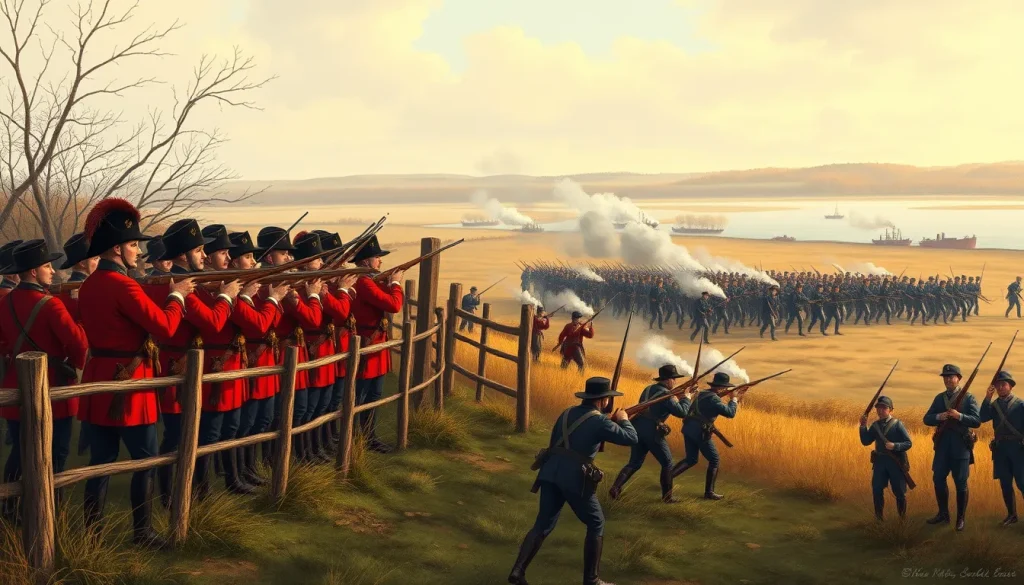
The Battle of Crysler’s Farm was fought on 11 November 1813 along the St. Lawrence River between Morrisburg and Cornwall in Upper Canada (now Ontario). It was a decisive British and Canadian victory that ended the American Saint Lawrence Campaign, which had aimed to capture Montreal. Although the American force outnumbered the British by roughly three to one, the well-drilled British regulars, supported by Canadian Voltigeurs and Indigenous warriors, repulsed the attack and forced the Americans to retreat, effectively killing the invasion plan.
Historical Context
In 1813, the United States sought to conquer the Canadian colonies. The American Secretary of War, John Armstrong Jr., devised a two-pronged invasion of Lower Canada. Major General James Wilkinson would lead an army of about 8,000 men down the St. Lawrence River from Sackets Harbor, while Major General Wade Hampton would advance from Lake Champlain toward the Chateauguay River. The two forces were to unite before attacking Montreal, the principal British stronghold.
Wilkinson’s expedition got off to a slow start and was delayed by bad weather, disease, and poor organization. Hampton’s advance was checked at the Battle of the Chateauguay on 26 October, where a Canadian force under Charles-Michel de Salaberry turned him back. Hampton retreated to American territory, but Wilkinson did not learn of this until after Crysler’s Farm. Meanwhile, the British prepared to meet Wilkinson’s army. A small “corps of observation” under Lieutenant-Colonel Joseph Morrison was sent to harass and shadow the American flotilla, eventually receiving reinforcements from Prescott.
What Happened
After passing Prescott, Wilkinson landed part of his force on the Canadian shore to deal with Canadian militia harassment. Brigadier-General John Boyd was given command of roughly 2,000 regulars to act as a rearguard. On 10 November, Boyd encamped near a tavern, while Morrison took position at the farm of John Crysler, less than two kilometres east. The battlefield was a narrow strip of farmland bordered by the St. Lawrence River on one side and a swamp and woods on the other.
The following morning, 11 November, Morrison’s light troops opened the action with skirmishing. Boyd launched several columns against the British line, which was supported by gunboats on the river under Captain William Mulcaster. The American attacks were poorly coordinated and broken up by disciplined volleys from the British 49th and 89th Regiments of Foot. British counterattacks with the bayonet drove the Americans back. As American cavalry and artillery arrived late and in confusion, Boyd ordered a general retreat. The Americans withdrew to French Mills for the winter.
Why It Matters
The defeat at Crysler’s Farm, combined with Hampton’s failure at Chateauguay, ended the American campaign to capture Montreal in 1813. The British position in the Canadas was secured, and the strategic initiative on the St. Lawrence remained with the British. The battle demonstrated the effectiveness of well-trained regulars against larger, less cohesive American forces, and it also highlighted the weaknesses in American command and cooperation. Historians have argued that the campaign failed largely because of the rivalry between Wilkinson and Hampton, poor logistics, and the lateness of the season.
In the longer view, Crysler’s Farm was one of several actions that contributed to the eventual stalemate of the War of 1812. It also became a symbol of Canadian and British identity, particularly after the war when the monument was erected in 1895.
Prelude
Following the British victory at the Battle of Chateauguay on 26 October 1813, the American advance on Montreal had already been weakened. Wilkinson’s force, however, was still moving down the St. Lawrence. After passing Prescott on 7–8 November, Wilkinson decided he must eliminate the British force following him before attempting the difficult Long Sault Rapids. Boyd’s rearguard turned to meet Morrison, leading to the clash on Crysler’s farm.
Forces and Commanders
The American force committed at Crysler’s Farm numbered approximately 2,000–2,500 regulars under Brigadier-General John Boyd, along with cavalry and artillery. Overall commander Major General James Wilkinson remained on his boat suffering from illness. The British force consisted of about 800–900 men: 630 regulars from the 49th and 89th Regiments, a small detachment of Canadian Voltigeurs, a few Indigenous warriors, and militia. Lieutenant-Colonel Joseph Morrison commanded the British; Captain William Mulcaster commanded the gunboat flotilla on the river.
Battlefield and Map Context
The battlefield was situated on John Crysler’s farm, near the present-day community of Upper Canada Village, south of Morrisburg, Ontario. The terrain was a narrow plain between the St. Lawrence River and a wooded, swampy area. Two ravines crossed the field, and split-rail fences offered cover. This favored the defending British. The river was also within range of British gunboats, which provided supporting fire.
Battle Chronology
At approximately 2 p.m., British light troops and Voltigeurs advanced and engaged American skirmishers. Boyd ordered three columns forward but they were repulsed by intense musketry. An American column attempted to turn the British left but was stopped. Morrison then launched a counterattack, forcing the Americans to retreat from the field. The fighting lasted about two hours, with the Americans suffering heavy casualties as they straggled back to their boats.
Casualties and Losses
The American force lost 102 killed, 237 wounded, and 120 captured (totaling 459). British and Canadian casualties were 31 killed, 148 wounded, and 13 missing (totaling 192). The British lost roughly 20% of their force, while the Americans—though they had committed fewer than half their army—still lost more than 20% of the troops engaged. Exact figures vary slightly among sources, but these are the commonly cited numbers.
Result
Morrison’s force won a clear tactical victory. The American rearguard retreated in disorder and joined the main army, which subsequently withdrew to French Mills on the Salmon River. The American campaign against Montreal was abandoned. Wilkinson later claimed the battle as a victory, but this was not accepted by his contemporaries or historians.
Strategic Consequences
The failure at Crysler’s Farm, combined with Hampton’s earlier retreat, saved Montreal from attack in 1813. The American forces went into winter quarters and were greatly reduced by sickness and desertion. Britain retained control of the St. Lawrence River and the link between Upper and Lower Canada. The battle also reinforced the importance of British regulars in the defence of Canada, a theme that echoed in later campaigns of the war.
Primary Accounts
Important contemporary documents include the official reports of Lieutenant-Colonel Morrison and Brigadier-General Boyd to their superiors, which give differing perspectives. American surgeon William “Tiger” Dunlop described Morrison’s victory as “a very brilliant little affair.” Other accounts appear in letters from soldiers and in American court-martial proceedings that followed the failed campaign. These sources must be read with awareness of the authors’ loyalties and the need to justify their actions.
Battlefield Today
The original battlefield was partially inundated by the construction of the St. Lawrence Seaway in the 1950s, which flooded the area. In 1960, a monument and plaque were relocated to Crysler Park, near Upper Canada Village. The park, operated by Parks of the St. Lawrence, preserves the memory of the battle and includes interpretive panels and a small museum. The 1895 monument, erected by the Canadian Parliament, stands at the site.
Primary Sources
Key primary sources for the battle include the official despatches of Lieutenant-Colonel Morrison and Brigadier-General Boyd, both written in November 1813 and published in contemporary London and Washington newspapers. These reports provide the commanders’ perspectives and casualty lists. Also valuable are the personal memoir of William “Tiger” Dunlop, who served on the British side, and the compiled court-martial documents of American officers who were afterwards investigated for the campaign’s failure. These documents are held in national archives in Canada, the United Kingdom, and the United States.
Further Reading
- Hitsman, J. Mackay. The Incredible War of 1812: A Military History (revised edition, 1999).
- Elting, John R. Amateurs to Arms! A Military History of the War of 1812 (1991).
- Benn, Carl. The War of 1812 (Osprey, 2002).
- “Battle of Crysler’s Farm.” The Canadian Encyclopedia. Accessed online.
- “Crysler’s Farm.” Parks Canada Directory of Federal Heritage Designations.
References
- Lafferty, Renée, and Tabitha de Bruin. “Battle of Crysler’s Farm.” The Canadian Encyclopedia, 22 Jan. 2026, https://thecanadianencyclopedia.ca/en/article/battle-of-cryslers-farm.
- “Crysler’s Farm.” Government of Canada, Department of National Defence, https://www.canada.ca/en/department-national-defence/services/military-history/history-heritage/battle-honours-honorary-distinctions/cryslers-farm.html.
- Rickard, J. “Crysler’s Farm, 11 November 1813.” History of War, http://www.historyofwar.org/articles/battles_cryslers_farm.html.
- “Battle of Crysler’s Farm.” Wikipedia, 2024, https://en.wikipedia.org/wiki/Battle_of_Crysler%27s_Farm.
- “Battle of Crysler’s Farm Monument.” Veterans Affairs Canada, https://www.veterans.gc.ca/en/remembrance/memorials/canada/battle-cryslers-farm-monument.
FAQ
Who won the Battle of Crysler's Farm?
The British, under Lieutenant-Colonel Joseph Morrison, won a decisive victory over a larger American force led by Brigadier-General John Boyd.
Why did the Americans attack at Crysler's Farm?
The attack was part of the American Saint Lawrence Campaign, which aimed to capture Montreal. The battle occurred when Boyd's rearguard turned to confront the British force that had been shadowing Wilkinson's army.
What was the significance of Crysler's Farm?
The British victory, combined with the earlier American defeat at Chateauguay, ended the American invasion of Montreal in 1813 and helped secure British control of the St. Lawrence River.


Leave a Reply