

Short Answer
The first year of the War of 1812 (June 1812–June 1813) witnessed a series of American military failures that undermined U.S. confidence and shaped the war’s early course. These failures occurred primarily in the land campaigns aimed at invading British Canada, with notable defeats at Detroit and Queenston Heights, and they stemmed from deep-rooted military weakness, poor leadership, and strategic miscalculation. Their significance lies in setting the tone for a conflict that the United States had entered with overconfidence but soon found was far from won.
Historical Context
When the United States declared war on Great Britain on June 18, 1812, it did so with an army and navy that had been drastically reduced under President Thomas Jefferson’s policies. Jefferson’s emphasis on a small regular army and reliance on state militias, combined with severe budget cuts to the War Department, left the United States woefully unprepared for offensive operations. The regular army numbered only about 7,000 men, scattered along the frontier, while state militias were poorly trained and often refused to serve outside their borders. Moreover, the nation’s strategic objective—the conquest of Canada—was pursued with a flawed three-pronged invasion plan that lacked coordination and adequate logistics. This context of military atrophy and strategic overconfidence set the stage for the disasters that followed.
What Happened
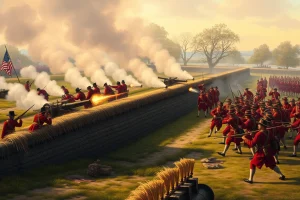
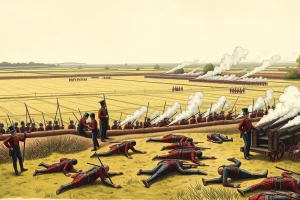
The first major failure occurred on the western frontier. Brigadier General William Hull, governor of the Michigan Territory and commander of the Army of the Northwest, crossed into Canada from Detroit in July 1812, but quickly withdrew due to supply problems and the threat of British forces. On August 16, Hull surrendered Fort Detroit and his entire army of about 2,500 soldiers to a much smaller British force under Major General Isaac Brock, who was supported by Tecumseh and his Indigenous warriors. Hull’s surrender was later blamed on his fear of massacre and his own indecisiveness. This loss not only handed the British control of the Michigan Territory but also opened the door for raids on American settlements.
The second invasion attempt, launched on the Niagara front, also ended in defeat. On October 13, American troops crossed the Niagara River and attacked Queenston Heights, but they were repulsed with heavy losses. A key reason for the defeat was the refusal of American militia units to leave U.S. soil to support the regulars who had already crossed, leaving them isolated and outnumbered. Although British commander Isaac Brock was killed in the battle, the American force was driven back and surrendered. The failure at Queenston was emblematic of the militia’s unreliability and the lack of effective command.
Further setbacks continued into late 1812 and early 1813. An attempted attack at Frenchman’s Creek in November 1812 failed due to confusion and poor coordination. On the Lake Champlain frontier, American forces were stalled by a lack of supplies and manpower. By the spring of 1813, the United States had lost control of key points along the Great Lakes and the Niagara frontier, while British and Canadian forces remained firmly on the defensive. The only bright spot for the Americans in this period was the naval victories of the USS Constitution, which captured British frigates, but these did not decisively affect the land campaigns.
Why It Matters
The failures of the first year had immediate military and political consequences. They shattered the myth of American invincibility and gave Great Britain confidence that its Canadian provinces could be defended. Domestically, the defeats fueled Federalist opposition to the war and led to cries of incompetence and treason. The surrender of Detroit was particularly shocking, and Hull was court-martialed and sentenced to death (though later pardoned). These failures also forced a reassessment of American military leadership and strategy. Historians often point to these early disasters as a direct result of Jefferson’s neglect of the military and Madison’s inability to reverse it quickly. The defeats revealed fundamental flaws in the nation’s defense establishment, including reliance on untrained militia, inadequate logistics, and a lack of professional officers. Without these lessons, the later successes of the war, such as the battles at Chippawa and Lake Erie, might not have been achieved.
Definition
By “American military failures during the first year of the War of 1812,” historians refer to a series of defeats and strategic setbacks suffered by U.S. forces from the declaration of war in June 1812 until mid-1813. These failures encompass battlefield losses, surrenders, and abortive campaigns, particularly on the land theaters, and are contrasted with the early naval victories. The term also implies a systemic failure of preparation, leadership, and planning, rather than simply isolated battlefield blunders.
Background
The background to these failures lies in the military policies of President Thomas Jefferson. Jefferson and his Republican allies prioritized a small standing army and placed their faith in state militias. Under his administration, the regular army was reduced, the navy was scaled back (until the Barbary Wars), and the military establishment was often used for exploration and public works rather than preparation for warfare. When the war came under James Madison, the country was not ready. The War Department lacked basic administrative competence, and the officer corps was riddled with political appointees. The invasion plans were made hastily and ignored the geographic and logistical realities of attacking Canada. This background of atrophy and overconfidence is essential to understanding why the first year proved so disastrous.
How It Worked
The military failures of the first year worked through a sequence of interconnected problems. First, the United States lacked a sufficient number of regular soldiers and trained officers. The regular army was too small to execute offensive operations without militia, and militia units were unreliable; they often refused to fight outside their home states, as seen at Queenston Heights. Second, supply lines were overextended and poorly organized. Hull’s invasion stalled because he lacked provisions and feared being cut off. Third, command decisions were often indecisive or insubordinate. Hull surrendered despite having a larger force; other generals failed to cooperate with each other. Fourth, there was no coherent strategic vision from Washington. The three-pronged invasion plan (Detroit, Niagara, Lake Champlain) assumed that Canadian citizens would welcome the Americans, but they did not, and the plan failed because the prongs were too far apart to support one another. These operational failures combined to produce a string of defeats.
Competing Viewpoints
Historians disagree on the relative importance of these failures. Some, like David Martin in his 2016 thesis, emphasize the long-term atrophy of the army under Jefferson as the primary cause. They argue that the United States had neglected its military for so long that it was impossible to reverse the damage in just a few months. Others focus on the performance of individual generals, such as Hull and the controversial actions of militia commanders. Some British and Canadian historians, however, have downplayed American failures, pointing instead to the effectiveness of British and Canadian defense, including Indigenous support, as the key to explaining the early British victories. There is also debate about whether the failures were inevitable or could have been avoided with better leadership. For instance, some argue that if Hull had pressed his attack, he might have succeeded, while others contend that his supply and communication problems made failure unavoidable.
Role in the War of 1812
The American failures of the first year played a crucial role in determining the course of the War of 1812. They emboldened Britain, which was already preoccupied with the Napoleonic Wars, to allocate fewer resources to North America, assuming its existing forces could hold Canada. They also shaped American strategy—by early 1813, the United States shifted its focus to the Great Lakes and naval control, which proved more successful. The failures also had a profound impact on American national pride and political debates, intensifying Federalist anti-war sentiment and regional divisions. In a broader sense, these failures taught the United States the need for a professional, well-funded military, contributing to later defense reforms.
Consequences and Historical Interpretation
The consequences of the first-year failures were immediate and lasting. Immediately, they cost the United States control of the Michigan Territory and allowed British and Indigenous forces to launch raids into Ohio and New York. They also led to the court-martial of General Hull, making him a scapegoat. In the longer term, the failures exposed the weaknesses of the Jeffersonian military system and led to a gradual expansion of the regular army and improvements in staff organization. Historians have interpreted these failures as a catalyst for American military modernization, noting that by the war’s later campaigns (1814–1815), American forces performed much better. Some scholars view the first year as a low point from which the United States recovered, while others argue that the failures were so serious they almost cost the nation its independence. The memory of these defeats contributed to a war narrative that emphasized redemption through later victories, such as those at Lake Erie and New Orleans.
Primary Sources
Key primary sources for understanding the American failures include official reports and correspondence of the commanders involved. General William Hull’s letters to Secretary of War William Eustis, particularly his report after the surrender of Detroit, offer insight into his decisions and justifications. The court-martial records of Hull provide a detailed account of his actions. Additionally, the papers of Secretary of War John Armstrong and President James Madison reveal the strategic planning and the political pressures. Among other important sources are the diary and letters of Captain John Richardson, a British officer who described the Battle of Queenston Heights from the other side. These documents must be used carefully, as participants often wrote to defend their own reputations; Hull’s reports, for example, have been criticized as self-serving. They are best read alongside later military after-action reports and the correspondence of British and Canadian officials.
Further Reading
- David Alan Martin, Mr. Jefferson’s Army in Mr. Madison’s War: Atrophy, Policy, and Legacy in the War of 1812 (Master’s thesis, University of Southern Mississippi, 2016).
- Donald R. Hickey, The War of 1812: A Forgotten Conflict (University of Illinois Press).
- J. C. A. Stagg, Mr. Madison’s War: Politics, Diplomacy, and Warfare in the Early American Republic, 1783–1830.
- Pierre Berton, The Invasion of Canada 1812–1813.
References
- Martin, David A. “Mr. Jefferson’s Army in Mr. Madison’s War: Atrophy, Policy, and Legacy in the War of 1812.” Master’s thesis, University of Southern Mississippi, 2016. https://aquila.usm.edu/masters_theses/204
- Primary sources include William Hull’s official report to Secretary of War Eustis, dated August 26, 1812, and the court-martial proceedings of Hull (January–April 1814).
- Hickey, Donald R. The War of 1812: A Forgotten Conflict. University of Illinois Press, 1989.
- Stagg, J. C. A. Mr. Madison’s War: Politics, Diplomacy, and Warfare in the Early American Republic, 1783–1830. Princeton University Press, 1983.
- Berton, Pierre. The Invasion of Canada 1812–1813. McClelland & Stewart, 1980.
FAQ
Why did the American military fail so badly in the first year of the War of 1812?
The United States had neglected its military under President Thomas Jefferson, leaving a small regular army and unreliable militias. Poor leadership, inadequate logistics, and overambitious invasion plans compounded the problem, leading to defeats like the surrender of Detroit and the failure at Queenston Heights.
What was the impact of General William Hull's surrender of Detroit?
Hull's surrender on August 16, 1812, was a major blow. It gave the British control of the Michigan Territory and opened the way for attacks on American settlements. It also severely damaged American morale and confidence in the war effort.
Did the Americans have any military successes in the first year?
Yes, especially at sea, where the USS Constitution captured HMS Guerriere and HMS Java. However, these naval victories did not offset the land failures and did not significantly change the strategic situation.


Leave a Reply