

Short Answer
The Era of Good Feelings, spanning roughly 1815 to 1825, describes a period of heightened American nationalism, political unity under the Democratic-Republican Party, and economic prosperity that followed the War of 1812. The term originated in a July 1817 Boston newspaper and captured the sense of victory and domestic harmony that pervaded the United States after the Treaty of Ghent and the Battle of New Orleans. While the era is often associated with President James Monroe’s two terms (1817–1825), its roots lie in the war’s outcomes, which dissolved the Federalist Party and fueled a new spirit of national purpose. Yet the era also contained the seeds of future conflict over slavery and economic policy, making it a pivotal bridge from the early republic to the Jacksonian Age.
Historical Context
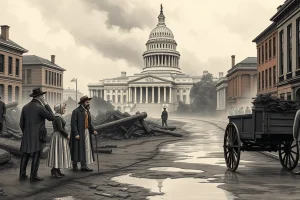
The War of 1812, fought between the United States and Great Britain from June 1812 to February 1815, ended with the Treaty of Ghent, signed December 24, 1814, which restored prewar boundaries and left many maritime disputes unresolved. The American perception of victory, reinforced by Andrew Jackson’s triumph at the Battle of New Orleans on January 8, 1815, overshadowed the war’s military stalemate and the burning of Washington, D.C. The conflict had deeply divided the nation: New England Federalists, who opposed the war, convened the Hartford Convention in late 1814 to protest its impact on trade and to propose constitutional amendments, but their efforts were discredited by the peace and Jackson’s victory. The war’s end thus left the Federalist Party politically isolated, paving the way for Democratic-Republican dominance. At the same time, the war exposed weaknesses in America’s infrastructure and financial system, prompting postwar efforts to strengthen the national economy.
What Happened
After the war, the United States experienced a wave of nationalism and economic growth. James Monroe, elected president in 1816, sought to heal regional divisions and promote national unity. During a goodwill tour to Boston in July 1817, the city’s Columbian Centinel newspaper coined the phrase “Era of Good Feelings” to describe the prevailing atmosphere of political harmony. Congress chartered the Second Bank of the United States in 1816, enacted the protective Tariff of 1816, and funded internal improvements like the National Road, which reached Wheeling, Virginia (now West Virginia) by 1818. Diplomatically, the Rush-Bagot Treaty (1817) limited naval forces on the Great Lakes, and the Convention of 1818 clarified the U.S.–Canadian boundary. The Adams-Onís Treaty (1819) acquired Florida from Spain, and the Monroe Doctrine (1823) declared the Western Hemisphere closed to European colonization. However, the era’s harmony was interrupted by the Panic of 1819, a severe economic depression, and by the Missouri Crisis of 1819–1820, which led to the Missouri Compromise temporarily balancing slave and free states and prohibiting slavery north of the 36°30′ parallel in the Louisiana Purchase territory. The one-party system fractured with the election of 1824, when multiple Democratic-Republican candidates competed, leading to John Quincy Adams’s victory and the rise of a new two-party system.
Why It Matters
The Era of Good Feelings shaped American politics and national identity for decades. It marked the decline of the First Party System and the beginning of a more democratic, participatory politics that culminated in the Jacksonian era. The war’s perceived success fueled a generation of nationalism, manifesting in commemorations, architecture, and literature that often drew more from the Revolution than from the 1812 conflict itself. The era’s economic policies—the Second Bank, tariffs, and internal improvements—established precedents for federal involvement in the economy, while the Missouri Compromise revealed the deep sectional fault lines that would eventually lead to civil war. Historians emphasize that the “good feelings” were superficial: beneath the surface, disputes over slavery, tariffs, and states’ rights simmered. The era’s legacy is thus twofold: it consolidated American independence and prosperity, but it also exposed the unresolved contradictions that later defined the antebellum period.
Definition
The Era of Good Feelings is a historiographic term for the period in American history from approximately 1815 to 1825, marked by the absence of a strong opposition party, a surge of national pride, and a focus on internal improvement. The name comes from a Boston newspaper editorial and does not imply unanimous contentment; rather, it highlights the political dominance of the Democratic-Republicans after the demise of the Federalists. The era is closely tied to the War of 1812 because that conflict’s ending created the conditions for unity: the discrediting of Federalists, the elevation of nationalist sentiment, and the desire to build a stronger nation.
Background
The War of 1812 itself was the immediate catalyst. The United States declared war in 1812 over impressment, trade restrictions, and British support for Indigenous resistance on the frontier. Despite a difficult start, including failed invasions of Canada and the burning of Washington (1814), American successes—especially the naval victories on the Great Lakes, the defense of Baltimore, and the triumph at New Orleans—fostered a narrative of success. The Treaty of Ghent, which essentially restored the prewar status quo, was nonetheless treated as a diplomatic victory. The war discredited the Federalist Party, which had opposed it, while Republican leadership, particularly James Madison and then James Monroe, channeled postwar energy into national programs. Economic growth after 1815, driven by European demand for American agricultural products, further boosted confidence and a sense of shared purpose.
How It Worked
In practice, the Era of Good Feelings operated as a period of one-party rule, with the Democratic-Republican Party absorbing many former Federalist policies, including a national bank, protective tariffs, and internal improvements. Under Monroe, a Virginia Republican, the federal government took on a more active role in economic development. The national bank regulated credit, tariffs protected domestic manufacturing, and federal funds built roads and canals. Monroe also avoided partisan appointments, and his goodwill tours symbolized an attempt to unite the sectionally divided country. However, this unity was fragile. The Panic of 1819 and the Missouri Compromise revealed that regional and economic interests diverged sharply. By the early 1820s, the one-party system had spawned factionalism, as rival leaders such as John Quincy Adams, Andrew Jackson, Henry Clay, and William Crawford competed for the presidency, setting the stage for the Second Party System.
Competing Viewpoints
Historians debate the degree to which the “good feelings” were real or illusory. Traditional accounts, such as George Dangerfield’s The Era of Good Feelings (1952), emphasize the era’s nationalism and economic progress while acknowledging underlying tensions. A revisionist view, reflected in works by Charles Sellers and Daniel Feller, argues that the era was a period of intense social and economic change that actually increased discord, as the market economy transformed American life and slavery expanded into new territories. Some historians point out that the era saw the violent suppression of Indigenous peoples and the intensification of slavery, contradicting any notion of universal harmony. The term itself was a product of contemporary journalism rather than an objective description, and later scholarly usage often applies it with irony. Nevertheless, most agree that the War of 1812’s outcome provided a crucial boost to American nationalism and political consolidation.
Role in the War of 1812
The Era of Good Feelings was both a consequence and a reinterpretation of the War of 1812. The war itself did not create the era directly, but its conclusion shaped the political landscape: the Federalists’ antiwar stance led to their collapse, while the perceived victory, epitomized by New Orleans, generated a surge of patriotic fervor. The war also exposed military and economic weaknesses that federalists and Republicans alike sought to address through national improvements. Thus, the era was, in part, a response to the challenges revealed by the war. At the same time, the era’s memory of the war was selective, emphasizing heroic naval battles and Jackson’s victory while downplaying defeats, the burning of Washington, and the peace treaty’s limitations. This manufactured memory helped sustain the “good feelings” by projecting a unified national triumph.
Consequences and Historical Interpretation
The era’s biggest consequences were political realignment and the rise of a new party system. The end of the Federalist Party allowed the Democratic-Republicans to absorb their economic program, but it also led to factional disputes that produced the two-party system of the Jacksonian era. The Panic of 1819 spurred demands for democratic reform, while the Missouri Compromise established the precedent of sectional compromise over slavery, temporarily preserving the Union but setting the stage for later crises. The Monroe Doctrine, issued in 1823, asserted America’s influence in the Western Hemisphere and became a cornerstone of U.S. foreign policy. Historical interpretation of the era has evolved: early twentieth-century historians viewed it as a period of nation-building, while modern historians stress the conflict buried beneath the veneer of harmony. The era remains significant as the moment when the United States transitioned from a revolutionary republic to a more powerful, continentally oriented nation.
Primary Sources
Primary sources from the era include the Boston Columbian Centinel article of July 12, 1817, which first used the phrase “Era of Good Feelings.” James Monroe’s inaugural address of 1817 and his messages to Congress outline his vision of national unity. Albert Gallatin, who served as Treasury Secretary under Jefferson and Madison, wrote a letter in 1815 observing that the war “has renewed and reinstated the national feelings and character.” The Treaty of Ghent and the Monroe Doctrine are official documents illuminating the period. However, these sources are inherently biased: newspapers championed specific political or partisan viewpoints, Monroe’s speeches were designed to inspire unification, and Gallatin’s reflections came from a prominent American statesman. Readers must weigh these biases when interpreting the era.
Further Reading
- Dangerfield, George. The Era of Good Feelings. New York: Harcourt, Brace, 1952.
- Feller, Daniel. The Jacksonian Promise: America, 1815–1840. Baltimore: Johns Hopkins University Press, 1995.
- Sellers, Charles. The Market Revolution: Jacksonian America, 1815–1846. New York: Oxford University Press, 1991.
- Moore, Glover. The Missouri Controversy, 1819–1821. Lexington: University of Kentucky Press, 1953.
- National Park Service, “New Nationalism in an ‘Era of Good Feelings,’” https://nps.gov/articles/new-nationalism-in-an-era-of-good-feelings.htm.
- American Battlefield Trust, “The Era of Good Feelings & The Jacksonian Age,” https://www.battlefields.org/learn/articles/era-good-feelings-jacksonian-age.
References
- Dangerfield, George. The Era of Good Feelings. New York: Harcourt, Brace, 1952.
- American Battlefield Trust. “The Era of Good Feelings & The Jacksonian Age.” Accessed 2025. https://www.battlefields.org/learn/articles/era-good-feelings-jacksonian-age.
- Encyclopedia.com. “Era of Good Feeling.” Accessed 2025. https://www.encyclopedia.com/history/encyclopedias-almanacs-transcripts-and-maps/era-good-feeling.
- U.S. History.org. “23a. The Era of Good Feelings and the Two-Party System.” Accessed 2025. https://www.ushistory.org/free-online-textbooks/us/politics-and-the-new-nation/23a-the-era-of-good-feelings-and-the-two-party-system.
- National Park Service. “New Nationalism in an ‘Era of Good Feelings.’” Accessed 2025. https://nps.gov/articles/new-nationalism-in-an-era-of-good-feelings.htm.
FAQ
What caused the Era of Good Feelings?
The Era of Good Feelings was primarily caused by the end of the War of 1812, which boosted American nationalism, discredited the Federalist Party (which had opposed the war), and spurred economic growth and a desire for national unity.
How long did the Era of Good Feelings last?
Historians typically date the era from the end of the War of 1812 (1815) to the election of 1824, or more narrowly to James Monroe's presidency (1817–1825). It ended with the Panic of 1819, the Missouri Compromise, and the resurgence of party politics.
Was the Era of Good Feelings truly an era of unity?
No. While there was a temporary decline in party conflict and a rise in nationalism, the period experienced deep divisions over slavery (Missouri Crisis), economic policy (Panic of 1819), and regional interests. Many historians view the 'good feelings' as superficial.



Leave a Reply