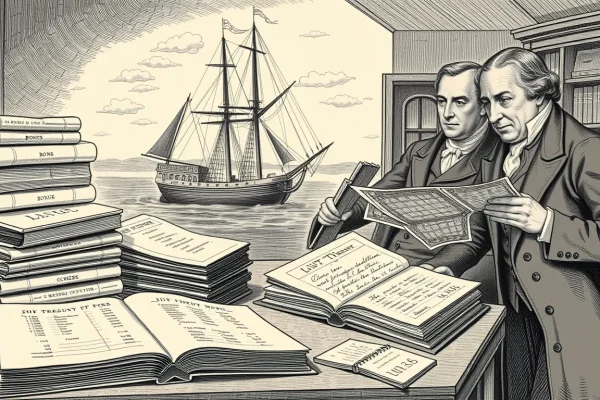
Why Did New England Oppose the War of 1812?

New England’s opposition to the War of 1812 stemmed from deep-seated Federalist political resistance, economic dependence on maritime trade, and fears that the conflict served the interests of the Democratic-Republican South and West. This sectional opposition culminated in the Hartford Convention and shaped the decline of the Federalist Party.

Read More →

Trade During the War of 1812

Trade was both a primary cause and a major casualty of the War of 1812. The British blockade devastated American exports, while American privateers harassed British commerce, shaping the war’s economic impact and influencing post-war American industrialization.

Read More →

Macon’s Bill No. 2 Explained

Macon’s Bill No. 2 (1810) was a U.S. law that reopened trade with Britain and France while threatening to re-impose an embargo on whichever belligerent failed to respect American neutral rights. It was exploited by Napoleon and contributed directly to the coming of the War of 1812.

Read More →

Financing the War of 1812

The War of 1812 forced the United States to improvise a wartime financial system despite a weakened federal treasury, an expired national bank charter, and reliance on customs duties. The resulting mix of loans, treasury notes, and direct taxes shaped the war effort and pushed the country toward a more centralized banking and taxation structure.

Read More →

Political Cartoons of the War of 1812 Explained

During the War of 1812, political cartoons by artists such as William Charles and William Elmes used satire to shape public opinion, criticize leadership, and express emerging nationalism. These prints blended British caricature traditions with American themes, becoming an influential form of wartime propaganda and a significant historical source.

Read More →

The 1812 Presidential Election and the War

The 1812 United States presidential election, held during the early months of the War of 1812, saw incumbent James Madison defeat DeWitt Clinton in a contest widely viewed as a referendum on the conflict. Madison’s victory ensured the continuation of the war and the survival of the Democratic-Republican administration.

Read More →

American Politics During the War of 1812

American politics during the War of 1812 pitted the dominant Democratic-Republicans, who favored the conflict, against a Federalist minority that opposed it as a ‘war of party.’ This internal struggle shaped military recruitment, funding, and culminated in the Hartford Convention, leaving a lasting impact on the nation’s party system.

Read More →