
Short Answer
The War Hawks were a vocal faction of young, mostly southern and western Republicans in the Twelfth United States Congress (1811–1813) who aggressively advocated for war with Great Britain. Led by Henry Clay of Kentucky, and including John C. Calhoun of South Carolina, Felix Grundy of Tennessee, and others, they argued that military confrontation was the only way to end British violations of American neutral rights, impressment of American sailors, and British support for Indigenous resistance on the frontier. Their influence was decisive in securing the U.S. declaration of war against Britain on June 18, 1812.
Historical Context
By the late 1800s and early 1810s, the United States found itself caught in the middle of the Napoleonic Wars between Britain and France. Britain’s Orders in Council restricted American trade with France and its allies, and the Royal Navy impressed thousands of American sailors into service, claiming they were British deserters. At the same time, American expansion into the Northwest Territory was met by Indigenous resistance, which many Americans believed was secretly encouraged by British agents in Canada.
President Thomas Jefferson’s policy of economic coercion, most notably the Embargo Act of 1807, had failed to sway Britain or France. By the time James Madison took office in 1809, tensions remained high, and a younger generation of politicians, many born after the American Revolution, grew impatient with diplomacy. They saw British actions as an insult to American sovereignty and honor.
What Happened
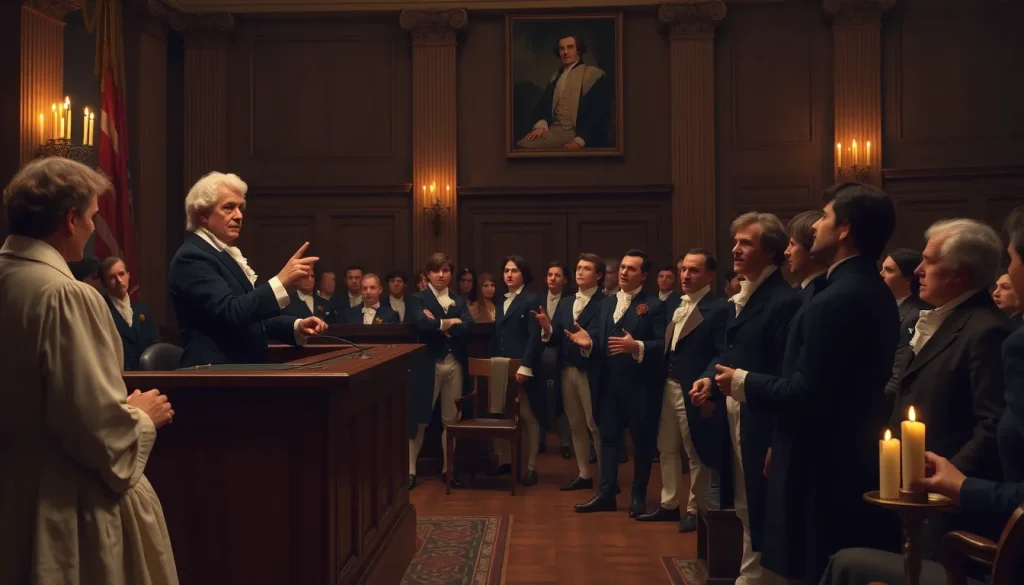
The Twelfth Congress convened in November 1811, and its new, more aggressive members quickly asserted themselves. Henry Clay, who had previously served in the Senate, was elected Speaker of the House on the first ballot, defeating the more moderate William Bibb by a vote of 75 to 38. Clay and his allies—collectively nicknamed “War Hawks” by the eccentric Virginia congressman John Randolph of Roanoke—moved to shape key committees. They placed Peter B. Porter of western New York at the head of the Committee on Foreign Affairs, with Calhoun as a member, and also secured control of the Naval, Military Affairs, and Ways and Means Committees.
The War Hawks argued that Canada was vulnerable and that an invasion would compel Britain to make concessions on trade and impressment. They also sought to end Indigenous resistance by removing British influence. In June 1812, after months of debate and a secret session, the House voted 79 to 49 for war, followed by the Senate’s 19 to 13 vote. All votes in favor came from Republicans; no Federalist supported the declaration.
Why It Matters
The War Hawks’ importance lies both in their role in bringing about the War of 1812 and in what their rise represented. They embodied a new, more assertive American nationalism that prioritized honor and territorial expansion. Their success in steering Congress to war, despite a deeply divided political landscape, demonstrated the power of a determined minority to shape national policy. Historians have debated whether the War Hawks were primarily motivated by maritime grievances, western land hunger, or a desire to annex Canada. Their legacy is tied both to the war that followed and to the national identity that emerged from it.
Definition
The term “War Hawks” refers to a group of Republican members of the U.S. House of Representatives who, in 1811–1812, actively campaigned for war with Great Britain. The name was coined by John Randolph, who derisively called them “war hawks” because of their aggressive stance. They were characterized by their youth, their origin in the southern and western states, and their willingness to use military force to resolve long-standing disputes.
Background
Most War Hawks were born in the 1770s and 1780s, too young to have fought in the Revolution but deeply attached to its principles of independence. They were frustrated by what they saw as the weak response of Federalist and older Republican leaders to British insults. The failed embargo and non-intercourse policies, combined with reports of British-instigated Indian attacks on the frontier, fueled their conviction that only war could restore American honor.
How It Worked
The War Hawks exercised influence through organization and control of congressional machinery. Henry Clay, as Speaker, set the legislative agenda and appointed committee chairs. Through the Committee on Foreign Relations, they issued a report in November 1811 that laid out grievances against Britain and recommended military preparations. They also pushed through bills to expand the army and navy, although they were often unwilling to fund these measures with new taxes. Their debates in Congress were widely reported, and they used speeches to rally public opinion.
Competing Viewpoints
Historians differ over the primary motivations of the War Hawks. Traditional interpretations, such as Julius W. Pratt’s “Expansionists of 1812,” argue that they sought to conquer Canada to gain land and to open new territories for cotton and slavery. A later view, exemplified by Bradford Perkins, emphasizes maritime rights and national honor, seeing the War Hawks’ talk of Canada as a tool to pressure Britain. Still others, like Reginald Horsman, point to a combination of factors, including a desire to crush Indigenous confederacies that they believed were British-backed.
Role in the War of 1812
The War Hawks were instrumental in the declaration of war. They did not constitute a majority of the Republican Party, but their fervor and organization allowed them to overcome the resistance of the “peace party” and the Federalists. Once war began, many War Hawks served as military officers or in civilian leadership roles. Henry Clay was a peace commissioner at the Treaty of Ghent, while John C. Calhoun later served as Secretary of War. Their influence continued to shape the war’s course, particularly in the failed invasions of Canada.
Consequences and Historical Interpretation
In the short term, the War Hawks’ goal of conquering Canada proved unrealistic, and the war ended in a draw with the Treaty of Ghent in 1814. Long-term, the war marked the end of the Federalist Party and the beginning of a new era of American nationalism. Historians have interpreted the War Hawks as both champions of a necessary defense of national sovereignty and as proponents of an aggressive, expansionist agenda. Their memory lives on as the archetypal “war party” in American political rhetoric.
Primary Sources
Important contemporary sources include the report of the House Committee on Foreign Relations, issued in November 1811, which detailed grievances against Britain and called for military preparations. The “secret minutes” of the House session of June 4, 1812, record the decisive votes on the war bill. Speeches by Henry Clay and John C. Calhoun in Congress were printed in the Annals of Congress. The election broadside The Voice of Warning (1810) shows partisan attacks on Federalists. Each source offers insight into War Hawk arguments, but also reflects the political biases of its authors.
Further Reading
- Hickey, Donald R. The War of 1812: A Forgotten Conflict. University of Illinois Press, 1989.
- Perkins, Bradford. Prologue to War: England and the United States, 1805–1812. University of California Press, 1961.
- Pratt, Julius W. Expansionists of 1812. Macmillan, 1925.
- Horsman, Reginald. “Who Were the War Hawks?” Indiana Magazine of History 60 (June 1964): 105–120.
- Mayo, Bernard. Henry Clay: Spokesman of the New West. Houghton Mifflin, 1937.
References
- National Park Service. “’War Hawks’ urge military confrontation with Britain.” Accessed October 2023. https://www.nps.gov/articles/war-hawks.htm.
- Horsman, Reginald. “Who Were the War Hawks?” Indiana Magazine of History 60 (June 1964): 105–120. Accessed via scholarworks.iu.edu.
- Lilly Library. “War Hawks.” War of 1812 in the Collections of the Lilly Library. Accessed October 2023. https://collections.libraries.indiana.edu/warof1812/exhibits/show/warof1812/before/war-hawks.
- McColley, Robert. “War Hawks.” Encyclopedia.com, 2023. https://www.encyclopedia.com/history/dictionaries-thesauruses-pictures-and-press-releases/war-hawks.
- Beirne, Francis F. The War of 1812. E. P. Dutton, 1949. Chapter 7.
FAQ
Who were the main War Hawks?
Henry Clay, John C. Calhoun, Felix Grundy, Peter B. Porter, and others from the south and west.
Why did the War Hawks want war with Britain?
They sought to end impressment, trade restrictions, and British support for Native American resistance.
How did the War Hawks influence Congress?
Through leadership roles, such as Henry Clay as Speaker, and control of key committees to push war measures.



Leave a Reply