
Short Answer
The Treaty of Ghent, signed on December 24, 1814, ended the War of 1812 between the United States and Great Britain, yet it made no mention of impressment—the practice of the Royal Navy seizing sailors from American ships. This omission is striking because impressment had been one of the most frequently cited causes of the American declaration of war in June 1812. The absence of any provision addressing impressment resulted from a combination of diplomatic realism, the end of the Napoleonic Wars, and both sides’ desire for a swift peace that restored pre-war boundaries.
Historical Context
The War of 1812 grew from long-standing Anglo-American tensions rooted in the broader conflict between Britain and Napoleonic France. Britain’s Orders in Council restricted neutral trade, while the Royal Navy’s practice of impressing sailors—including many naturalized Americans claimed as British subjects—provoked intense anger in the United States. Impressment was particularly controversial because it challenged American sovereignty and the principle of neutral rights. Between 1796 and 1812, an estimated 9,991 American sailors were impressed, according to the British naval historian Brian Arthur (as cited in historical studies). The United States also resented British support for Indigenous resistance on the western frontier, which many Americans believed was encouraged to block expansion.
By 1814, the European context changed. Napoleon’s abdication in April 1814 ended the Napoleonic Wars, reducing the need for the Royal Navy to impress sailors. The British government, exhausted by decades of war, sought to avoid a prolonged North American conflict. Likewise, the American economy suffered severely from trade disruptions, and public support for the war waned, especially in New England. Both sides were ready to negotiate, but each had initial demands: the United States sought an end to impressment and respect for neutral trading rights; Britain insisted on maintaining its maritime rights and proposed an Indigenous buffer state in the Northwest.
What Happened
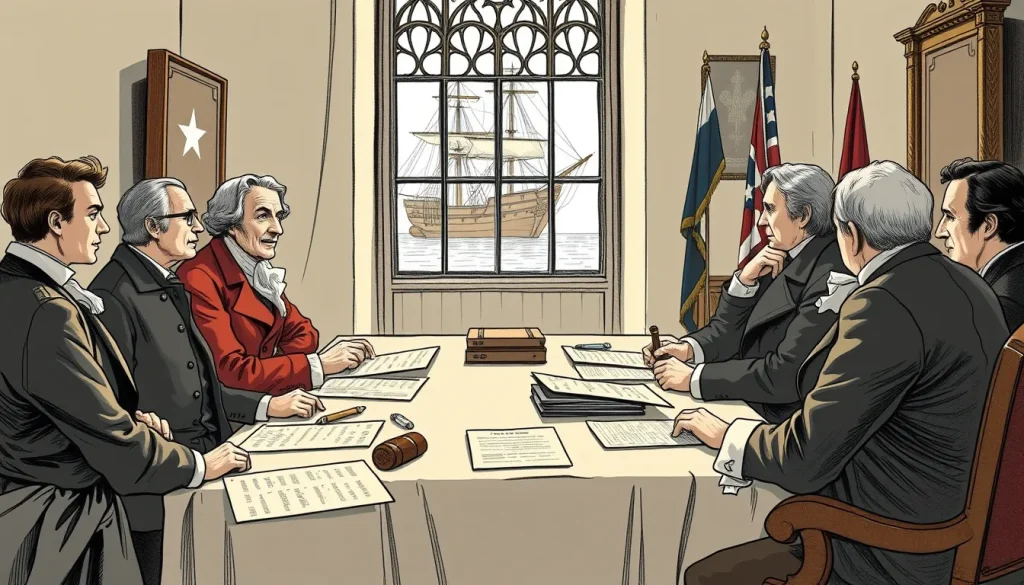
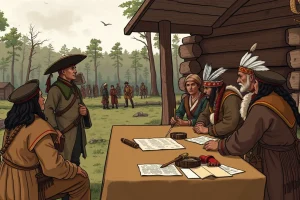
Peace negotiations opened in Ghent, in the Belgian Netherlands, in August 1814. The American delegation—comprising John Quincy Adams, Albert Gallatin, Henry Clay, Jonathan Russell, and James A. Bayard—initially sought an end to impressment, restoration of pre-war boundaries, and recognition of neutral commerce. The British negotiators, Admiral James Gambier, Dr. William Adams, and Henry Goulburn, presented demands that included the creation of an Indigenous buffer state, territorial adjustments along the border, and recognition of British maritime rights.
As negotiations progressed, the American delegates recognized that Britain was no longer impressing sailors into the Royal Navy. With the end of the war in Europe, the practice had effectively ceased, making the issue less acute. Consequently, the American delegation dropped its demand for an explicit renunciation of impressment. Meanwhile, the British gradually retreated from their more ambitious territorial and Indigenous proposals, partly because of military setbacks like the Battle of Plattsburgh and the failure to hold American territory, and partly because the Duke of Wellington advised that the military situation did not justify territorial demands. By December 1814, the negotiators had reached an agreement that largely restored the status quo ante bellum.
The final treaty, signed on Christmas Eve, contained eleven articles that dealt with boundary restoration, return of prisoners, and creation of commissions to settle boundary disputes. It said nothing about impressment, neutral rights, or the Orders in Council. The treaty’s silence on these issues reflected both the Americans’ recognition of political reality and the British success in preserving their maritime prerogatives.
Why It Matters
The omission of impressment from the Treaty of Ghent mattered immediately and in the long term. Immediately, it meant that the United States had failed to secure a formal renunciation of a practice it had gone to war to end. This failure contributed to the perception that the war achieved no American war aims. For Britain, the omission preserved its claim to the right of impressment and unrestricted maritime authority, although in practice the practice did not resume. The treaty’s focus on territorial restoration rather than maritime issues set a precedent for later Anglo-American diplomacy, which gradually resolved such disputes through negotiation and arbitration.
Historians have interpreted the omission in several ways. Some argue that the United States abandoned a key war aim out of necessity, as Britain would never concede on a matter of national sovereignty. Others maintain that the disappearance of the practice itself made the issue moot, and that securing peace was the paramount goal. The absence of any treaty provision also allowed both sides to claim victory: Britain preserved its maritime rights, and the United States avoided territorial concessions. Over time, impressment faded as a source of conflict, but the treaty’s silence has been cited by historians as evidence of the war’s inconclusive nature.
Definition
Impressment was the British practice of stopping merchant vessels at sea and removing sailors, usually by force, to serve in the Royal Navy. British naval commanders claimed the right to reclaim British subjects who had allegedly deserted or were evading service. Many of these men had emigrated to the United States and become naturalized American citizens, but Britain refused to recognize naturalization, asserting that “once an Englishman, always an Englishman.” Impressment was therefore not only a violation of individual liberty but also a challenge to American sovereignty and the rights of neutral nations.
Background
Impressment became a major issue after the outbreak of the French Revolutionary and Napoleonic Wars. The Royal Navy needed a large workforce to man its fleet, and recruiting sailors was difficult due to low pay and harsh discipline. Many British sailors deserted in American ports, where they received higher wages and better treatment. To recover these deserters, the Royal Navy stopped American merchant vessels and impressed seamen they claimed were British. The frequency of impressment increased during the 1790s and 1800s, particularly after the Chesapeake-Leopard affair in 1807 when the British ship HMS Leopard fired on the USS Chesapeake and removed four alleged deserters. This incident inflamed American public opinion and contributed to the drive toward war.
How It Worked
Impressment operated through the authority of captains of Royal Navy vessels. At sea, a boarding party would approach an American ship, search for deserters, and take crew members deemed to be British subjects. No trial was held; a captain’s word was final. The impressed men were forced to serve in the Royal Navy, often under brutal conditions. The practice was legal under British municipal law but was rejected by the United States as a violation of customary international law, which held that a neutral nation’s citizens should not be taken from its ships. The American government argued that a neutral ship should be inviolate, and that the only remedy for desertion was to reclaim sailors in American courts, not to seize them by force.
Competing Viewpoints
Americans viewed impressment as an outrageous infringement on their national sovereignty and individual rights. They argued that the British navy had no jurisdiction over American ships and that impressment effectively enslaved American citizens. The practice also fed broader grievances about British contempt for American independence and neutral rights. Britain, for its part, insisted that impressment was essential to maintain its naval supremacy and to recover deserters who owed allegiance to the king. Since Britain did not recognize the right of expatriation, any British-born sailor was considered subject to impressment even if naturalized in the United States. British officials also contended that impressment was a matter of internal policy and not subject to negotiation, as a nation had the right to press its own subjects into military service.
Role in the War of 1812
Impressment was one of the key causes of the war. President James Madison’s war message of June 1812 specifically cited the practice, and Congress listed it among the grievances in the declaration of war. American peace commissioners were originally instructed to secure an end to impressment as a condition of peace. However, during the negotiations at Ghent, the American delegation concluded that Britain would never formally renounce impressment, especially after the threat of Napoleon had ended. Moreover, the Royal Navy had already ceased impressment in practice by 1814 because the reduction of the fleet after the Napoleonic Wars eliminated the acute manpower shortage. The Americans therefore quietly abandoned the demand, focusing instead on achieving a peace that restored American territory and ended the fighting without ceding any land.
Consequences and Historical Interpretation
The omission of impressment from the Treaty of Ghent had several consequences. It allowed the United States to claim that it had not been defeated, while Britain could claim it had not surrendered its maritime rights. The treaty’s silence also meant that impressment remained a potential source of conflict, although it never recurred at the scale of the antebellum period. In subsequent decades, Anglo-American relations improved, and the practice gradually disappeared. Historians have debated whether the United States’s failure to secure a treaty provision on impressment constituted a diplomatic defeat. Some argue that by dropping the demand, the United States acknowledged its weakened position and the futility of pressing the issue. Others contend that since impressment ceased in practice, the omission was a pragmatic compromise that achieved the more important goal of peace.
Primary Sources
The primary source is the Treaty of Ghent itself, signed December 24, 1814, and ratified by the United States on February 17, 1815. The treaty text is available in the U.S. National Archives and online databases. Another key source is the diary and correspondence of John Quincy Adams, who recorded the negotiations in detail. Adams’s letters to his wife and colleagues show how the American commissioners debated the impressment issue and eventually decided to drop it. Also relevant are the instructions from Secretary of State James Monroe to the American peace commissioners, which initially insisted on ending impressment but left room for negotiation. Finally, the British government’s instructions to its negotiators, available in the British State Papers, reveal the British position on maritime rights and impressment.
Further Reading
- Hickey, Donald R. The War of 1812: A Forgotten Conflict. University of Illinois Press, 1989.
- Stagg, J.C.A. Mr. Madison’s War: Politics, Diplomacy, and Warfare in the Early American Republic, 1783–1830. Princeton University Press, 1983.
- Taylor, Alan. The Civil War of 1812: American Citizens, British Subjects, Irish Rebels, & Indian Allies. Alfred A. Knopf, 2010.
- U.S. National Archives. “Treaty of Ghent, 1814.” Founders Online, National Historical Publications and Records Commission.
References
- National Park Service. “Summer 1814: Americans and British open peace negotiations at Ghent.” http://nps.gov/articles/treaty-of-ghent-1.htm
- Tucker, Robert W., and David C. Hendrickson. “The Anglo-American Dispute: Neutral Rights and Impressment.” In Empire of Liberty: The Statehood of American Foreign Policy, Oxford University Press, 1990. doi:10.1093/oso/9780195062076.003.0019.
- American Battlefield Trust. “The Treaty of Ghent: Ending the War of 1812.” https://www.battlefields.org/learn/articles/treaty-ghent-ending-war-1812
- The War of 1812 Website. “Treaty of Ghent – War of 1812.” https://thewarof1812.org/treaty/
- Randall, Willard Sterne. “A Clumsy War, A Lasting Peace: The Treaty of Ghent.” American History, June 2017. https://historynet.com/clumsy-war-lasting-peace-treaty-ghent/
FAQ
Why did the United States stop demanding an end to impressment at Ghent?
The American negotiators realized that Britain had already stopped impressing sailors in practice after the end of the Napoleonic Wars, and that Britain would never formally renounce the right. Focusing on peace and restoration of territory became a higher priority.
Did the Treaty of Ghent contain any provision about impressment?
No. The treaty was entirely silent on impressment, as well as neutral trading rights and the Orders in Council. The issue was simply dropped during the negotiations.
Was impressment ever formally abolished?
Impressment was not formally abolished by treaty; it faded out of practice after 1815. The United States and Britain later resolved such disputes through arbitration and diplomacy, but no formal renunciation was ever made.

Leave a Reply